Three Temples, Three Faces
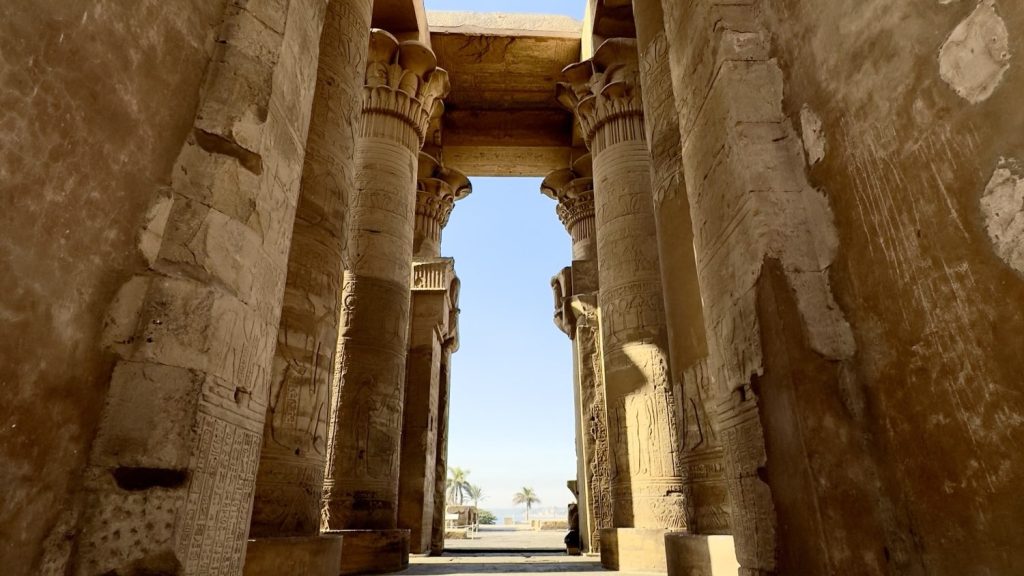
Aswan -> Luxor
A little research really does go a long way. When people think “Egypt,” they usually picture the classics—Cairo, Luxor, Alexandria, maybe Sharm el-Sheikh if you’re feeling fancy. You know, the Pyramids, the Valley of the Kings, the ruins of the ancient Library of Alexandria (and its slick modern counterpart), and all that “must-do” tourist checklist stuff. But while I was on one of my highly productive travel planning sessions, I stumbled upon a nifty little map by the Ministry of Tourism and Antiquities. A few enthusiastic clicks and a lot of “oooohs” and “ahhhhhs” later, I had tacked another 6–7 sites onto my already overachieving Excel itinerary.
It just so happened that three of those spots were directly en route from Aswan to Luxor, and—bless the algorithm—I found a convenient GYG tour that covered all of them. So off we go! First Stop: Kom Ombu temple.
Sobek Meets Horus
Set on a bend in the Nile where sacred crocodiles used to sunbathe like it was their private spa, the Temple of Kom Ombo is one of the most beautifully located temples in Egypt. But location aside, what makes this temple stand out is its identity crisis—it’s dedicated to two gods: Sobek, the local crocodile deity, and Haroeris, aka Horus the Elder (yes, there are multiple Horuses. No, I don’t know why either).


The temple’s twin dedication is reflected in its plan: perfectly symmetrical along the main axis of the temple, there are twin entrances, two linked hypostyle halls with carvings of the two gods on either side, and twin sanctuaries. It is assumed that there were also two priesthoods. The west side of the temple was dedicated to the god Haroeris, and the east half to Sobek, because apparently sharing wasn’t a thing in ancient divine real estate.
One of the most fascinating features lies on the back wall of the temple: carvings often described as ancient “surgical instruments.” While they may have been part of religious rituals rather than medical procedures, Kom Ombo did serve as a center of healing—arguably the closest equivalent to an ancient hospital. The fact that some of the instruments resemble modern medical tools is, frankly, astonishing.


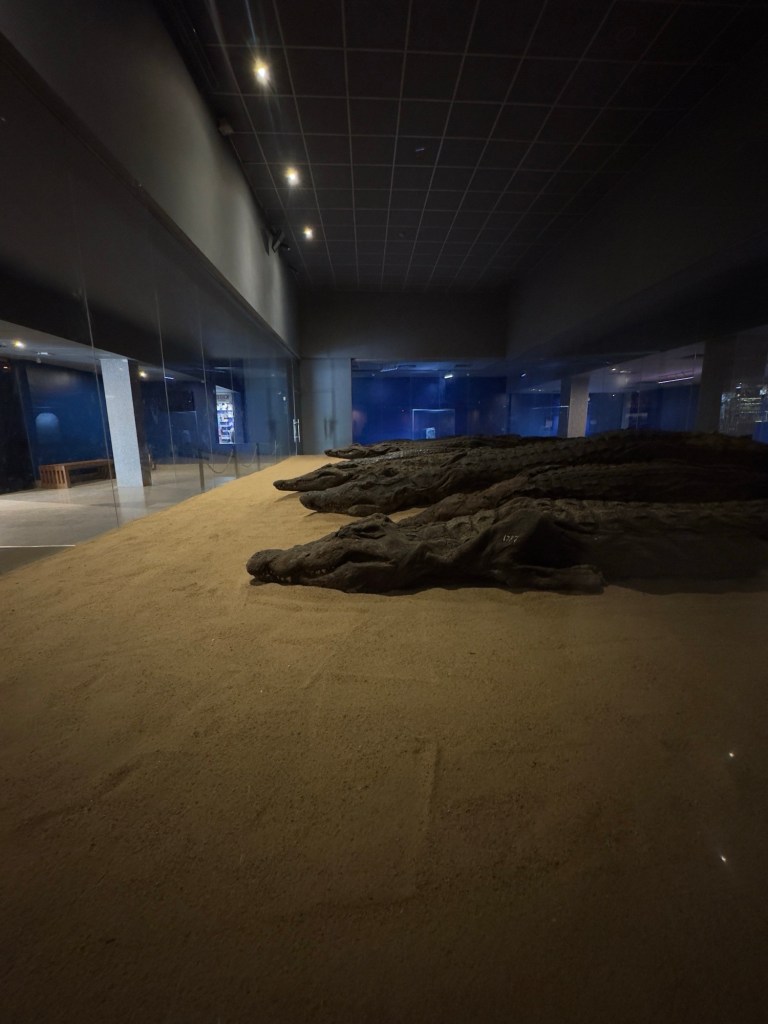
Just outside the temple, the path leads you to the Crocodile Museum, which is as oddly fascinating as it sounds. It’s home to a collection of mummified crocodiles—because what better way to honor your god than by embalming his real-world cousins for eternity? Bonus: the museum has air conditioning.
All Hail Horus and War
Roughly an hour’s drive from Kom Ombo lies Edfu, home to one of the best-preserved temples in all of Egypt. Buried beneath layers of sand for centuries, the temple was rediscovered in 1860 by French archaeologist Auguste Mariette, and it remains remarkably intact.

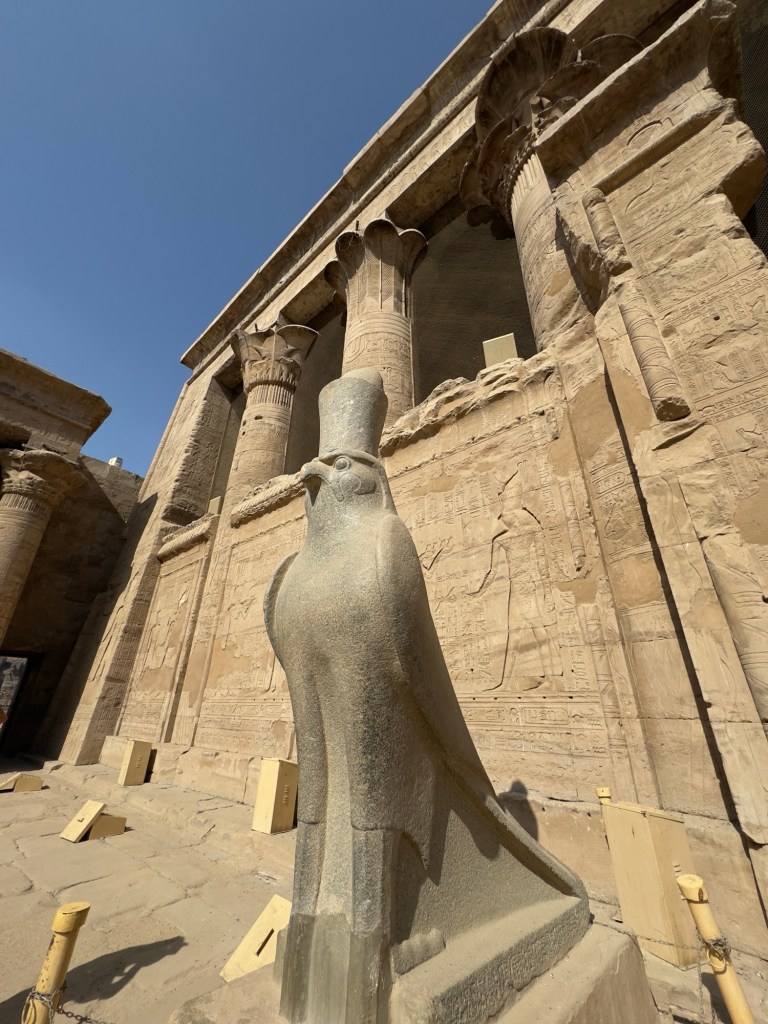
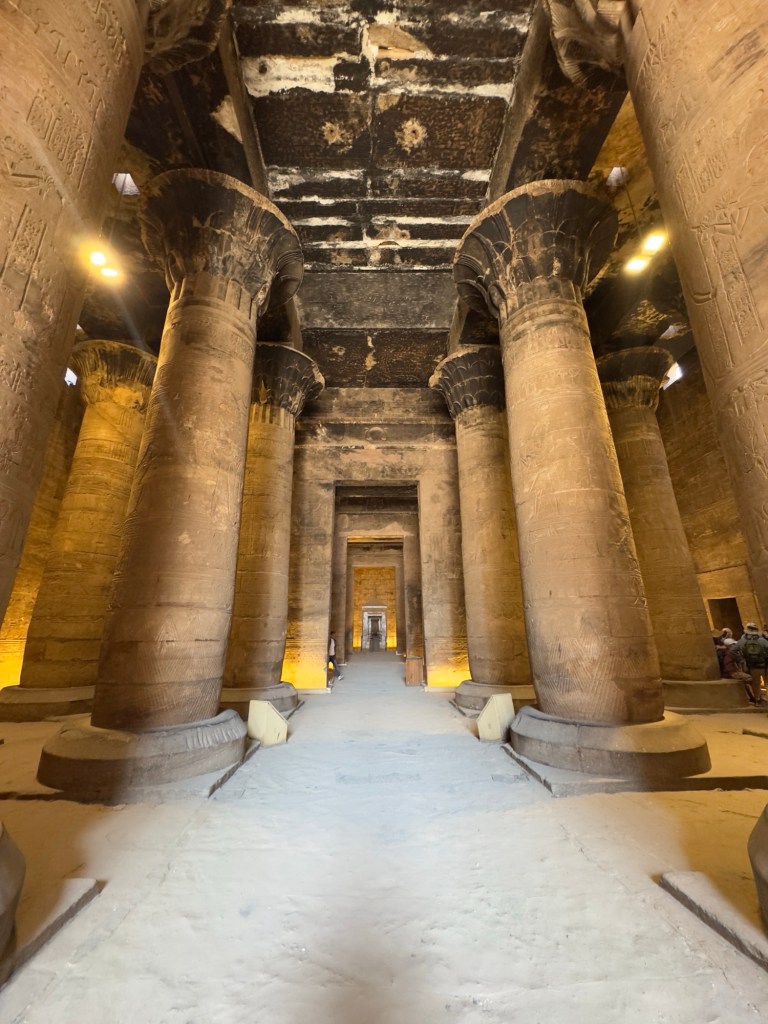
Even before entering, visitors are met with an impressive façade: a towering pylon flanked by two monumental granite statues of Horus in falcon form. The reliefs on the entrance walls are striking—Ptolemy XII is depicted grasping enemies by the hair in front of Horus, just before delivering a decisive blow. A vivid example of pharaonic propaganda, if ever there was one.
Inside, one of the standout features is the sanctuary of Horus, which houses a black granite shrine believed to have been donated by Pharaoh Nectanebo II. In front of it stands a replica of the sacred barque, the ceremonial boat used to carry the god’s statue during festivals. (The original now resides in the Louvre, naturally.)

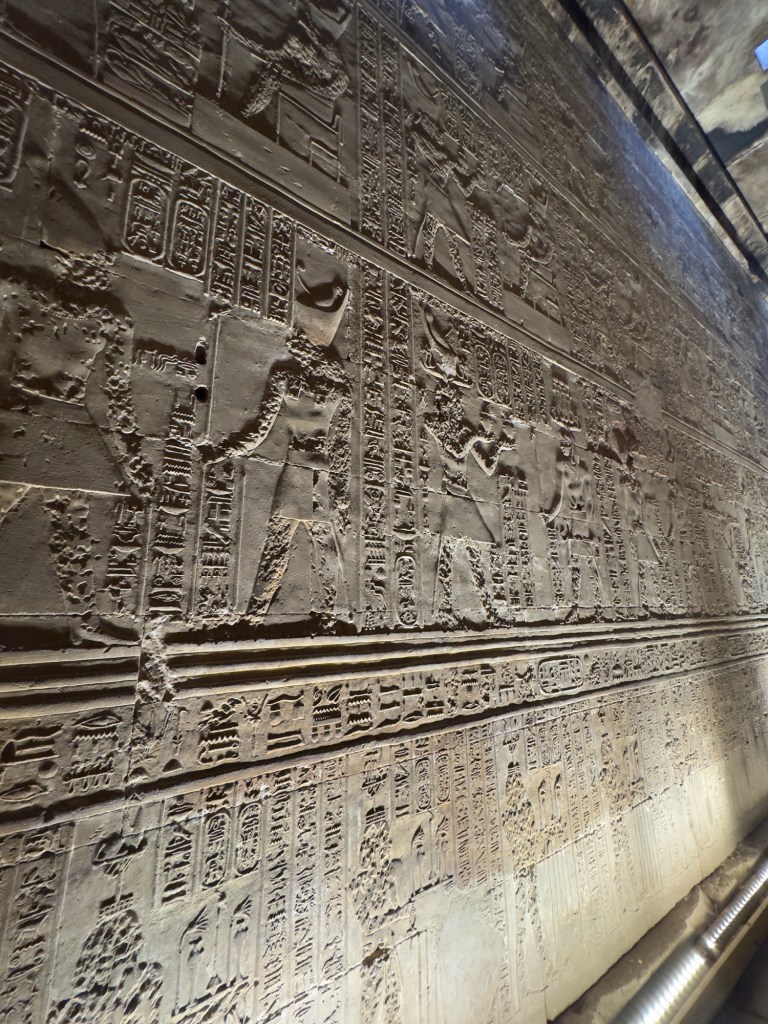
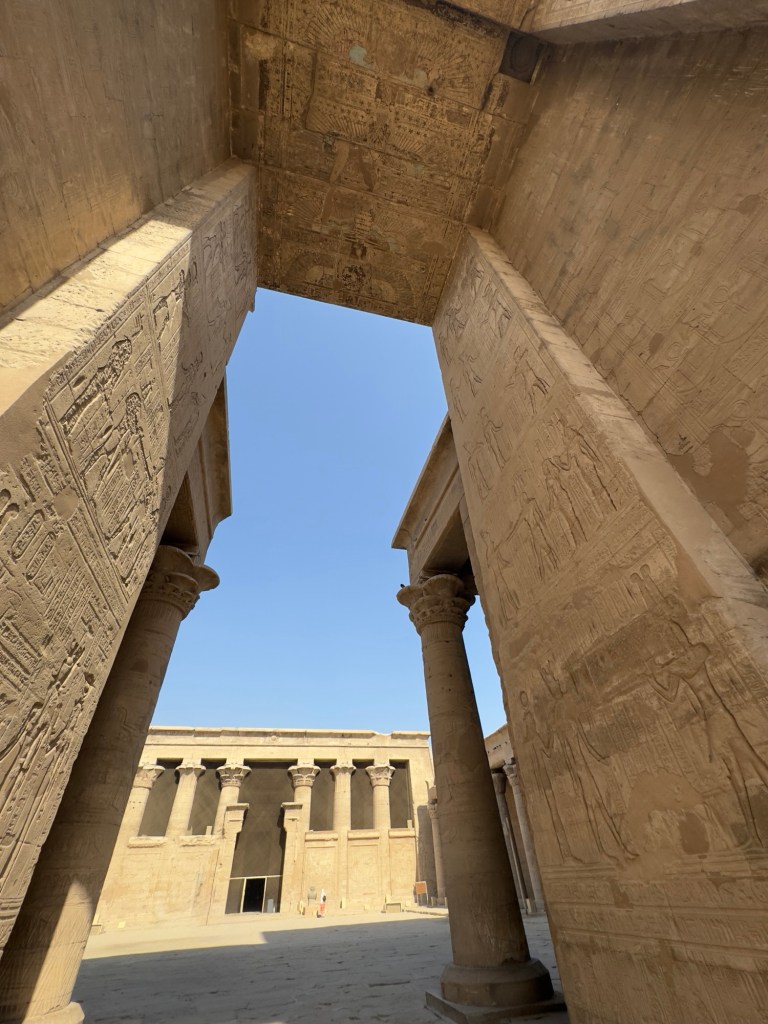
Edfu exudes a sense of power and triumph, quite different from the healing calm of Kom Ombo. The contrast feels fitting, as the temple was built on the legendary site of Horus’s victory over his rival Seth. With its sheer scale and mythological symbolism, Edfu leaves a lasting impression, on top of the sheer size of the structures, it’s hard not be in awe just standing there.
Star Maps in Stone
And then there was Esna. An hour’s drive from Edfu lands you in what can only be described as a chaotic fever dream wrapped in a historical gem. Before we even get to the temple itself, allow me a quick PSA: buy your tickets in advance. The ticket office isn’t anywhere near the main temple entrance. It’s across the street, in a small shack that looks nothing like a place to buy official passes and more like a security checkpoint, tucked just outside a bazaar that feels more like an ambush.
The “entrance” is marked by a big blue sign that says “Esna City Touristic Bazaars,” which sounds charming until you’re mobbed by enthusiastic vendors who take “interactive shopping” to a whole new level as you walk down the street towards the actual temple entrance. My guide assured me this was a low season experience. I weep for anyone who braves it in peak tourist months.
Security was minimal, and after the majesty of Kom Ombo and Edfu, the temple at first felt rather modest. What remains is a columned hall with 24 pillars—a far cry from the sprawling complexes I had just visited. But Esna quickly proves it deserves its place on the itinerary, this place has its own quiet magic.
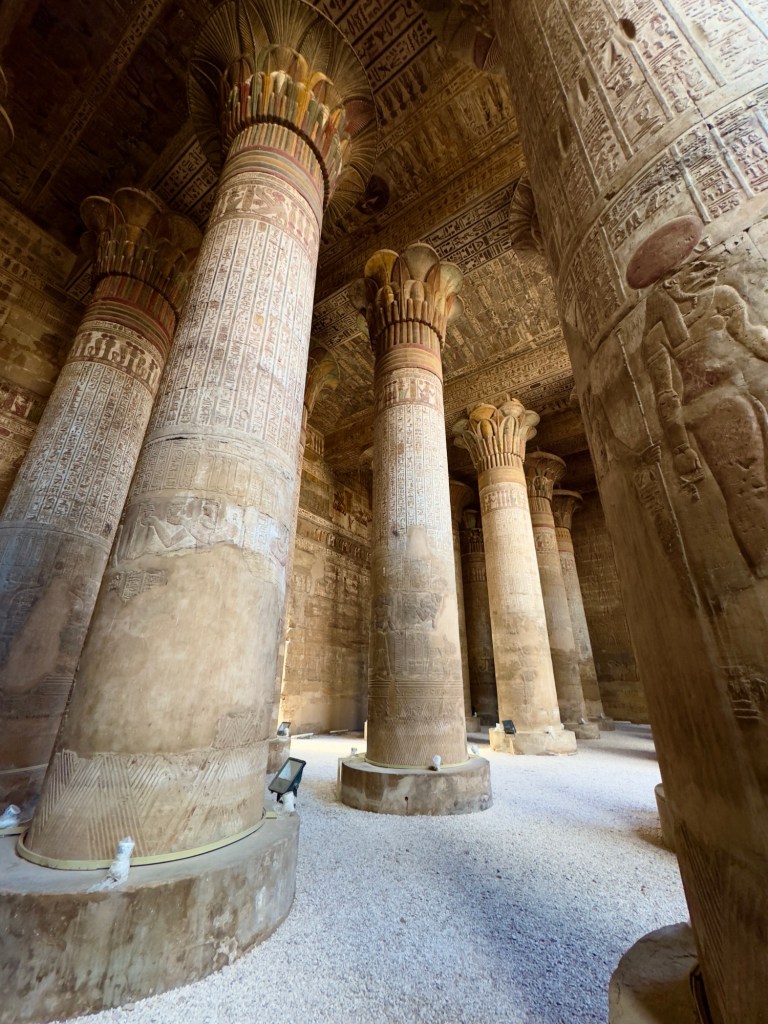
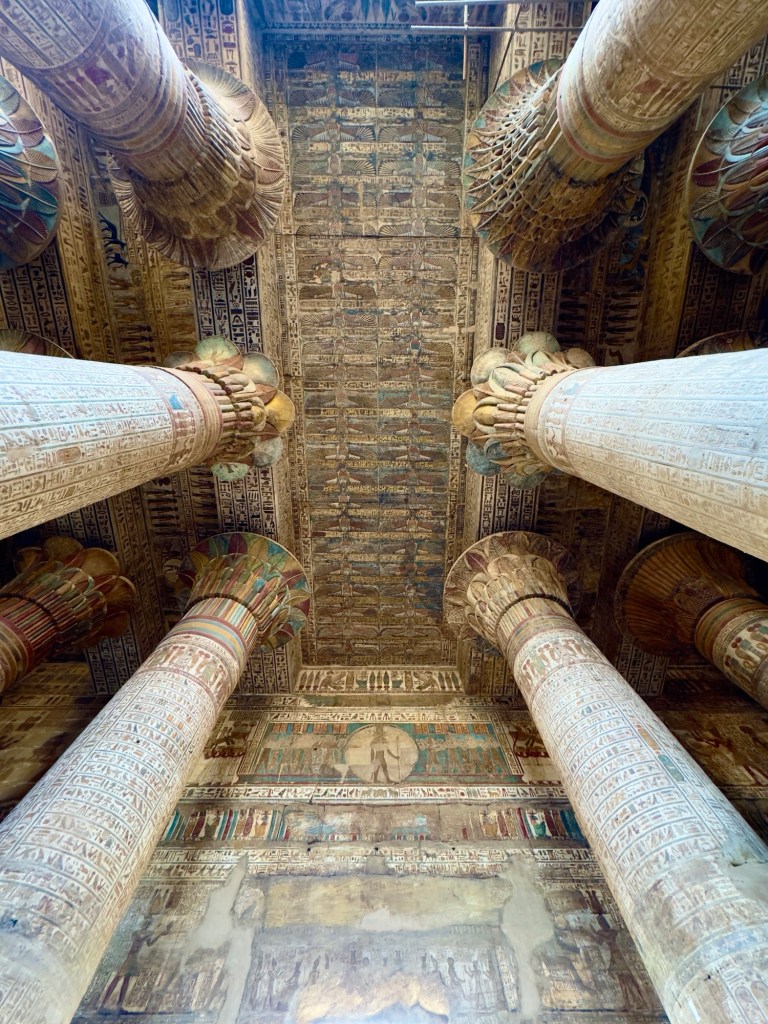
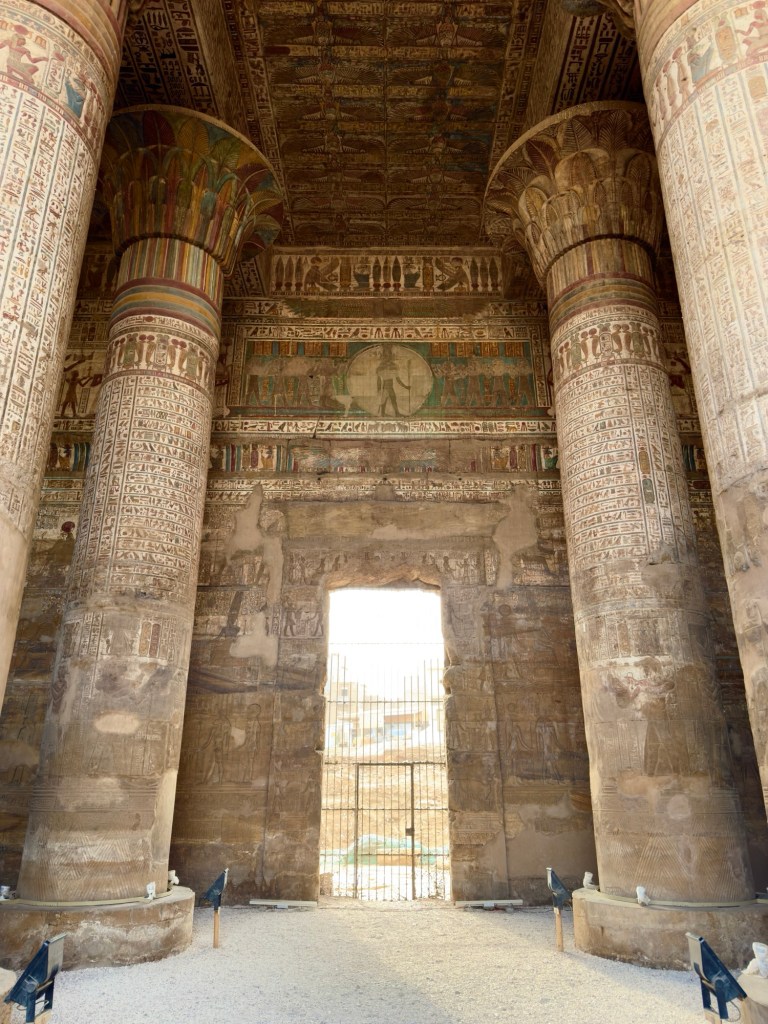
What makes Esna stand out is its stunning astronomical ceiling, packed with vibrant zodiac signs, constellations, and celestial beings. The hieroglyphs are some of the last ever written in Egypt, dating back to the Roman period, long after most temples had stopped functioning. It’s like walking into the final chapter of Egypt’s religious narrative.
Recent restoration work has uncovered vibrant original colors beneath centuries of soot and dust, offering a rare glimpse of how these temples may have looked in their prime. While most temples bear the faded scars of time, Esna’s colors are vivid, preserved by layers of grime that accidentally served as protection. It’s a small space, but it carries immense historical and artistic weight.
The temple is small, and a visit won’t take more than an hour, especially since much of the surrounding complex is still buried under the modern city. The Egyptian government is working to relocate local residents so further excavation can happen. And if this is what they’ve uncovered so far? I can’t wait to see what’s still hiding underground.
Onward to the Old Capital
Three temples, three distinct atmospheres, and three remarkable windows into the complexity of ancient Egyptian religion and culture. As the tour came to an end and we continued on to Luxor, I found myself even more excited for what lay ahead. If these were just the stops on the way, I could only imagine what the heart of ancient Thebes had in store.
 Shenanigans Abroad
Leave a Reply