Pilgrimage of Stars and Death

Prophecies In The Stars
Ahhhh, the Temple of Hathor — if there’s any temple that feels like it stepped straight out of a Tomb Raider fantasy (and then some), this is it. Crawling into crypts through holes in the walls, climbing the ritualistic steps of ancient priests, encountering strange, futuristic hieroglyphs, and being watched by many, many feline guardians… if there’s one reason I’d brave the EgyptAir fiasco again, this would be high on the list.
Located in Dendera, about 60 km from Luxor, the Temple of Hathor is the main temple of the Dendera Temple Complex. Hathor, goddess of love, beauty, music, fertility, and motherhood, had this as her principal cult center.
Construction began in the late Ptolemaic period under Ptolemy XII (Cleopatra’s father) and continued under Roman emperors like Augustus and Tiberius.
Tickets are available online for 300 EGP, but I’d again recommend buying them in person — you can’t purchase the Dendera panorama and crypts tickets online. They’re 100 EGP each and very much worth it.
Upon arrival, you’ll walk through what was once a garden in the open forecourt (or pronaos) just in front of the temple. It served as a transitional space between the outer world and the sacred interior. Archaeological evidence suggests that sacred trees — possibly sycamores or date palms — were once present here, both being sacred to Hathor.
It was also one of the first times I saw actual greenery still growing at a site like this. It genuinely brings life back into the space.
The Ceiling That Holds the Stars
As you enter the massive hypostyle hall, each 24 ornate columns is topped with a capital featuring the face of Hathor, you’d naturally look up onto the famous decorated ceiling with the astronomical scenes carved upon its surfaces, including a zodiac—a rare example of Greco-Roman and Egyptian fusion in art and cosmology.
I went accompanied this time, with as you guessed it, my guide booked with GYG, and he gave me some wonderful insight about the zodiacs in the hall.
The ceiling is divided into seven long registers, each filled with intricately painted scenes that map the heavens, depict the solar cycle, and convey complex mythological cosmology. It’s one of the few ancient Egyptian ceilings to retain so much original color — vibrant, surreal, almost dreamlike.
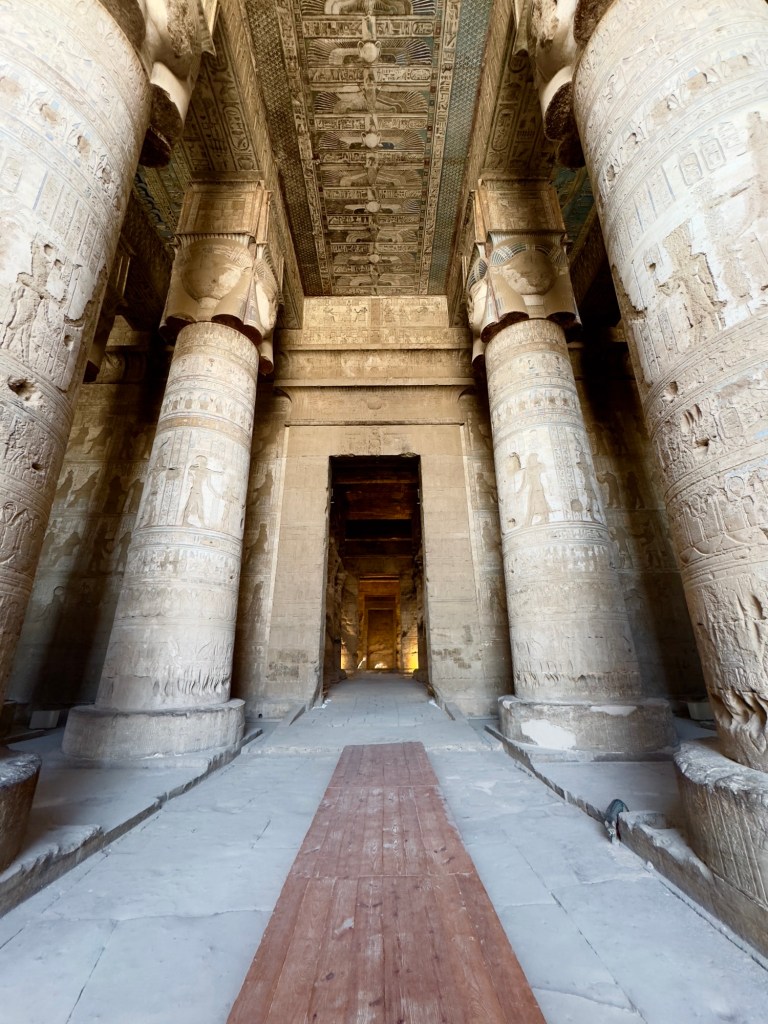
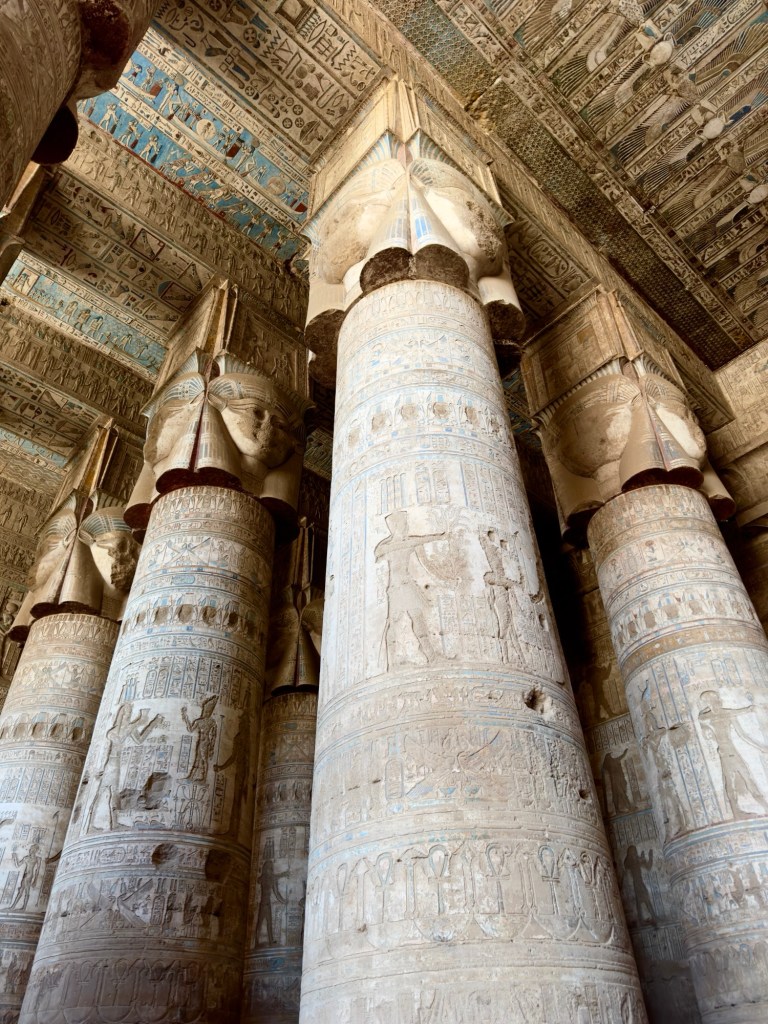
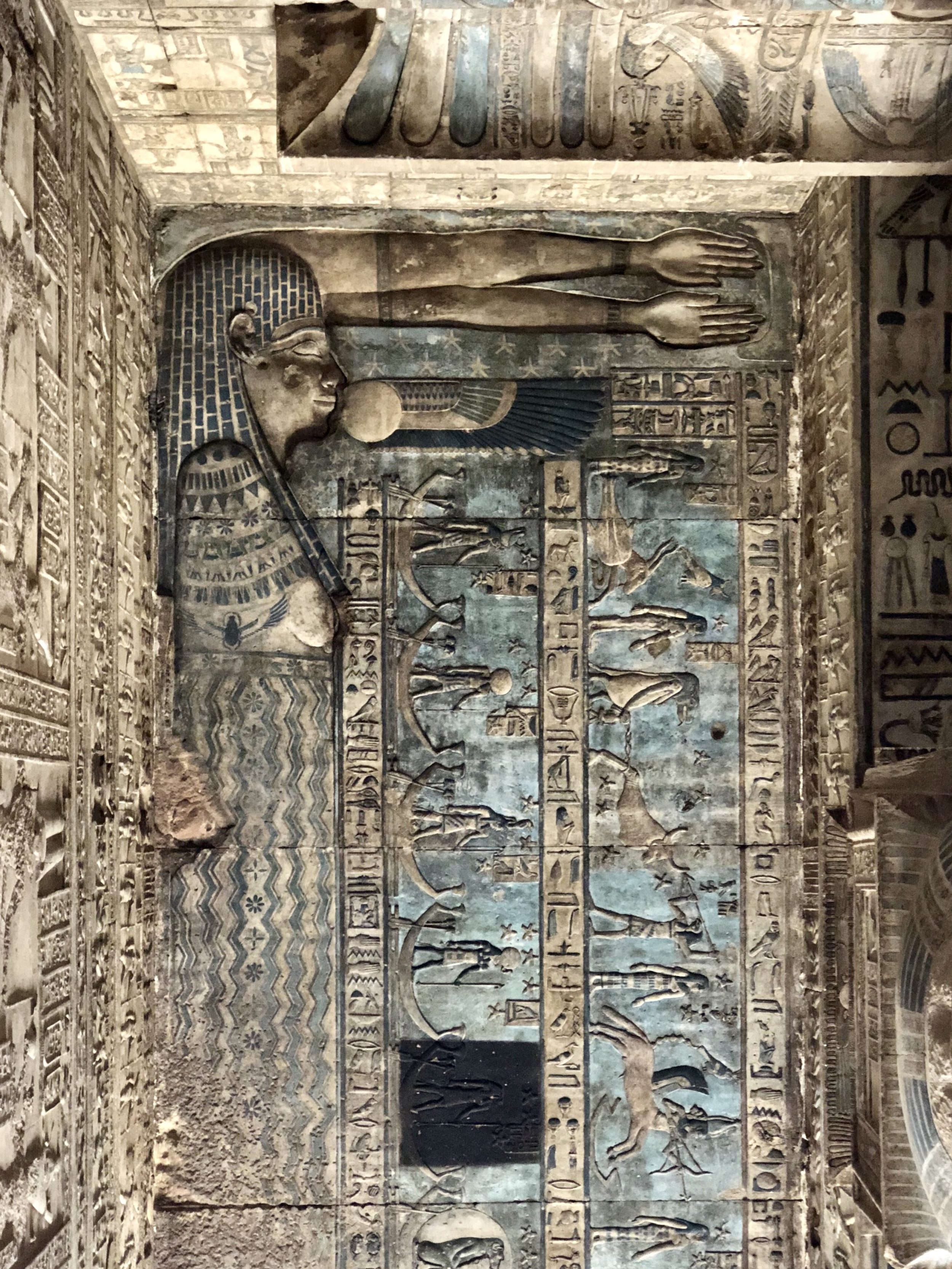
The ceiling features star charts, planets, and constellations portrayed as gods in boats or animals, aligned with Egyptian beliefs. After much squinting and a mini quiz from my guide, I finally spotted my zodiac. You’d think two fishes would be easier to spot, ainnit?
There are a couple of routes to explore the temple from the main hall, but my guide immediately steered us toward the crypts — with a trail of temple cats following our steps — giving me a quick rundown of what was to come.
Into the Crypts We Go
There are around 12 known crypts or treasure caches at Dendera, though only two or three are open to the public. These tight, narrow chambers were originally accessible only to priests, designed to store sacred items like ritual instruments, cult statues, precious metals, and astrological devices — none of which survive today. My guide suggests they were likely “legally looted” and repurposed for ritual use elsewhere.
During my visit, only two crypts were open. And yes, I wasn’t joking — you’ll be crawling into literal holes in the walls. One crypt entrance is perched high up a wall, while the other begins as a small hole in the ground, followed by a second one and a short, steep staircase. Prepare to get on your hands and knees, dusty and squeeze a bit.

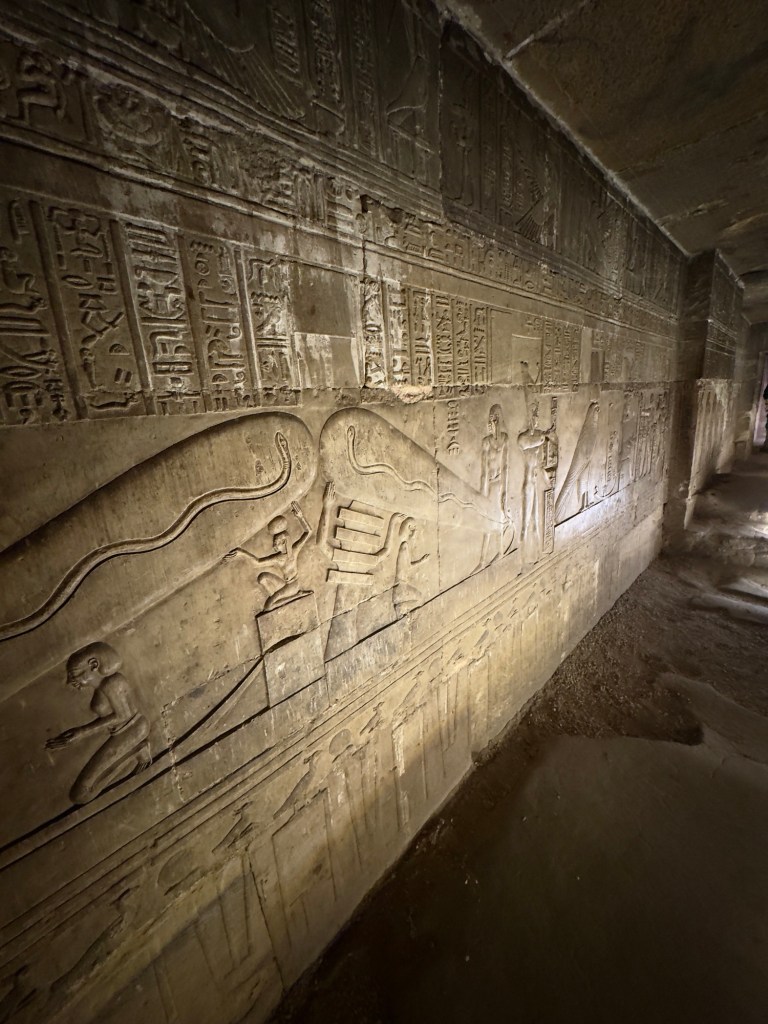

The most famous is the so-called “Dendera Light” crypt — named after a stone relief that resembles a light bulb. Egyptologists (and my guide) interpret it symbolically: Harsomtus (a form of Horus), in the form of a snake, emerging from a lotus flower.
The second crypt? Honestly, I remember little of what my guide said about it. He mentioned something about a procession, and that it was a recently reopened chamber, so there’s scarce info online. But it did scare the bejeezus out of me — crawling through a shaft only to be met with the faded stare of an ancient goddess is a jump-scare I didn’t expect.
Crypts done and literally dusted, we ascended to the roof chapels. Here’s how you know you have a great guide — I was so engrossed, I forgot to take photos. I still beat myself up over it. But let me paint a picture… or you could just Google “Melted Stairs Dendera.”
Sacred Ascent and Decent
Two staircases sit on opposite sides of the temple, built in a spiral (or helical?) pattern. One was for ascending to the roof chapels, the other for descent — designed to mirror ceremonial processions. The “melted” one (ascending) has a gentler incline, allowing priests to carry Hathor’s cult statue during festivals like New Year’s.
As always, nothing is without symbolism. The rising staircase represents the sun’s ascent and rebirth; the descending staircase symbolizes its descent into the underworld. Echoes of Nut’s myth — swallowing and birthing the sun — mirror this duality. East vs. West. Life vs. death. Earth vs. sky. Oxygen vs. my diminishing leg strength.
Balance and duality — cornerstones of Egyptian cosmology.
The walls of the ascending staircase are beautifully carved with reliefs of priests, musicians, and standard bearers in procession, giving us rare insight into ancient ritual movement and ceremony, and also really immerses you into the experience, as if you are reliving the procession of the priests themselves.
At Dendera, this is one of the rare instances where access to the roof is granted to visitors, with a ticket of course, and there you can find the Roof Chapel, during key festivals, the statue of Hathor would be taken from the inner sanctuary and processed up one staircase, where she could be symbolically reunited with the sun god at said Roof Chapel.
Most importantly, the Zodiac Room is up here.
The Zodiac Debacle
The original Dendera Zodiac, a bas-relief ceiling panel, was carved in the 1st century BCE during Ptolemy XII’s reign. It shows a celestial map: the 12 Greco-Roman zodiac signs, Egyptian gods as planets, Nut, solar boats, and lunar cycles, all arranged in a circular rotation around the celestial north pole.
This is where the real drama is, and boi do i love some drama.
I first saw the original Zodiac in the Louvre years ago. Naturally, I came to see the “other side of the story.” as naturally the narrative that was at the Louvre, well, is typical of for most items that were ‘collected’.
In 1820–1821, French engineer Jean-Baptiste Lelorrain, under the patronage of Sebastián Louis Saulnier, oversaw the extraction of the Zodiac ceiling from the rooftop chapel of the Temple of Hathor. The Zodiac was cut out of the sandstone ceiling using saws and explosives — a highly invasive method that left visible scars on the original site, that you can actually see on site.
The removed artifact was shipped to France and ‘acquired’ by King Louis XVIII, who donated it to the Louvre Museum, where it sits in a secluded corner on display in Room 325 of the Sully Building. But here’s a link to their online archive.
Needless to say, Egypt wasn’t pleased. The act was viewed even then by some as controversial, especially by Egyptian scholars and early nationalists who considered it a theft. And in recent decades, Egypt has made formal and informal calls for the return of the Dendera Zodiac as part of its broader campaign to reclaim key antiquities held abroad, along with the Rosetta Stone from the British Museum, and the Bust of Nefertiti from the Neues Museum, Berlin.
France, like many European institutions, maintains that these artifacts were legally acquired under the laws of the time and is preserved and displayed responsibly.
Only time will tell if Egypt will get these artifacts back.
Personal opinion? Ethically, yeah they should go back. It belongs to Egypt — it’s their cultural legacy. Realistically? I’m torn. The disparity in funding and preservation standards makes me question whether repatriation is always the best route.
I shan’t elaborate further as this could end up a very long conversation, but if you’d like to know about more about my thoughts, let me know in the comments below, otherwise, let’s get back on topic.
Back on the rooftop in the Zodiac room, where this very same heated conversation took place between me and my guide, we descended the western stairs to the rear of the temple.
Cleopatra and Caesarion
On the rear wall of the temple, this is where the best-preserved depiction of Cleopatra and Caesarion still remains, showing them making offerings to the gods. This remains the clearest visual confirmation of her reign as pharaoh in the traditional Egyptian style, and is one of the most remarkable and rare full depictions of the queen in an Egyptian temple.
This is significant as it is the only known temple relief showing Cleopatra and Caesarion together in such traditional style. It is one of the last monumental representations before Egypt fell to Rome following Cleopatra’s death.
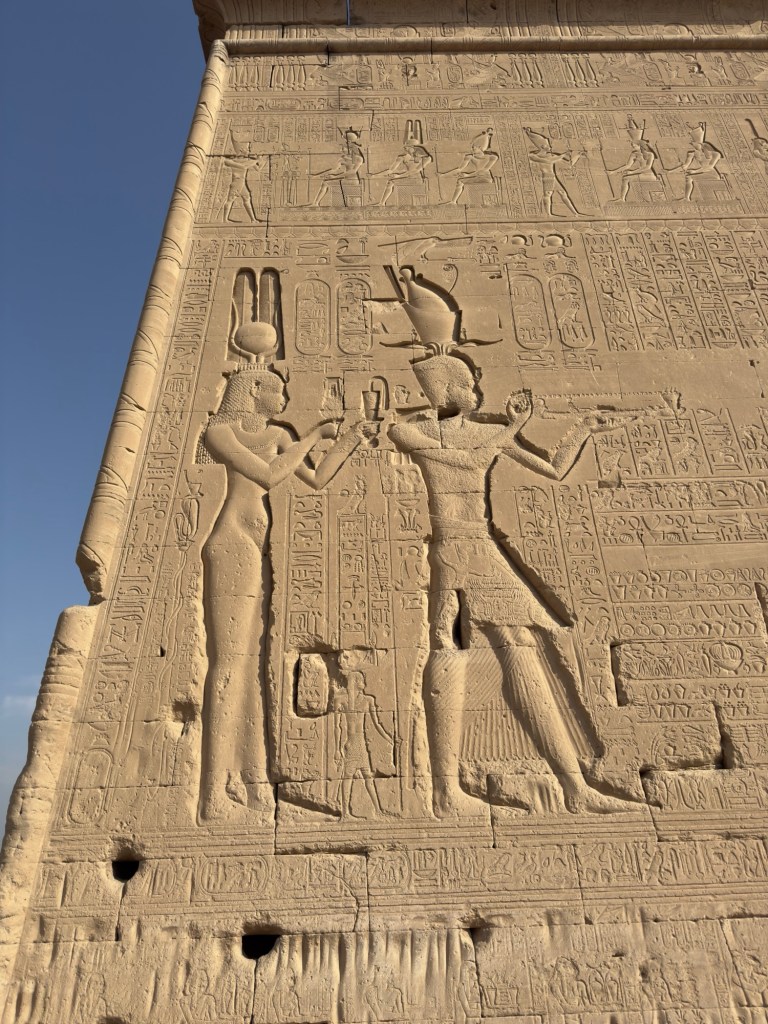
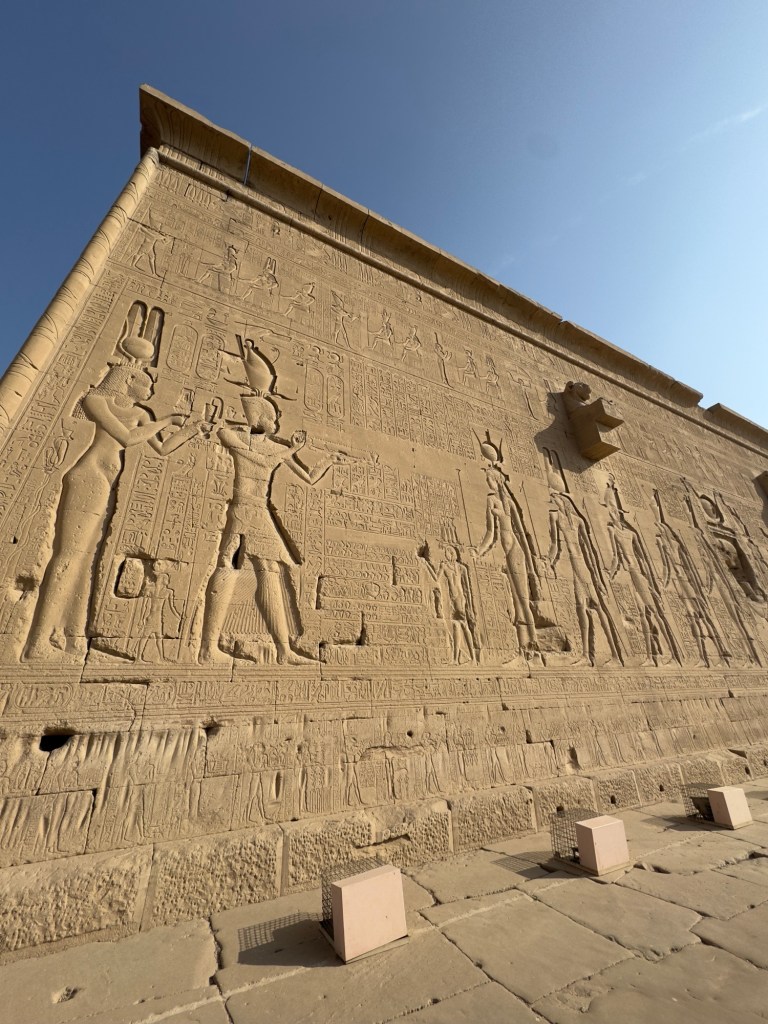
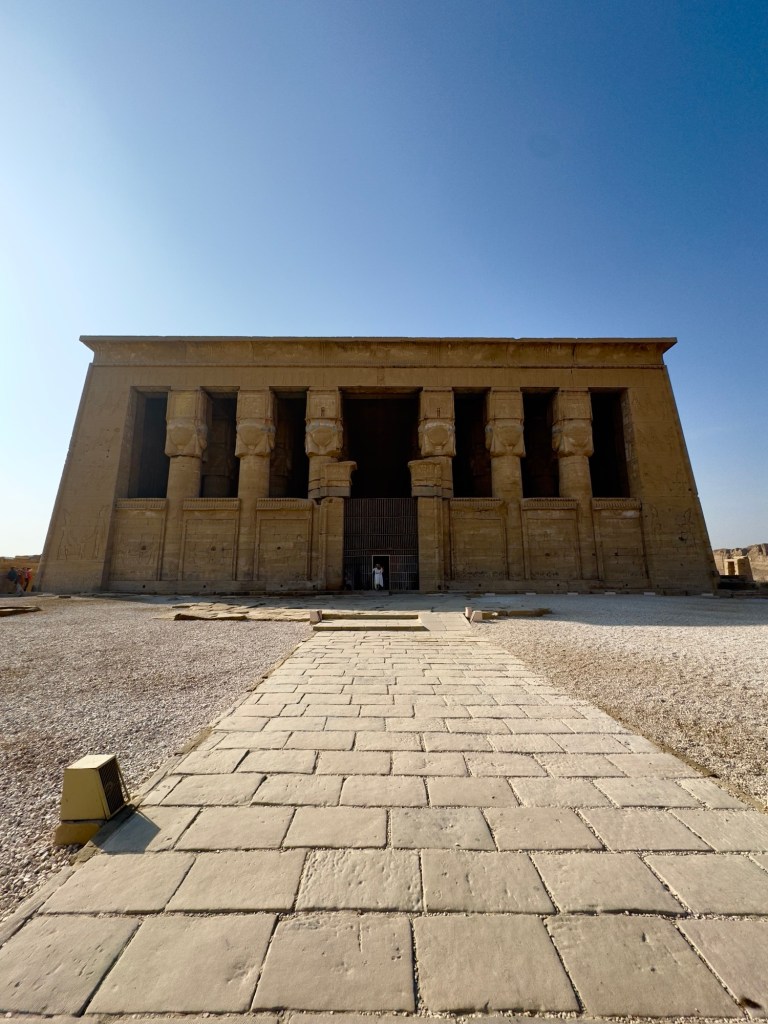
It stands as a testament to Cleopatra’s political genius: adept at speaking to multiple audiences, Egyptian priests, Roman leaders, and her own people through sacred art and architecture. By associating herself with the goddess Hathor, Cleopatra was aligning her rule with a powerful mother-goddess figure: nurturing, regal, and cosmic. The inclusion of Caesarion in the same scene was politically potent, It emphasized her dynastic legitimacy as a descendant of the Ptolemies.
It visually declared Caesarion as heir to both Julius Caesar and the Egyptian throne. But alas, we all know how that story came to an end.
For us, however, the story continues — next stop: The Temple of Seti I at Abydos.
From Hathor to Osiris
Located in Abydos, the Temple of Seti I was dedicated primarily to Osiris, the god of the afterlife, and was intended as a sacred center for funerary worship, divine kingship, and eternal remembrance.
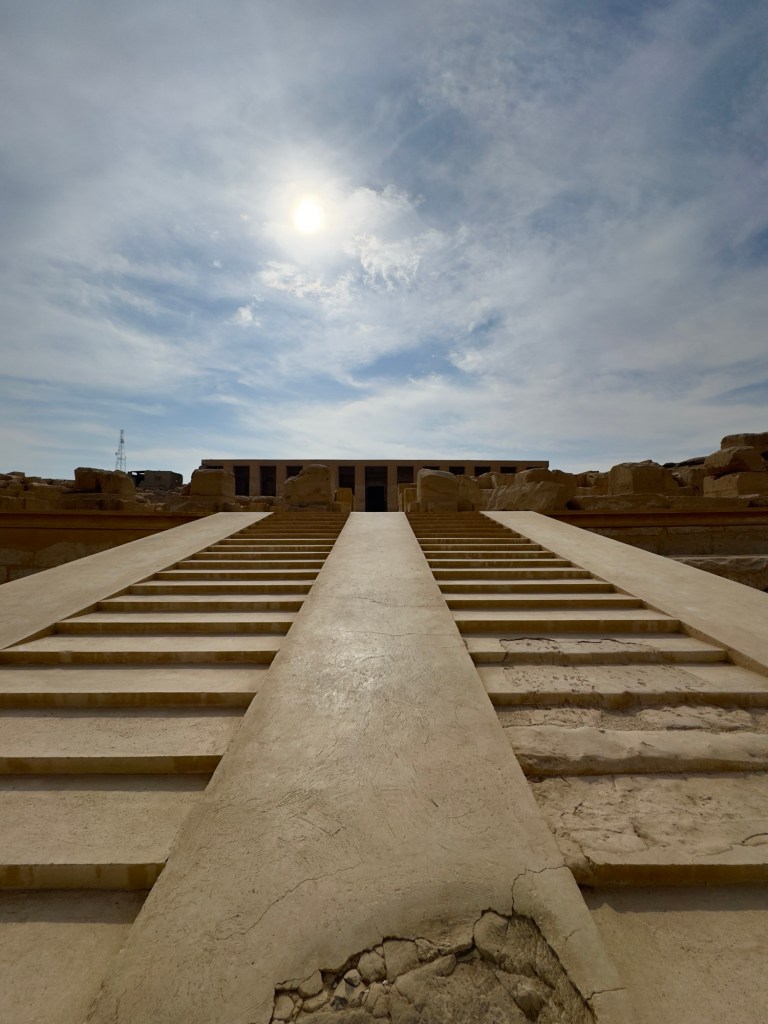
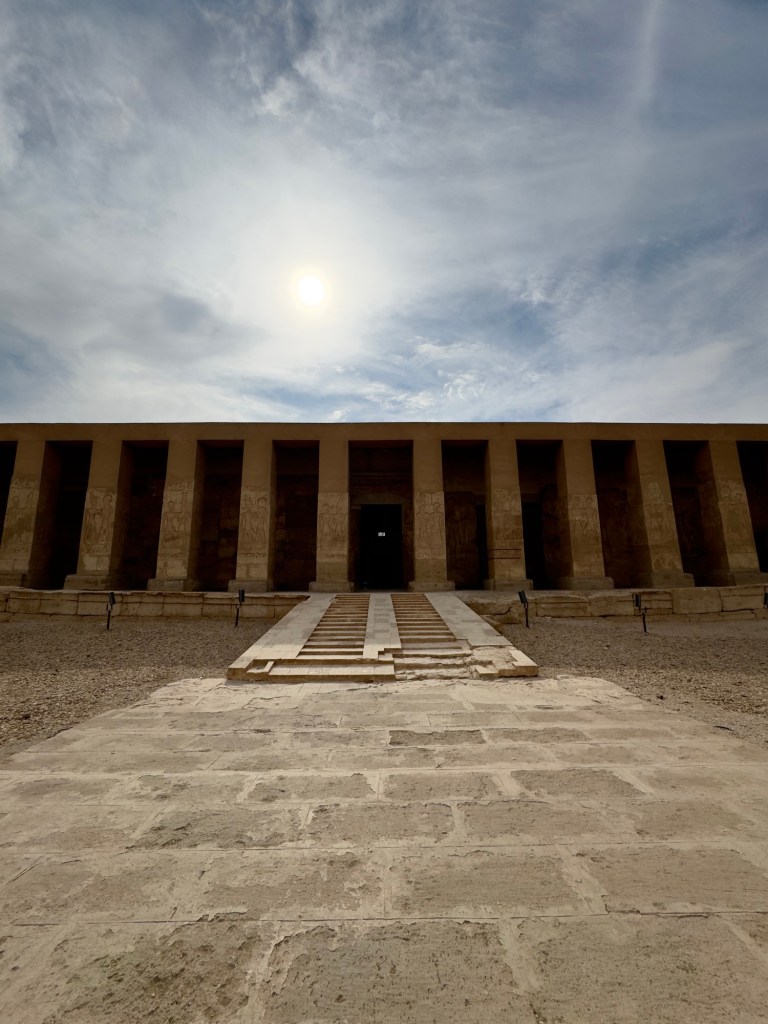

But what’s unique about this temple is that while it is dedicated primarily to Osiris, it contains seven shrines, each dedicated to a major deity: Osiris, Isis, Horus, Amun, Re-Horakhty, Ptah, and Seti I himself. The temple’s design is unique as well with its unusual L-shaped layout.
The reliefs inside are some of the most exquisite in all of Egypt, deeply carved and finely detailed, showcasing the peak of New Kingdom craftsmanship. The dimensionality is astonishing: individual plaits in garments, the translucent quality of fabric, and the almost 3D placement of ceremonial implements are unlike anything I’ve seen in other temples.


The temple also houses the Abydos King List, a chronological list of 76 pharaohs from Narmer to Seti I, a goldmine for Egyptologists — and a hotbed for controversy.
A Tale in Reliefs
Built during the reign of Seti I and completed by his son Ramesses II, the temple was a pilgrimage site for ancient Egyptians seeking closeness to Osiris. And because it was completed by two kings, you can see the artistic differences particularly in the first and second hypostyle hall.
Seti I’s reliefs at Abydos are among the most beautifully executed in all of Egypt. Figures are finely proportioned, naturalistic, and softly modeled with elegant lines and subtle expressions. Reliefs in Seti’s portion of the temple — especially in the seven chapels and first hypostyle hall — show exceptional detail, symmetry, and precision. Even the inscriptions are neatly rendered and consistent.
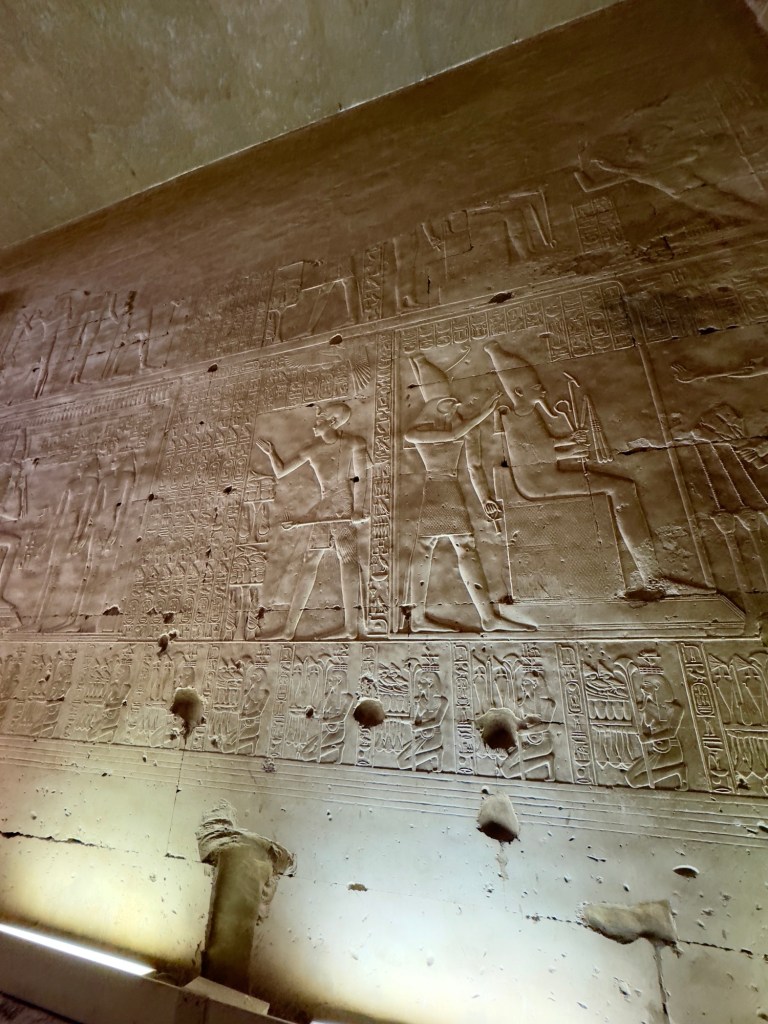
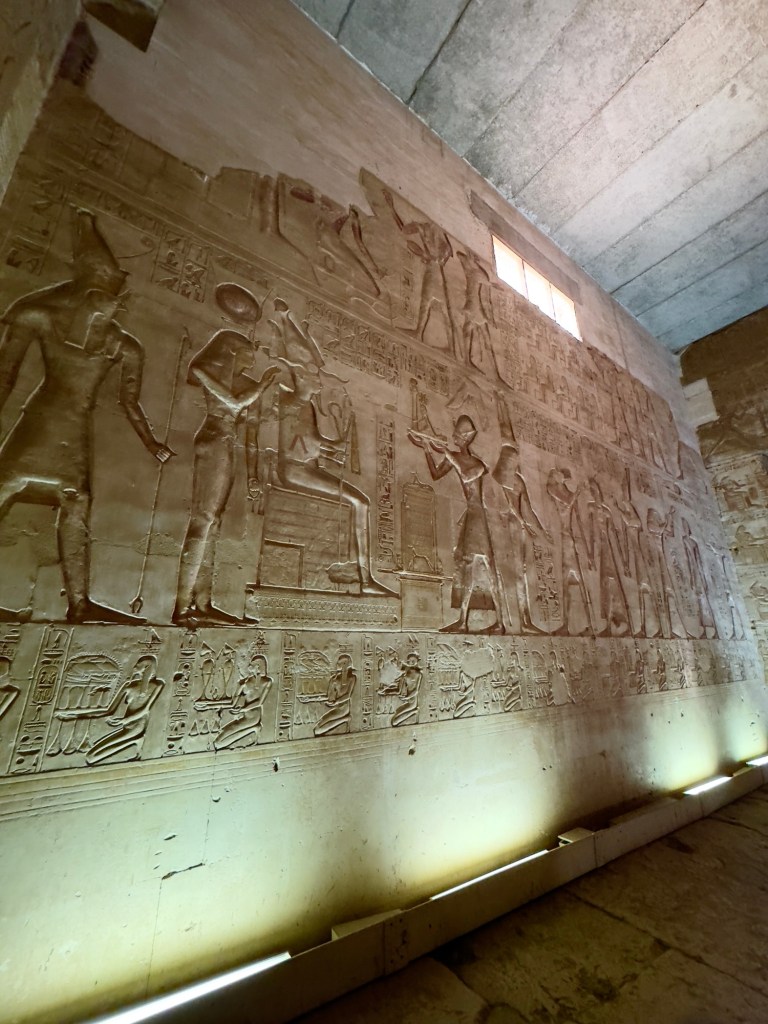
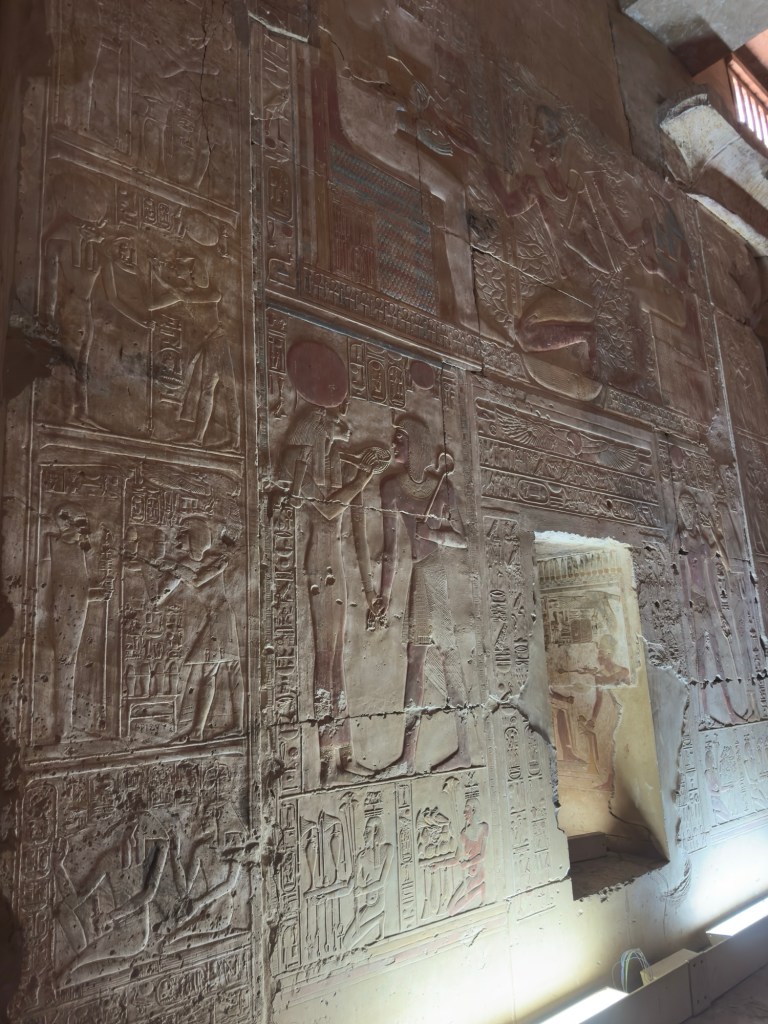
Ramesses II’s additions — particularly in the outer courtyards and second hypostyle hall — display a heavier hand. Figures are more rigid, muscular, and square, with less subtle modeling. While still religious in nature, Ramesses’ scenes shift toward royal glorification, including larger-than-life depictions of the pharaoh smiting enemies, dominating ritual scenes, and asserting his divine legitimacy.
This contrast between Seti I and Ramesses II offers a rare look at evolving royal priorities:
Seti focused on religious legacy and sacred beauty.
Ramesses focused on monumental legacy and royal propaganda.
The fact that both styles coexist in the same temple makes Abydos a living textbook of artistic and ideological evolution within a single dynasty.
Secret Rites and Silent Chambers
Abydos was also believed to be Osiris’ mythic burial site, making it incredibly sacred. Behind the temple lies the Osireion, a symbolic tomb to Osiris with massive granite blocks and a central island-like sarcophagus chamber.
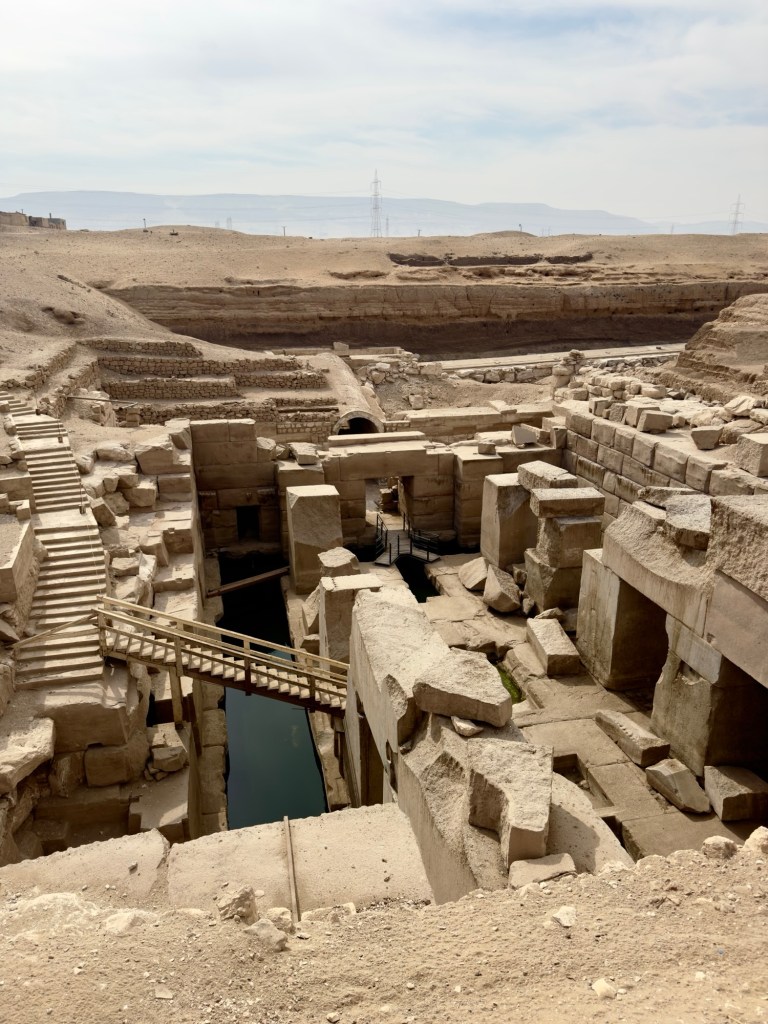
It represents the mound of creation emerging from the primordial waters of chaos — Nun. Rituals of rebirth likely took place here. My guide even claims that on rare occasions, he’s seen modern-day Osirian priests performing rites nearby.
Access is not granted to the public… officially. But, as my guide cryptically said, “everything can be done — for the right price.”
King List Debacle
Now, about that King List…
Carved in two horizontal rows, it starts with Narmer and ends with Ramesses I. Seti and Ramesses are shown offering to their predecessors. It’s a rare native chronology — most others come from Greek historians like Manetho.
So why the controversy?
Several pharaohs were deliberately excluded, particularly those considered heretical, illegitimate, or politically inconvenient, such as Hatshepsut (a female pharaoh), Akhenaten (the “heretic” king who introduced monotheism), Smenkhkare, Tutankhamun, and Ay — all linked to the Amarna Period and its religious reforms.
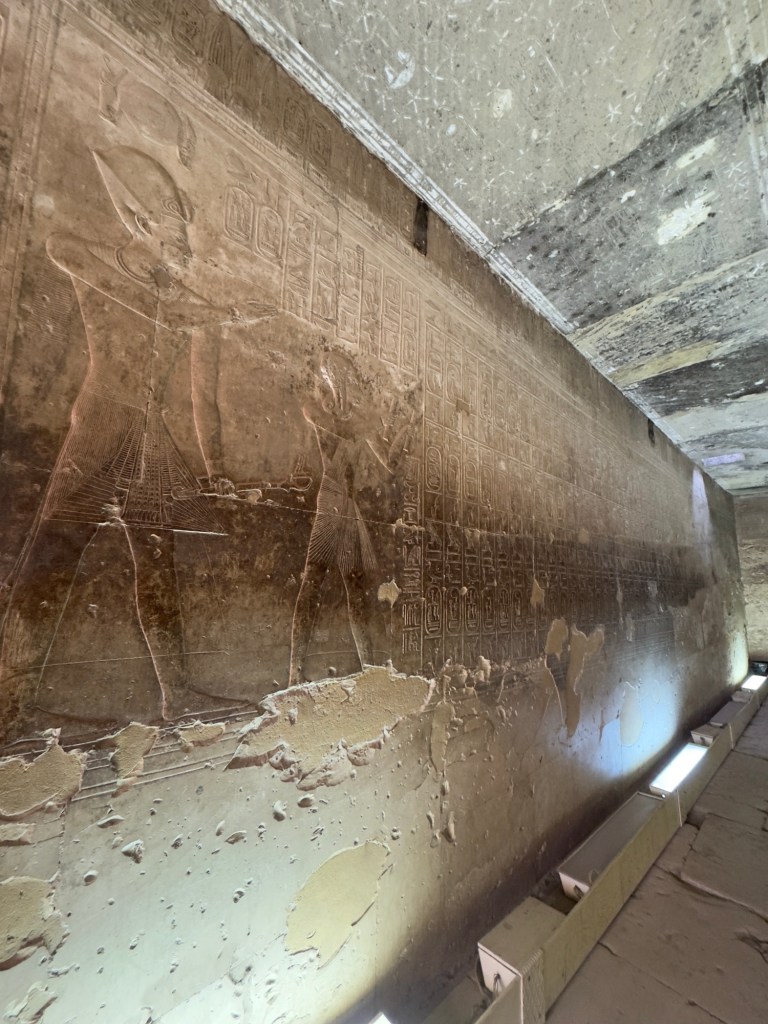
This deliberate omission reflects a politically curated version of history, aimed at erasing rulers who were seen as ‘threats’ to Ma’at (cosmic order), legitimizing Seti I’s rule by aligning him with a sanitized, idealized lineage.
So yes, even Hatshepsut — successful, wise, female — got booted.
What better example of: “History is written by the victors.”
Forgotten Temples, Unforgettable Stories
All in all, the Temple of Hathor in Dendera and Temple of Seti I in Abydos are two absolutely essential day-trip destinations from either Luxor or Cairo. Both are severely underrated, yet bursting with historical depth and cultural insight.
With the sun setting, it was time to move on to my next destination: Cairo — where something massive awaits in the shadows.
 Shenanigans Abroad
Leave a Reply