If Cairo is a fever dream of glittery museum artifacts, surprising greenery, car horns, grabby hands, and the looming possibility of lung cancer, then Giza, Saqqara, and Memphis are where time has stood still — centuries deep — while the rest of the world raced ahead.
We started early with the obvious: the Pyramids of Giza. Because you kind of have to. It’s like going to Paris and skipping the Eiffel Tower — except imagine if the Eiffel Tower was 4,500 years old, hand-carved from megalithic stones, and allegedly aligned with the stars by people who didn’t even have wheels or drones. Some say aliens built them. Some say ancient Egyptians were just wildly tech-savvy.
I say: “Holy shit, that’s a lot of limestone.”
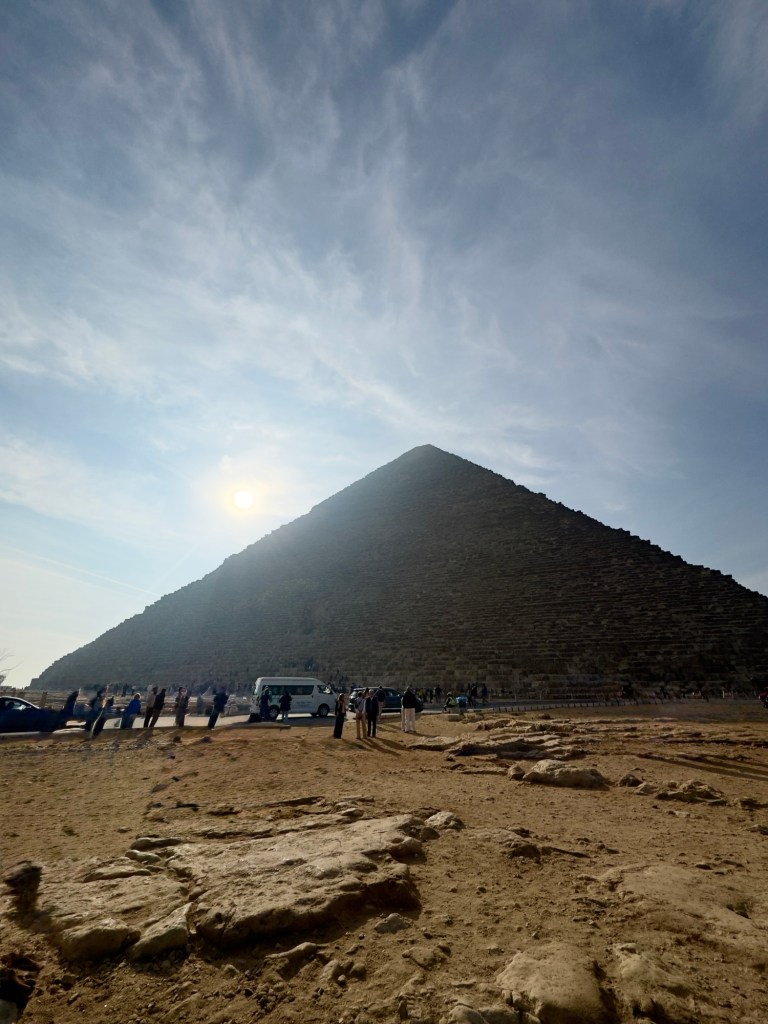
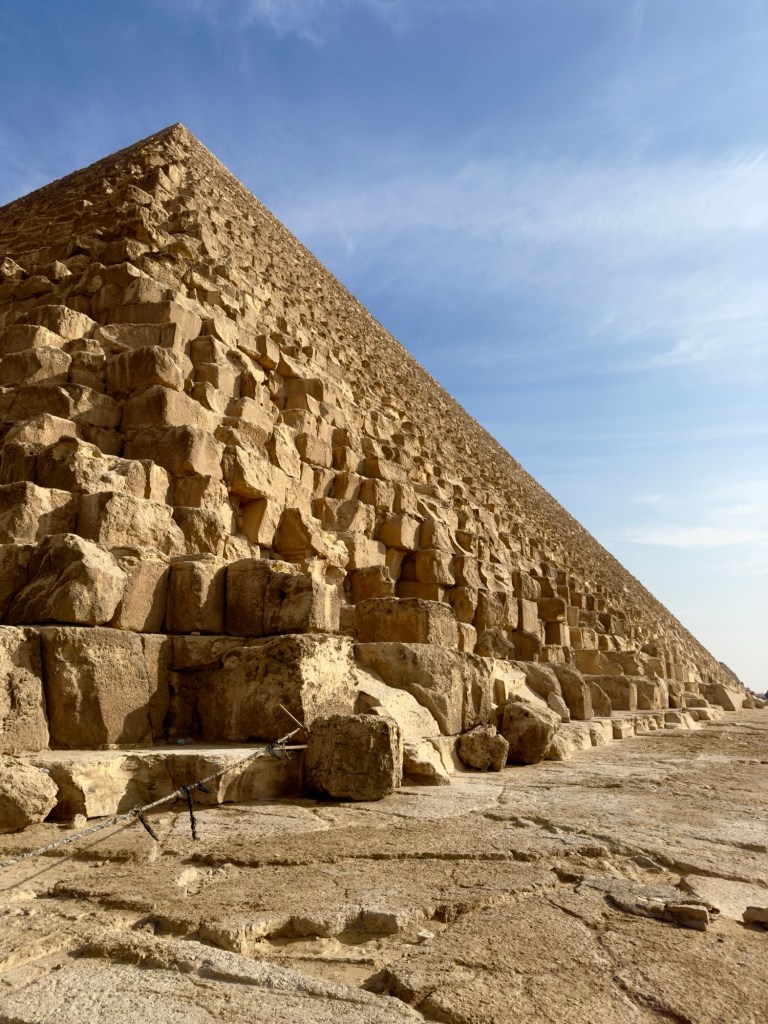
Let me just say: photos absolutely do not prepare you for the sheer absurdity of their size. They literally loom over you. The Great Pyramid of Khufu alone is 146 meters tall (well, was — time has trimmed it down a bit), and you feel it in your bones (and neck) when you stand beneath it. The scale is mindbogglingly ridiculous.
Entrance is 540 EGP, and — as of writing this — the main entrance has been relocated to a new site called “The Great Gate” on the Cairo-Fayoum road, replacing the old one near the Marriott Mena House.
This project aims to reduce congestion and pollution, banning private vehicles and tour buses from entering the plateau itself. Instead, visitors and guides are shuttled in via eco-friendly electric vehicles. I haven’t experienced the new system yet, but honestly — if it streamlines the experience? I’m all for it.
Because the old setup? An absolute logistical nightmare.
All visitors — and I do mean everyone — had to disembark with all their belongings to pass through a chaotic security process. There were no group lanes, so imagine armies of freshly landed tourists dragging oversized suitcases through disorganized lines, losing their guides, and waiting for vehicles to clear. It was an apocalyptic free-for-all. At 7 AM.
So here’s hoping the new system saves future souls.
Now back to the pyramids. The path to them is… well, straightforward. Literally. You can’t miss it. And as you walk toward — and eventually around — the Great Pyramid, you might spot a fossil or two embedded in the stones. Many of the limestone blocks contain visible marine fossils from when this land was a warm, shallow sea. Yes, the desert used to be ocean. Wild.
You can enter the Great Pyramid for a separate fee. I passed. After climbing through a rough-cut shaft, up a steep ramp called the Grand Gallery, you eventually reach the King’s Chamber — which is basically a hot, airless granite room with an empty sarcophagus. For 900 EGP?
Nah, I’m good.
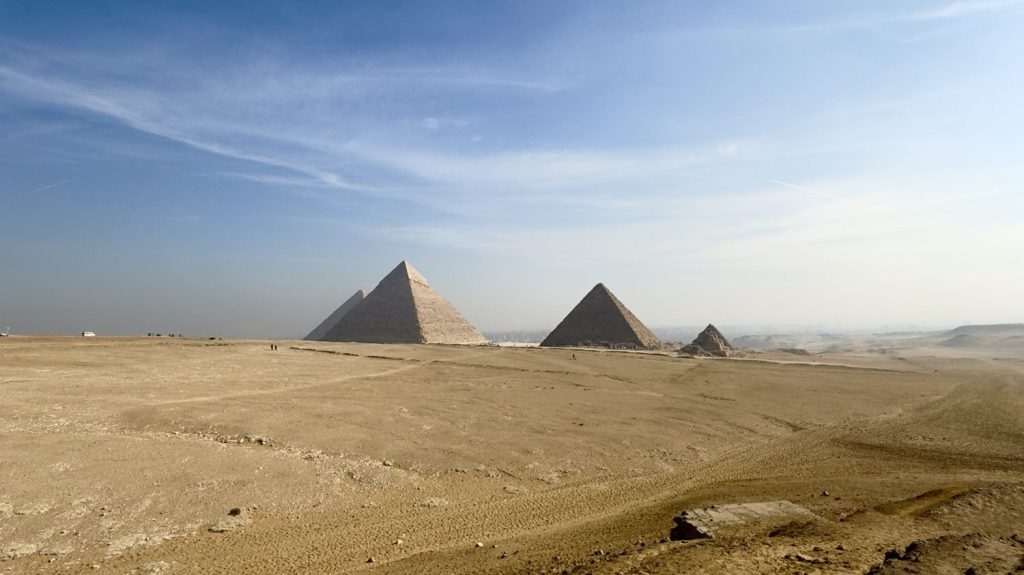
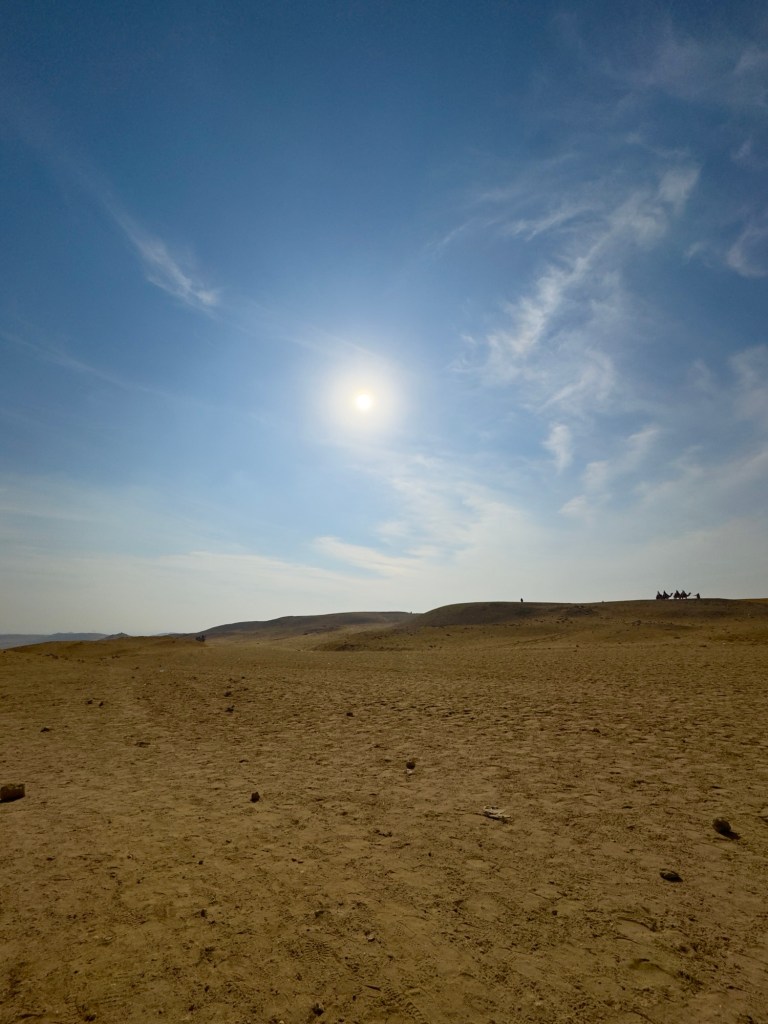
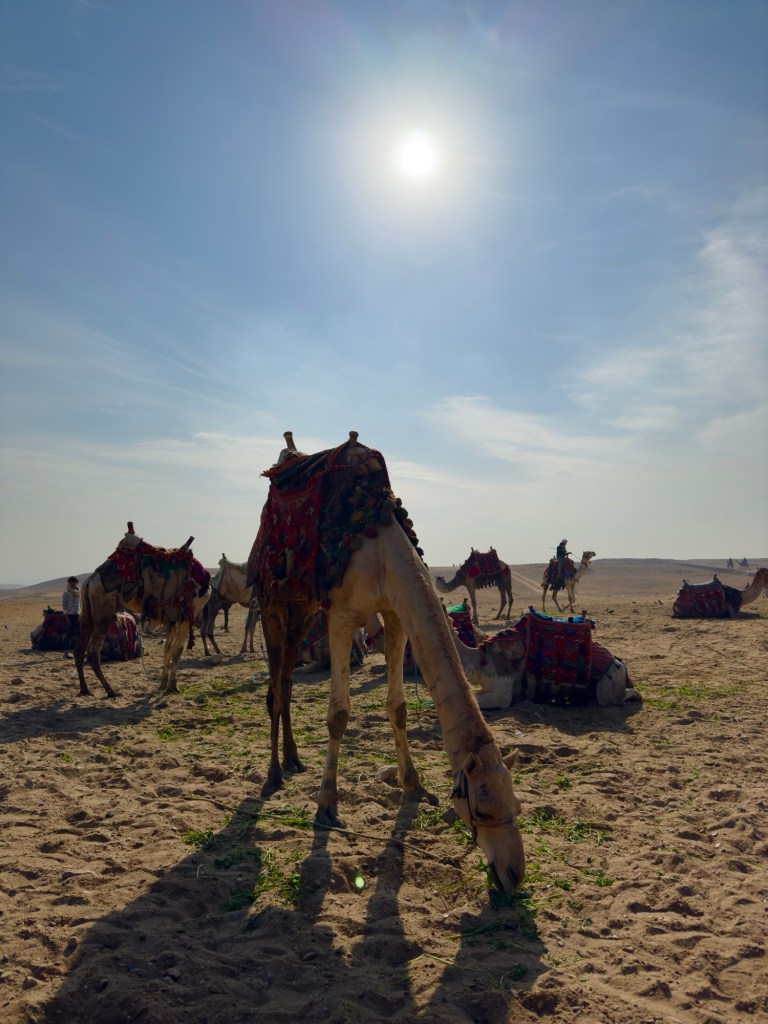
But do not skip the Panoramic Viewpoint. Whether it’s a drive or a dusty hike around the back, it’s so worth it. All three pyramids line up like a constellation in the sand. Camels groan nearby, the wind kicks up cinematic dust, and the scent of the animals… well, let’s call it atmospheric.
This is also the hotspot for camel and horse rides. Pro tip: book one through your guide or tour operator in advance. You’ll still need to tip your handler, but at least the chaos is managed. Trying to arrange a ride yourself? Risky. Every single person who tried to negotiate their own ride while I was at the viewpoint? It went sideways. Dramatically.
Because once you’re on the animal, they hold the power — not you. Not your wallet. You’re up there. They’re down here. And no, the tourist police won’t help you. Half of them aren’t even real cops to begin with.
(More on this in the upcoming Egypt Cheat Sheet — stay tuned.)
A visit to the Giza Plateau isn’t complete without visiting the Great Sphinx of Giza.
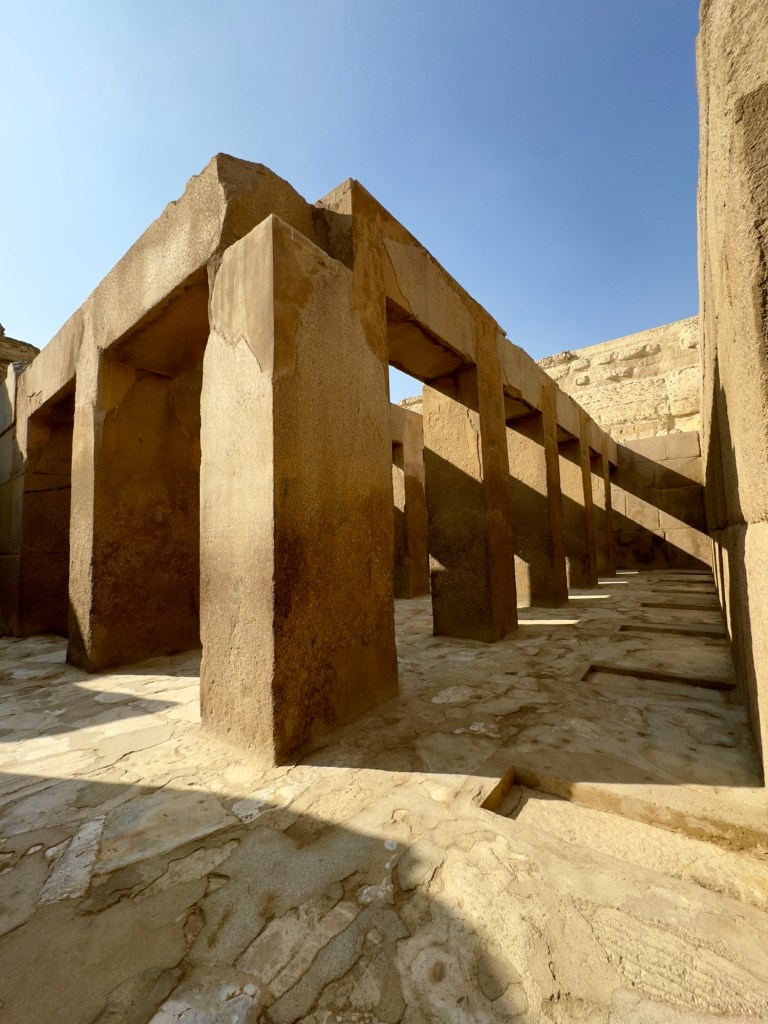
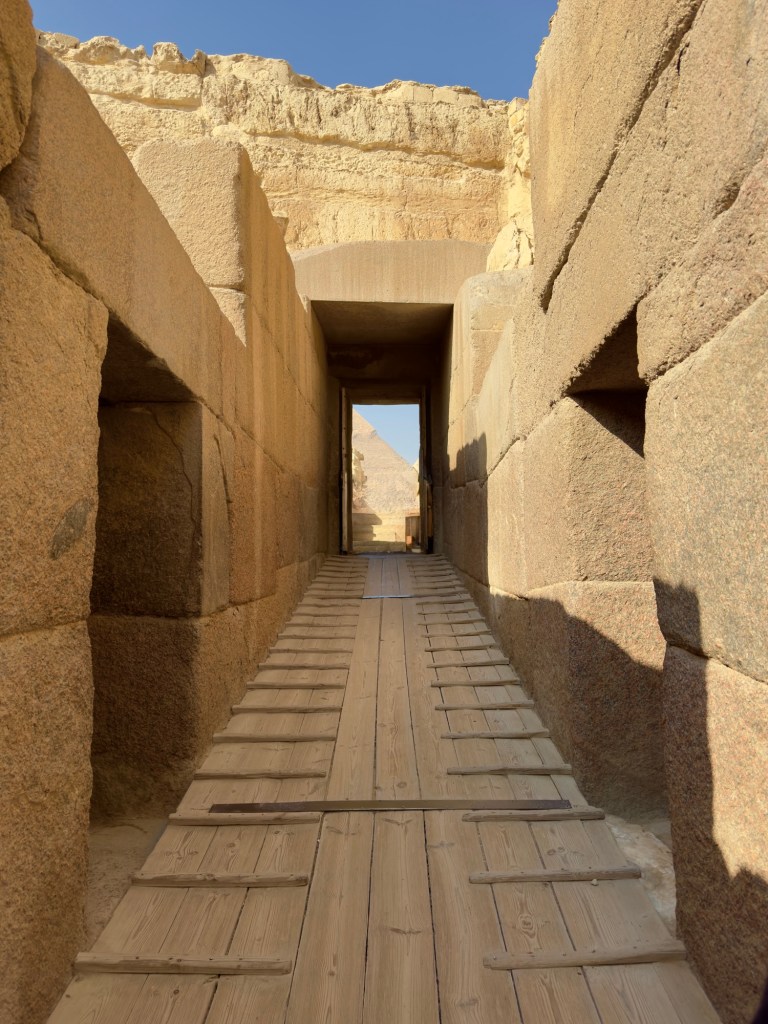
It starts with a quick detour through the Temple of Khafre — all massive limestone blocks and eerie stillness, like the world’s oldest minimalist lobby. The columns are thick, the light is soft, and everything feels weirdly preserved, like time hit pause around 2500 BCE.
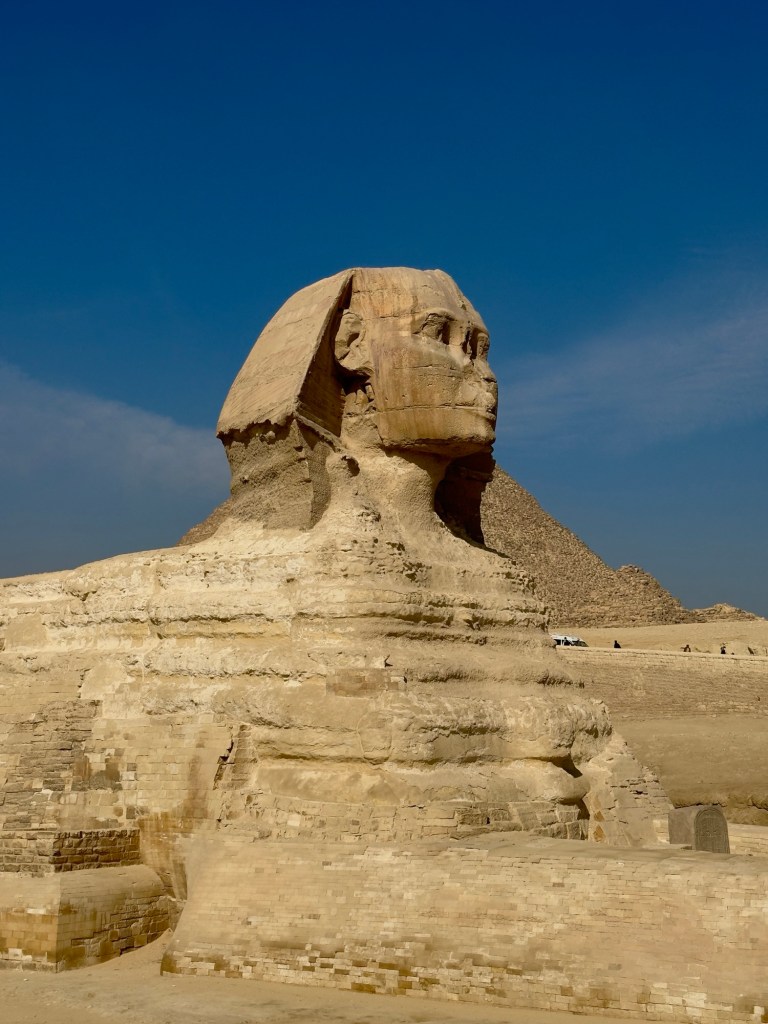
And then, just past the last threshold, there he is, the big stone kitty himself.
Seeing the Sphinx in person is strange. You know what it looks like, but standing in front of it is still surreal. It’s smaller than the pyramids but somehow just as commanding — part lion, part pharaoh, and a good friend of Monsieur Voldermort.
Getting close to it requires a bit of a queue and maneuvering through other tourists doing their best “kiss the Sphinx” poses. And the closest you can get to it is from the side.
There is a path that leads between the Sphinx’s paws, but from what I’ve gathered, that route is reserved for “special guests only.” We all know what that means. We just need to become MrBeast, apparently.
But if you must know what’s tucked between those iconic forelegs, it’s a stele — a slab of inscribed stone — dating back to the 1400s BCE. According to legend, it records a pharaoh’s dream where the Sphinx promised him the throne in exchange for clearing the sand off its body.
Honestly, that seems like a better bargain than getting saddled with a potentially deadly riddle. But who am i to judge?
The Sleeping Giant
Next up: Memphis.
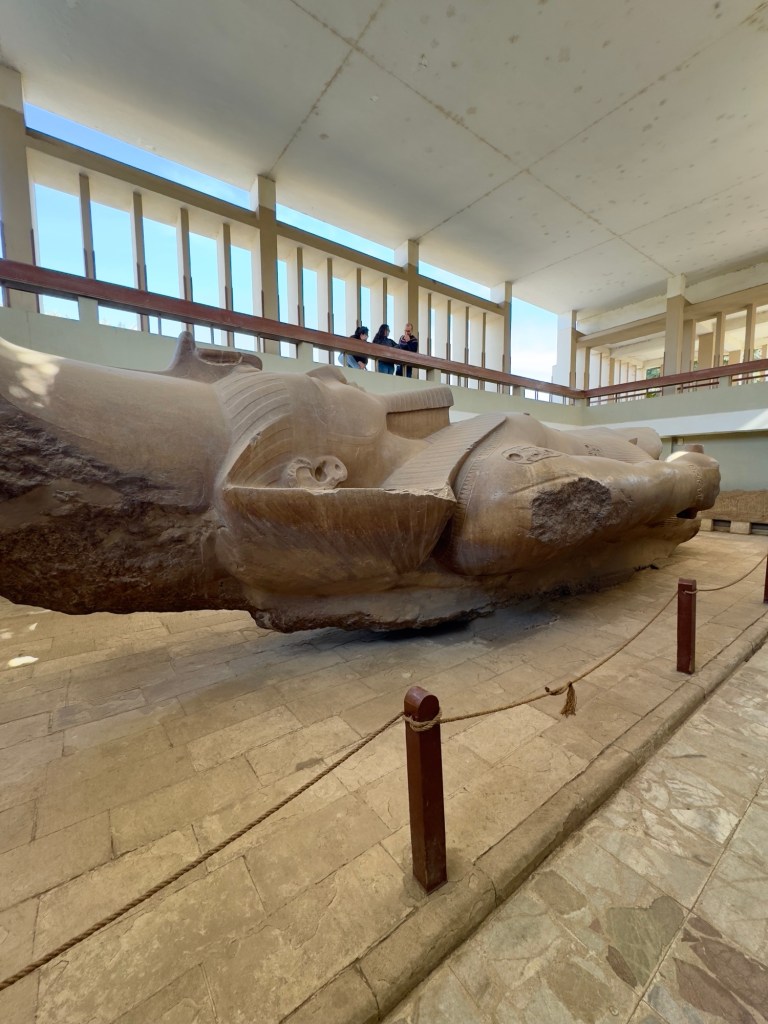
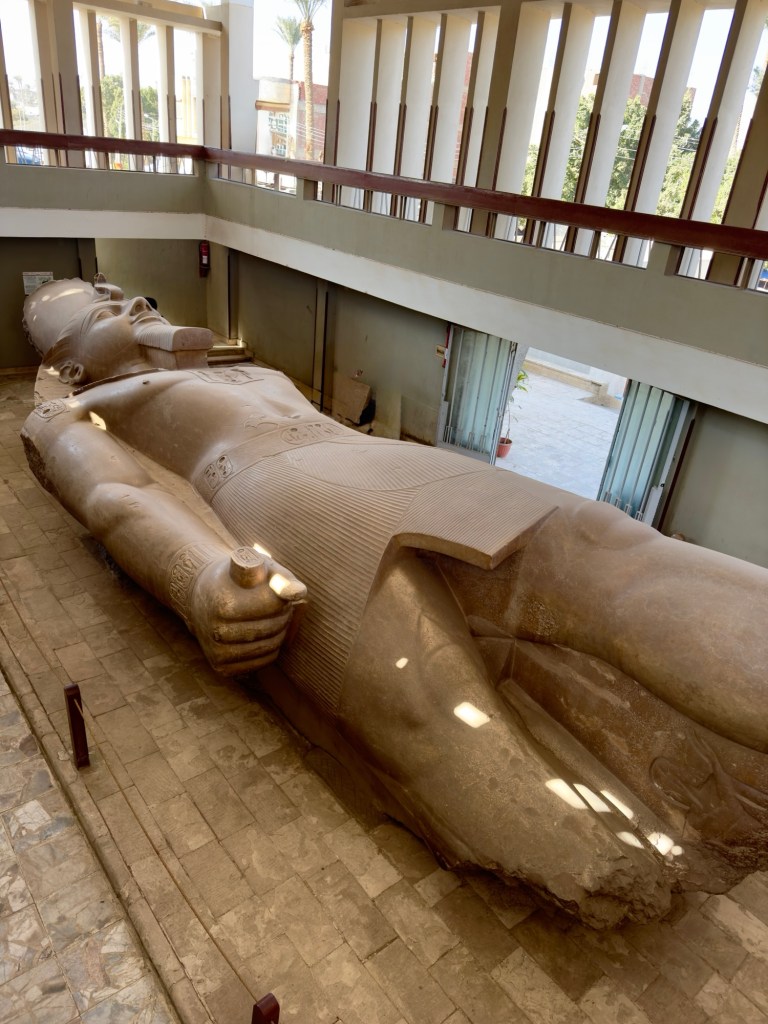
Memphis is what happens when a capital city from 3100 BCE refuses to fade quietly. There’s not a lot left — just a small open-air museum and some scattered ruins — but what is there will make you stop mid-sweat: the colossal, fallen statue of Ramesses II.
He’s lying down because, frankly, no one wants to risk trying to stand him up again. The 83-ton statue is too heavy, too old, and too precious. Even the British and French looked at it and said, “Nah, too expensive,” and so the Egyptians built the museum around it instead.
Even horizontal, he’s massive. You view him from a balcony above — the only way to take him all in. The level of detail carved into that limestone is insane. His nose alone is the size of a toddler. And perfectly symmetrical. It’s both eerie and majestic.
Then, when you think your brain can’t possibly take in more stone-and-sand-based awe, you hit Saqqara.
The Pyramid That Started It All
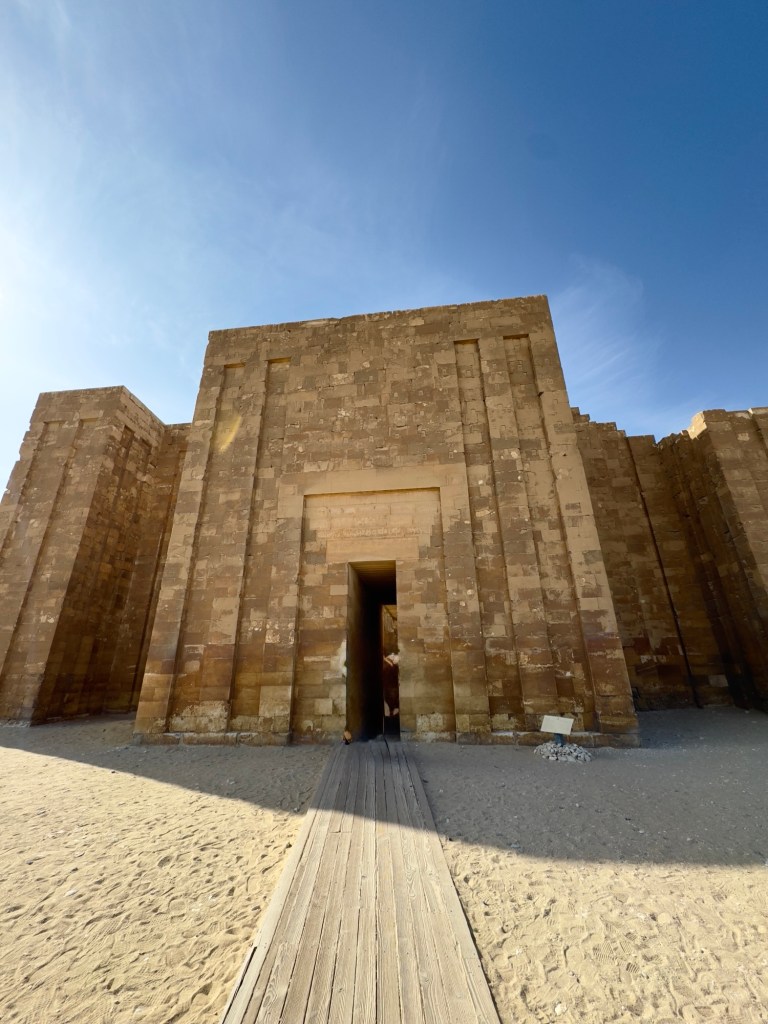
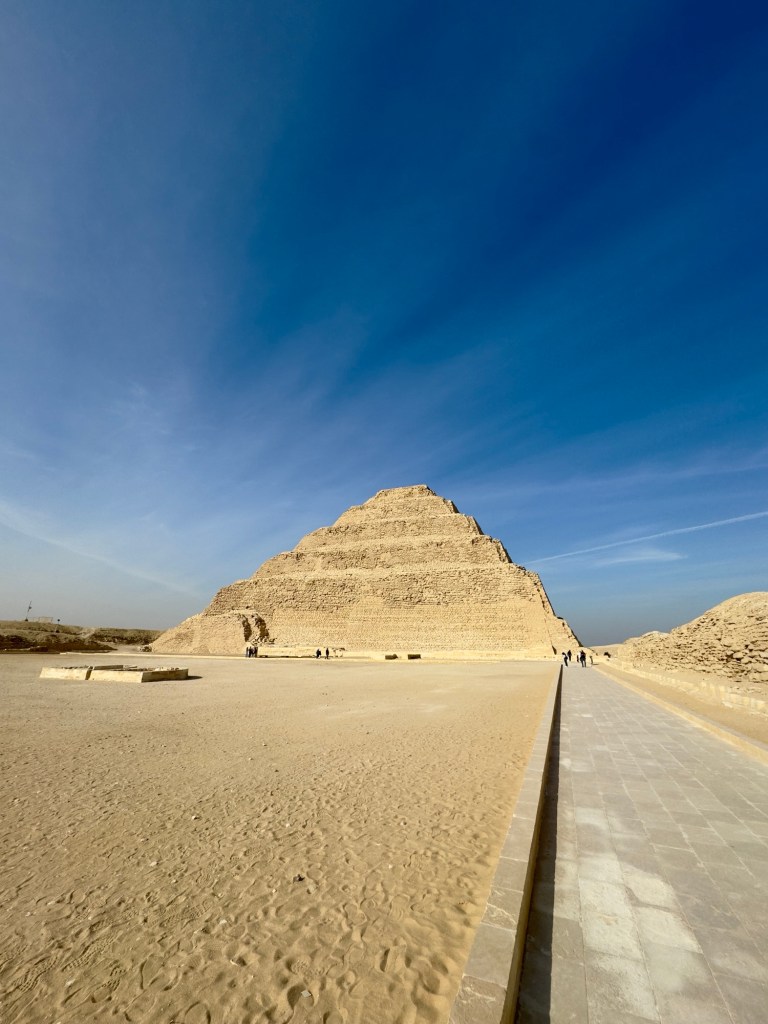
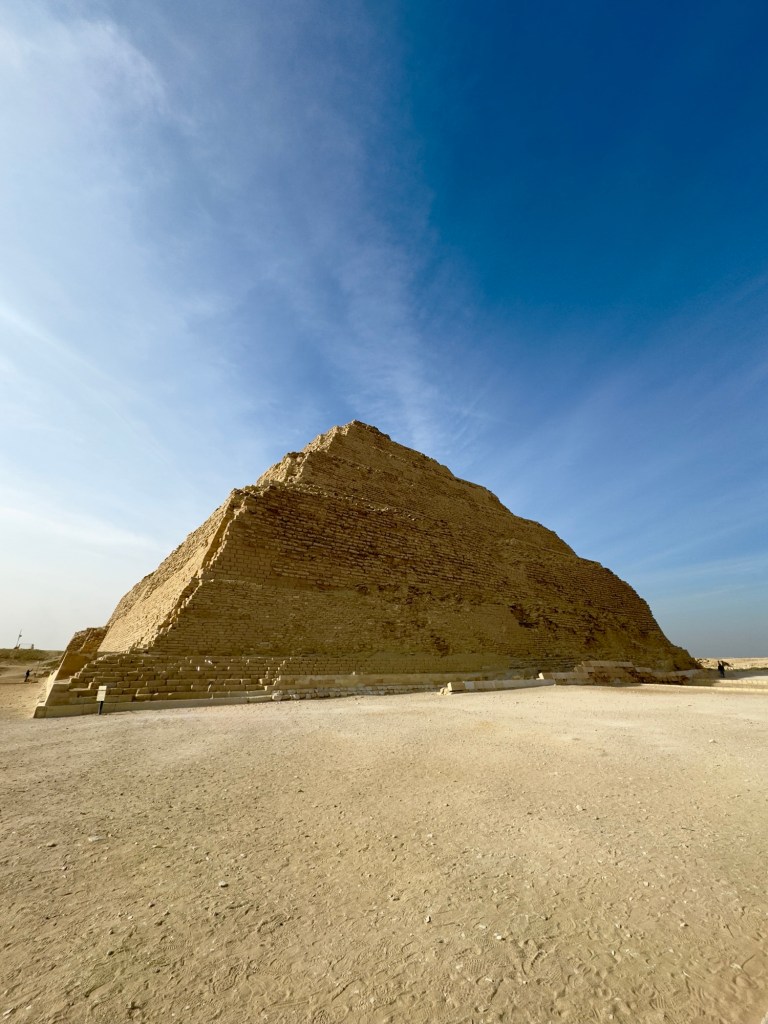
Where Giza is grandeur, Saqqara is origin. This is where it all began — with the Step Pyramid of Djoser.
It’s not smooth and polished like the Giza giants. It’s rough. Rugged. A little lopsided. And that’s exactly the point. This was the first. The architectural equivalent of a mad genius testing the impossible.
Before Djoser, pharaohs were buried in flat tombs. He basically said, “Nah. I want stairs to the afterlife.” And just like that — the world’s first monumental stone structure was born.
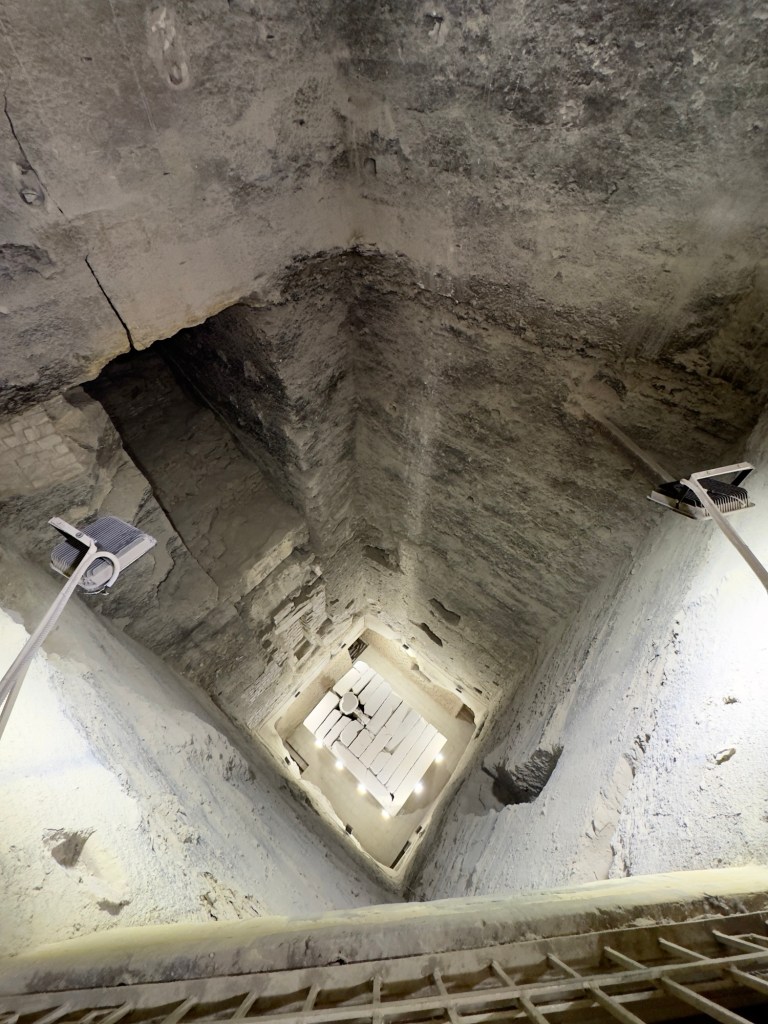
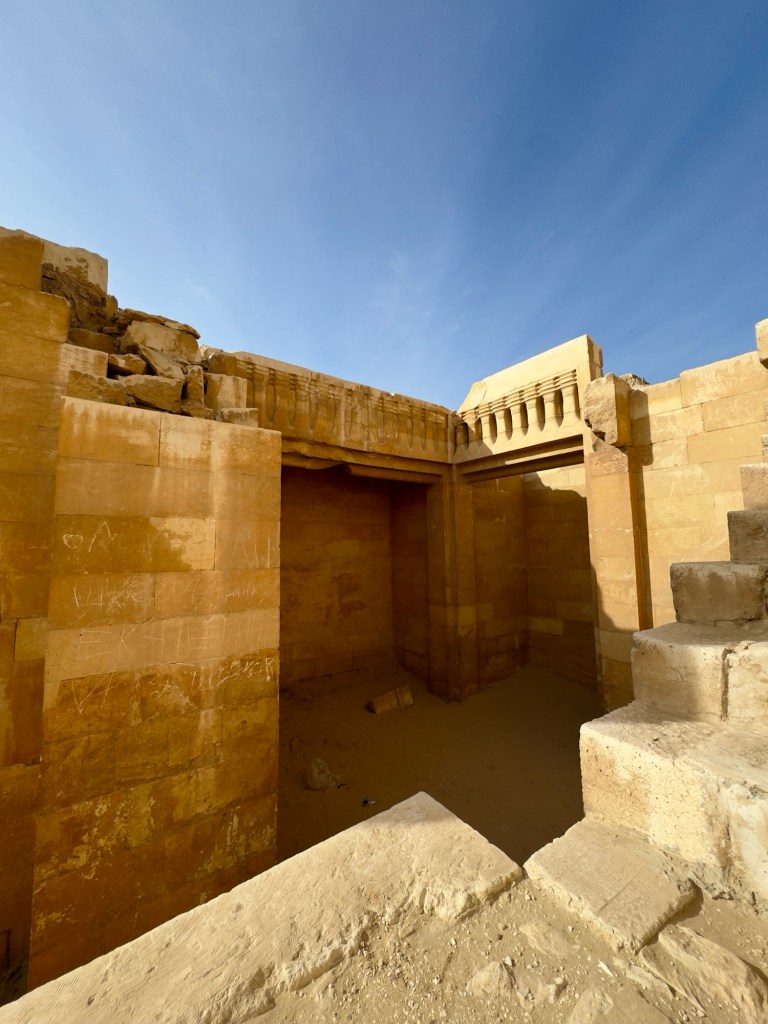
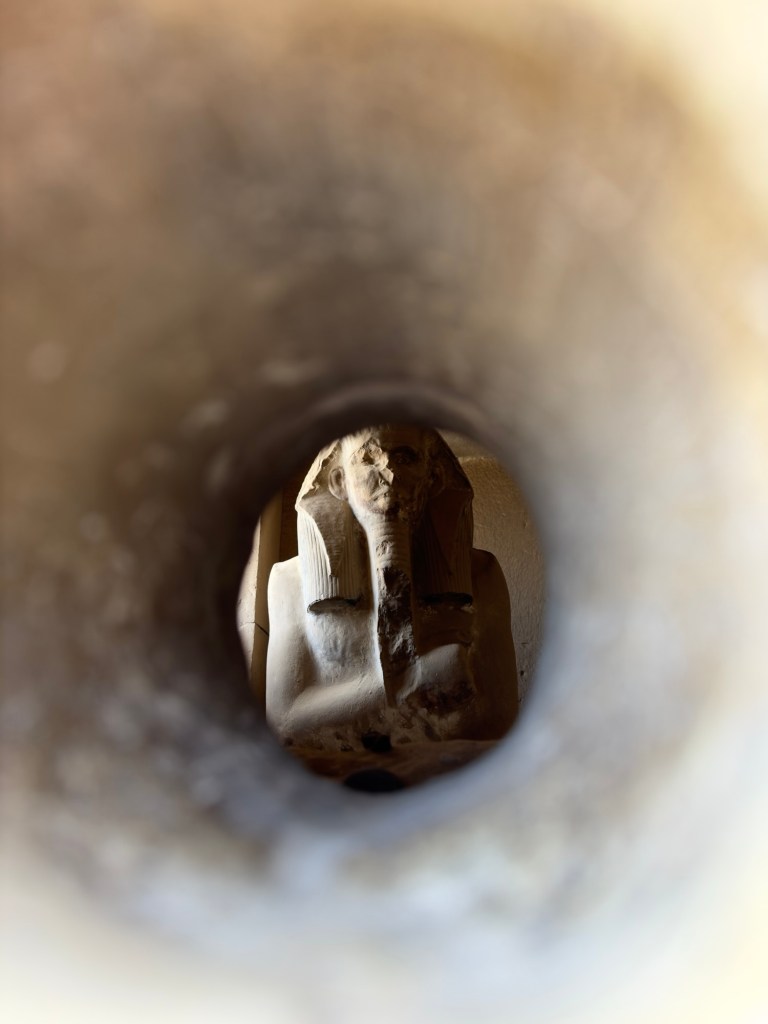
The surrounding complex still holds hints of its former glory — crumbling colonnades, battered walls, shafts dropping into ancient burial chambers — but the Step Pyramid itself steals the show. While not as impressive size wise, the Step Pyramid emits a quiet sort of power and authority, standing regally and making its name quietly in the annals of history.
Where Knowledge Burned
By the end of the day, I’d walked in the footsteps of gods and visionaries, seen stones older than entire languages, and stared down the gaze of kings who ruled when farming was still a shiny new idea, all while the soundtrack of ‘The Prince of Egypt” was playing in the back of my brain.
And somehow, through the sweat and the sand, the only though i had as i lay in bed was how these structures have stood against the tests of time, literally through wars and natural disasters. Of all the lost knowledge and technology.
And of my next destination, a place where “lost knowledge” isn’t just a sore spot, but a catastrophic wound in the story of civilization.
If I had two words to describe the capital city of Egypt, it’d be “Organized Mess,” with a heavy emphasis on mess.
Cairo is loud. It’s dusty. It smells like fried liver, car exhaust, and old books. There’s a honk every second, traffic laws are definitely just suggestions, and crossing the street is an extreme sport that requires prayer, agility, and a “may the odds be ever in your favor” attitude.
This is not the Cairo of postcards with camels and pyramids. No — that’s Giza. This is Cairo, where millennia of history sit layered beneath crumbling balconies, where Coptic crosses and minarets share skyline space, and where you can have a heart-to-heart with your Uber driver about life, love, and geopolitics before your second coffee.
And my first stop? Naturally — where all the mummies are.
National Museum of Egyptian Civilization
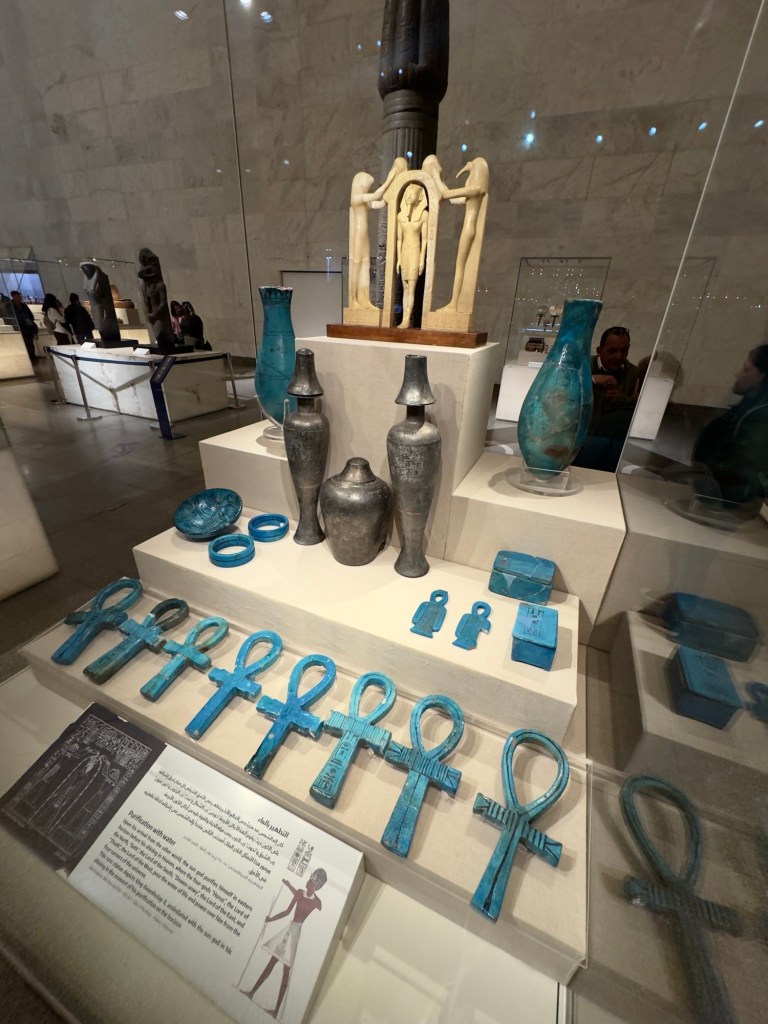
Let’s get one thing straight: the National Museum of Egyptian Civilization (NMEC) is clean, modern, and brimming with ‘life’. All pun intended. After all, this is where they’ve relocated 20 royal mummies — 18 kings and 2 queens, spanning from the 17th to the 20th dynasties — into one building during a fancy parade aptly named ‘The Pharaohs’ Golden Parade’ in April 2021.
Entering the Mummies Hall honestly feels like descending into a very fancy, very air-conditioned underworld.
The lighting is low, the temperature perfectly controlled, and the energy? Strangely reverent. Each glass coffin houses a king or queen, and beside them, a plaque tells you how long they ruled, what they were buried with, and — occasionally — how they died. No gold, no grandeur here. Just sun-leathered faces, preserved after thousands of years, each one whispering a quiet testament to mortality and memory.
Standing in front of Ramses II or Hatshepsut, I couldn’t help but think, “So this is the person who moved mountains — and now they fit in a climate-controlled box with a barcode.” It’s humbling, a little sad, and kind of beautiful in a morbid way.
Do take note, though: while photography is permitted everywhere else in the museum, it is strictly forbidden in the Mummies Hall. I can’t emphasize this enough. I watched security yeet an entire family out — not just from the room, but the entire premises — for attempting a selfie with a royal, human-shaped bundle of linen. Consider yourself warned… lest your 500 EGP ticket go to waste
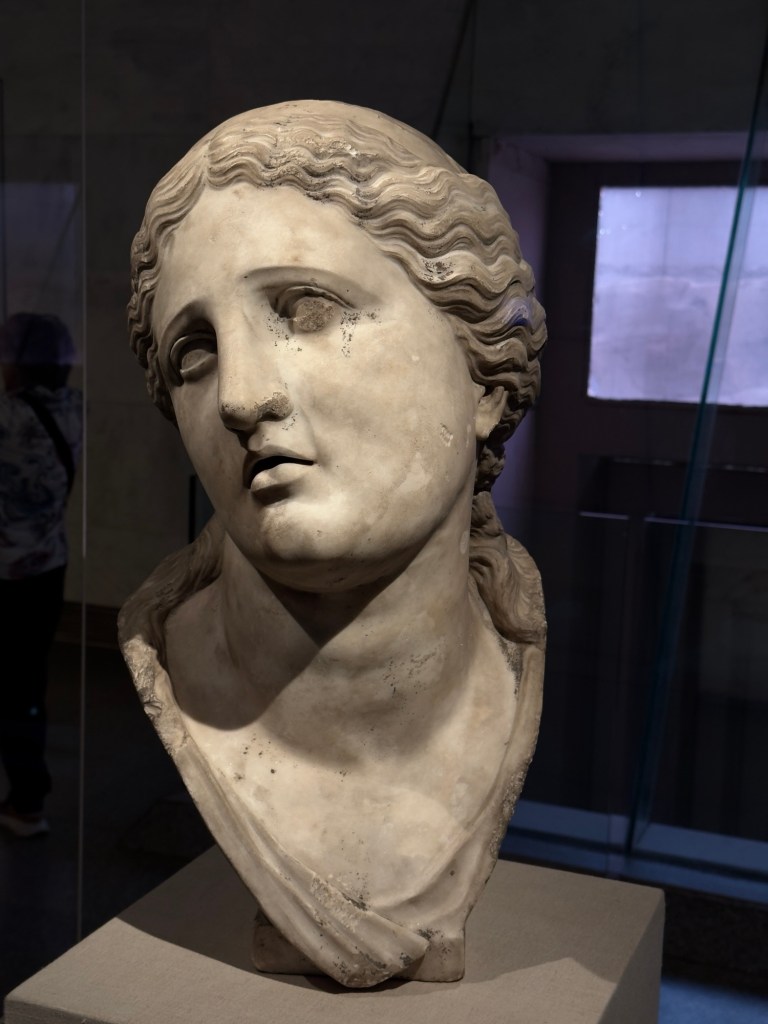
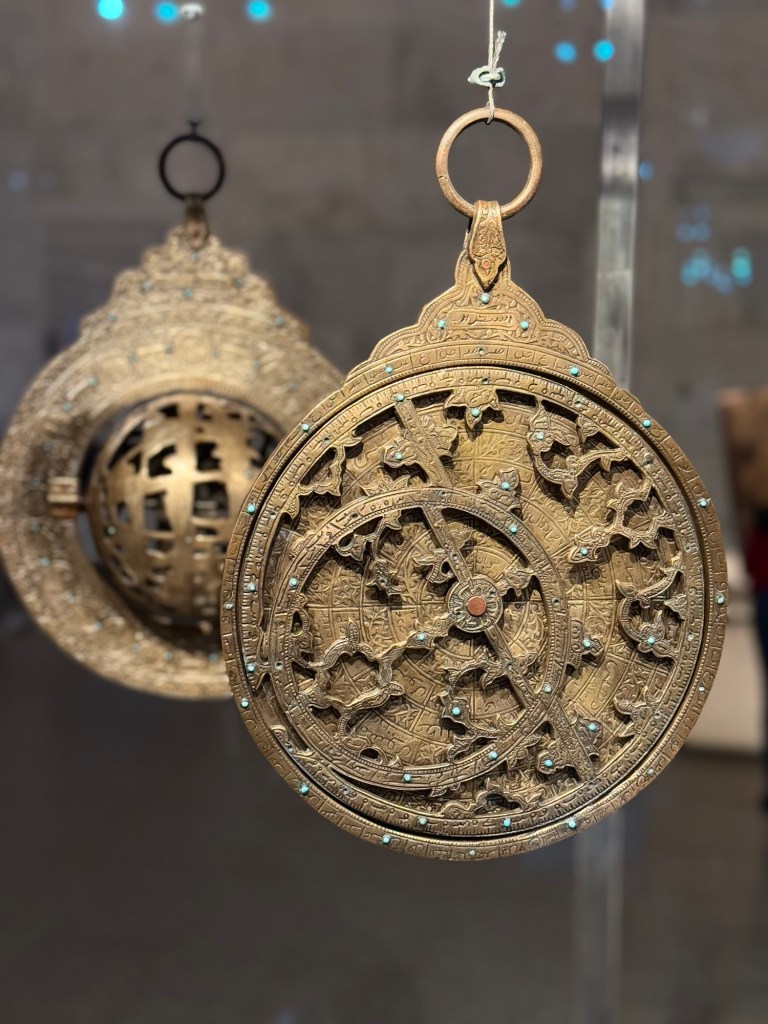
The main floor of the museum is wonderfully organized — it literally comes full circle, I might even say. It tells the story of Egyptian civilization as a continuous journey — from prehistoric stone tools to the rise and fall of ancient dynasties, its Greek and Roman periods, Islamic art, and Coptic icons. Egypt isn’t just Pharaonic — it’s layered. And NMEC does a brilliant job of reminding you of that.
Cairo Citadel
High above the city, where the haze (or smog) lifts just enough to catch your breath, the Cairo Citadel watches over everything like an old general who’s seen too many wars but still stands tall. Built in the 12th century by Saladin to keep out the Crusaders, it still holds its ground with grit and grace.
The climb up is steep — physically and historically. But once you’re inside, and 450 EGP lighter, the chaos of downtown Cairo fades. The air is a bit cooler, the pace slows, and for a moment, you’re suspended between centuries. Stone walls stretch in every direction, courtyards echo under your feet, and every tower carries that familiar scent of dust and diesel — the iconic Chanel No. 5 of Cairo.
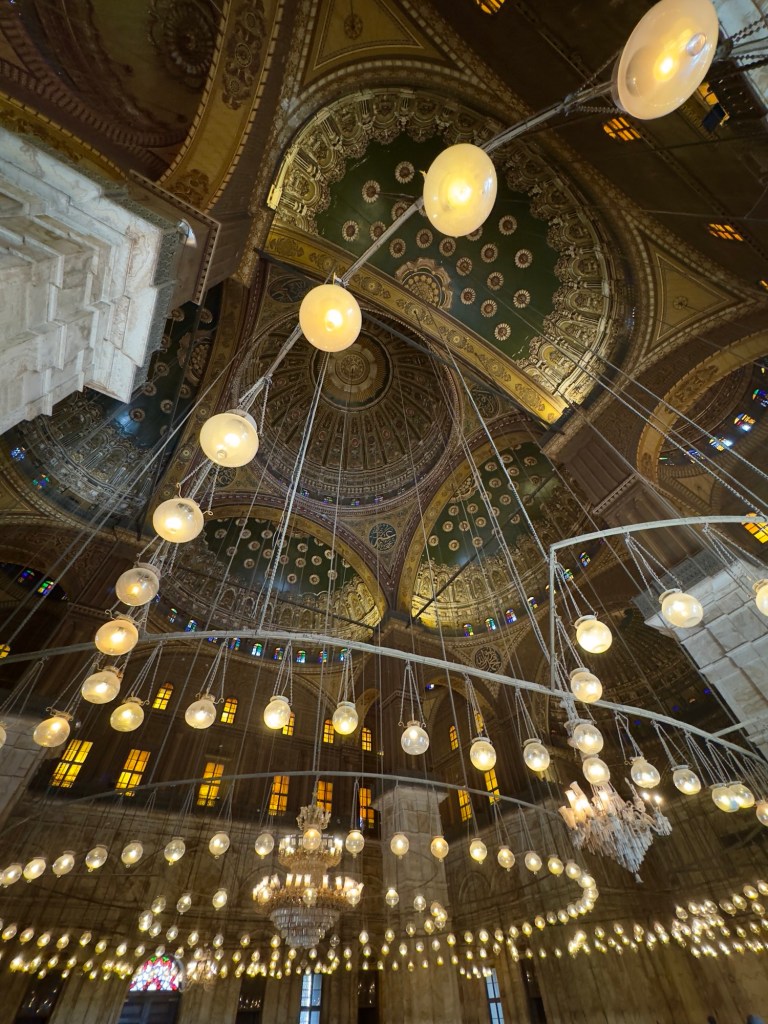
The centerpiece, of course, is the Mosque of Muhammad Ali. This isn’t just a mosque — it’s a power play in marble. Think: giant Ottoman domes, towering minarets, and interiors dripping in chandeliers and carved alabaster. It feels more like a palace for God than a place of prayer. Stand beneath that immense dome, and your voice comes back to you in ghostly whispers. It’s a space built to make we mortals feel small.
On the terrace, Cairo stretches below like a mirage made of stone and smog. You can see everything: the pyramids in the hazy west, the endless skyline of satellite dishes and minarets, and the pulse of a city that never, ever sleeps. It’s the kind of view that makes you shut up for a second and just look. Big plus is the number of kitten and puppies in the area too.
You don’t leave the Citadel refreshed. You leave it breathless (literally) . And slightly sunburned.
The OG Egyptian Museum
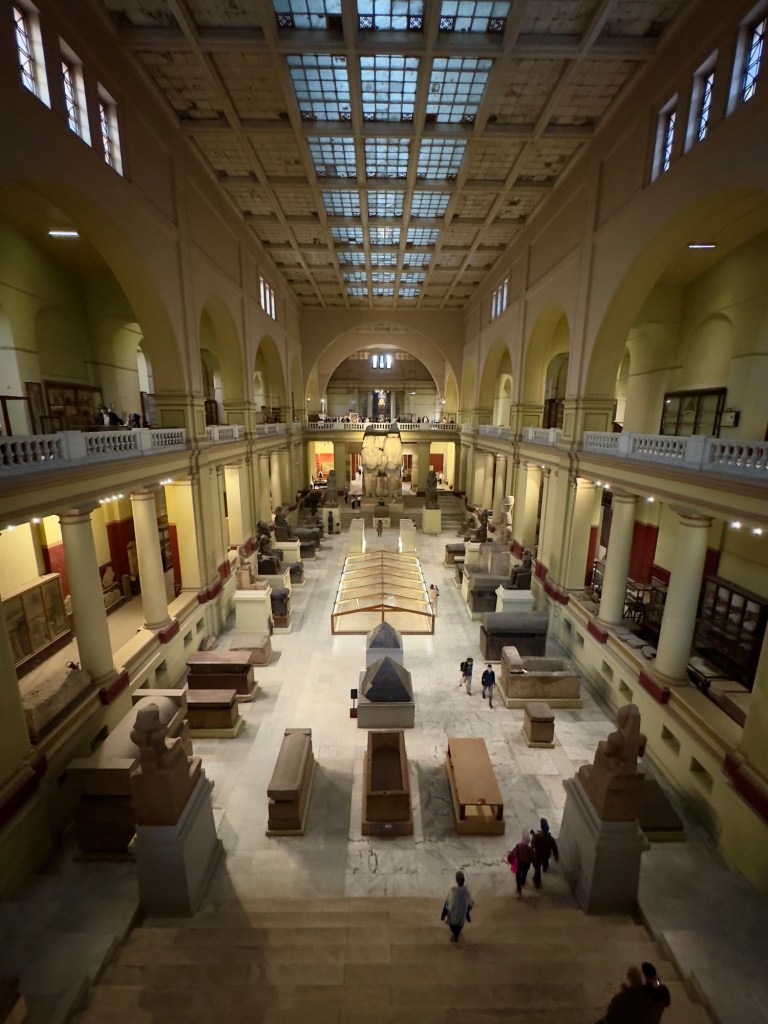
The Egyptian Museum in Tahrir is like a cabinet of curiosities — chipped, chaotic, and absolutely jam-packed.
It’s an old colonial relic with the vibe of a university archive — Tuition: 450 EGP — that somehow ended up housing some of the world’s greatest treasures. It smells like dust, papyrus, and powdered history. No fancy cases, no climate control — just open glass boxes filled with solid gold and enough ancient statuary to outfit a small kingdom
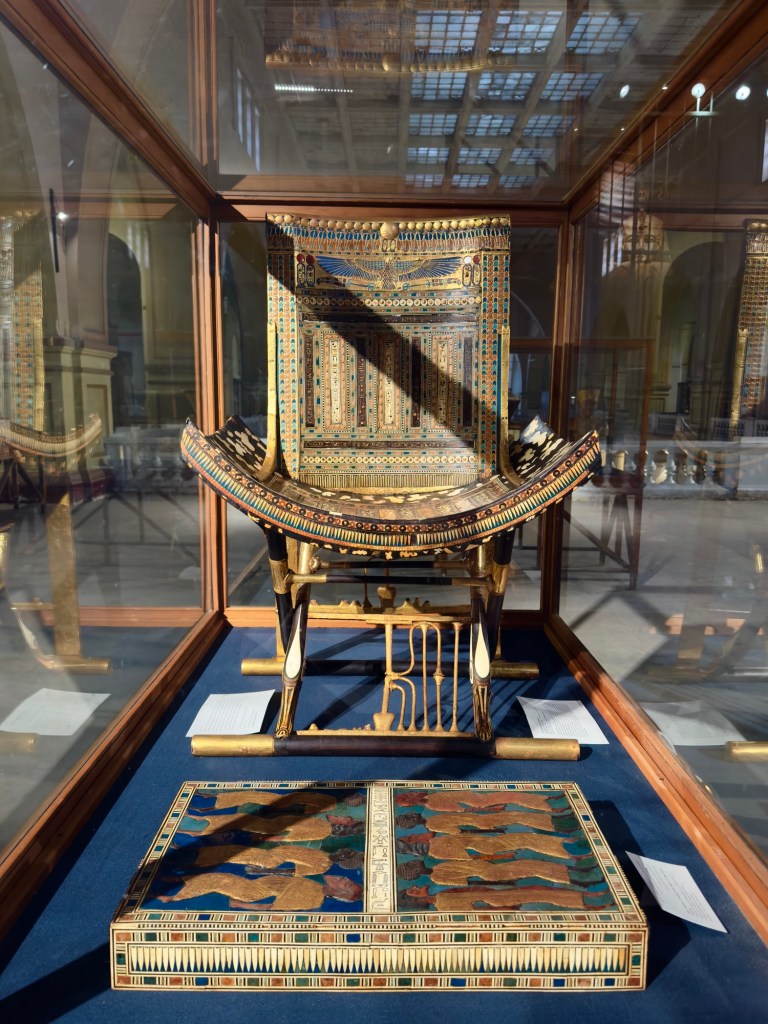
I came for Tutankhamun’s treasures before they’re permanently relocated to the Grand Egyptian Museum (GEM), and yes — they still take your breath away. That iconic golden mask? Smaller than you’d expect, but no less jaw-dropping. The craftsmanship, the detail, the luxury for a king who died barely out of puberty — it’s indulgence on a cosmic scale.
The room is also absolutely packed — personal space is not a thing here. But that doesn’t stop eagle-eyed security from snatching phones and cameras mid-air or peaking out from a sneaky pocket shot, screaming “NO PHOTO” at the top of their lungs or in your face. Yep, photography is prohibited in this room too. But there are some treasures outside the room that you can take photos of.
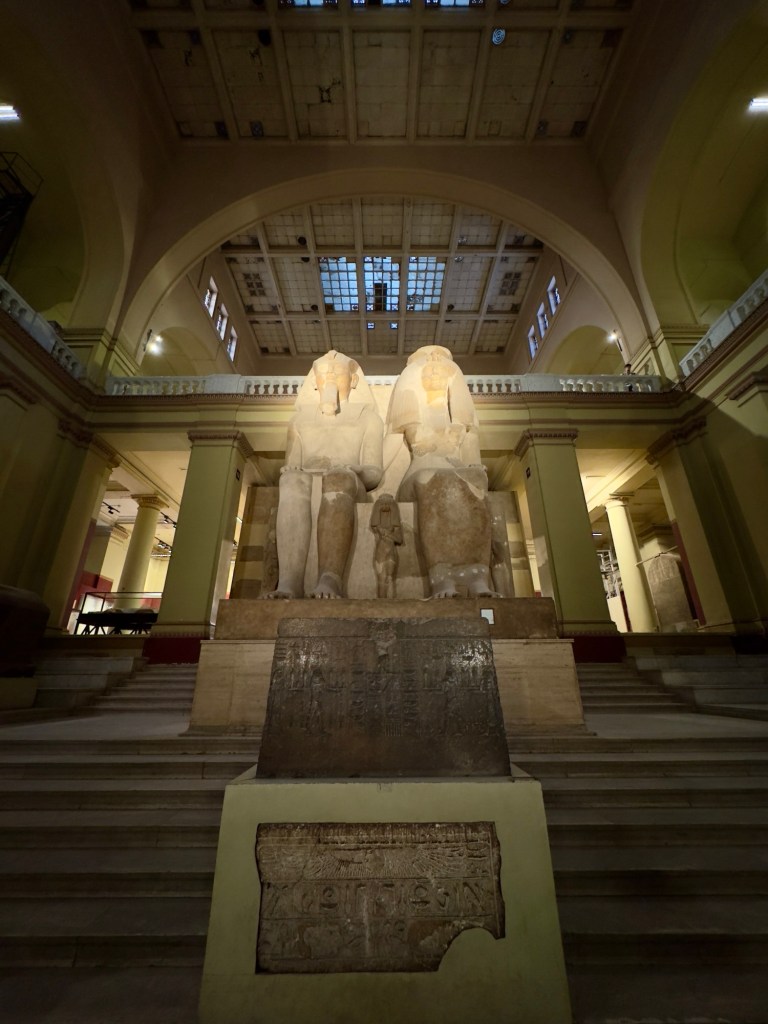
But honestly, the charm of this museum isn’t just in the blockbuster items. It’s in the way things are piled, sometimes literally, corner to corner — massive sarcophagi leaning casually next to dismembered statues. Every possible surface is stuffed with fragments of ancient history. You feel like you’ve stumbled into a pharaoh’s attic. I even overheard a guide admit that GEM was built because they’d literally run out of space here. And looking at it, I believe it.
Prince Mohamed Ali Palace
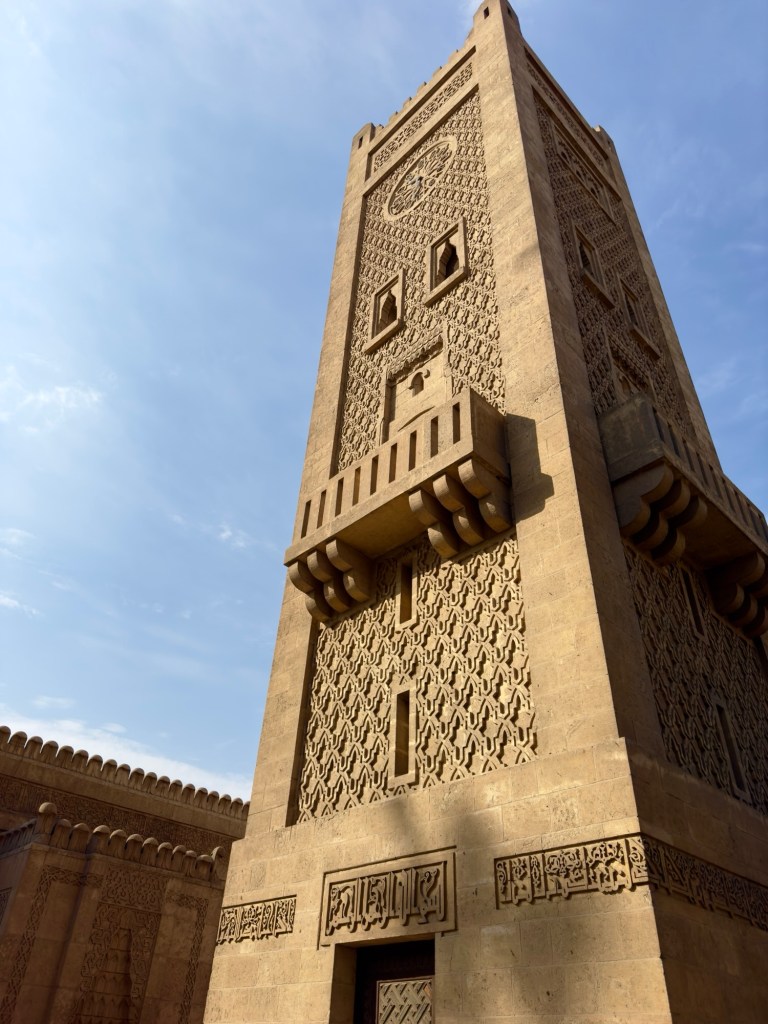
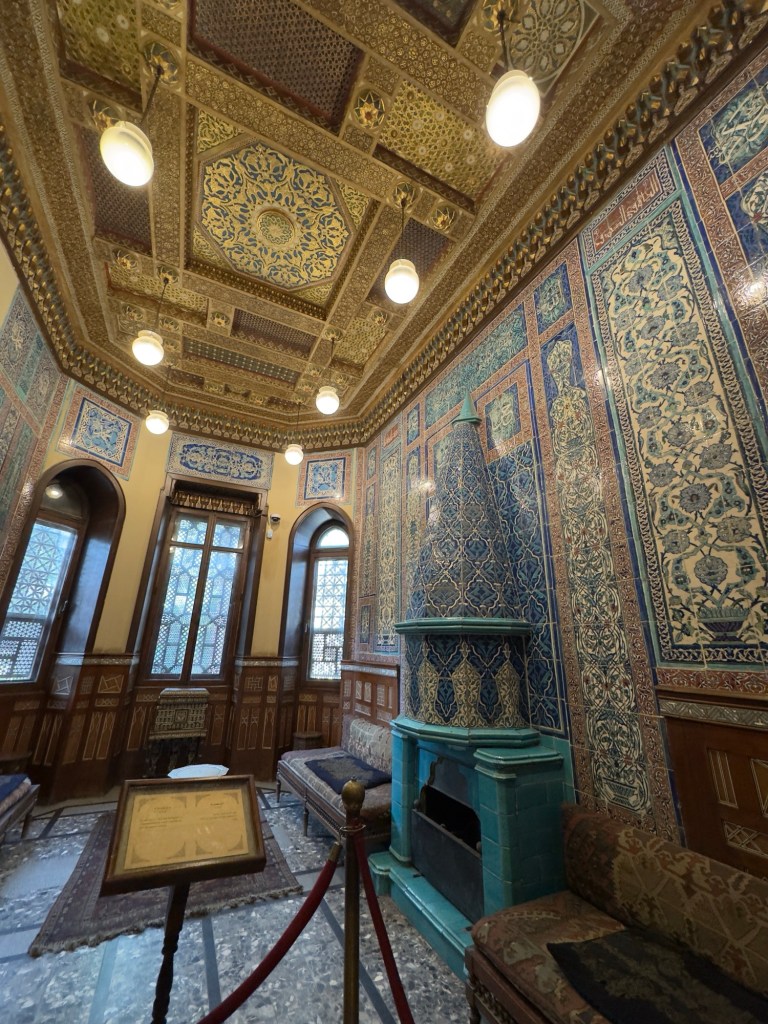
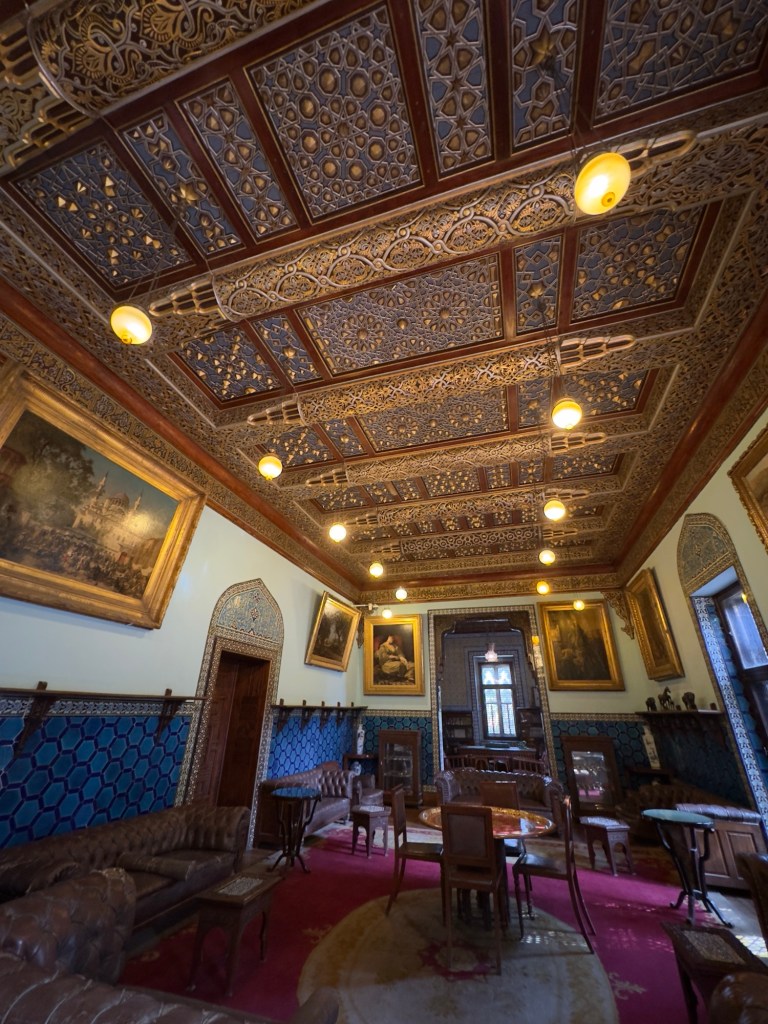
A bit off the main tourist grid is Prince Mohamed Ali Palace in Manial — and let me tell you, this place is an architectural fever dream.
The prince clearly said yes to everything. Moorish ceilings, Persian mosaics, Ottoman arches, Andalusian courtyards, Rococo flourishes — all somehow stitched together in the most flamboyantly harmonious way possible. Every room feels like it was designed by someone deeply in love with beauty itself.
There’s a softness here, a stillness, that makes it feel less like a royal residence and more like a waking dream. The private mosque is intimate and jewel-like, while the reception halls flirt shamelessly with excess.
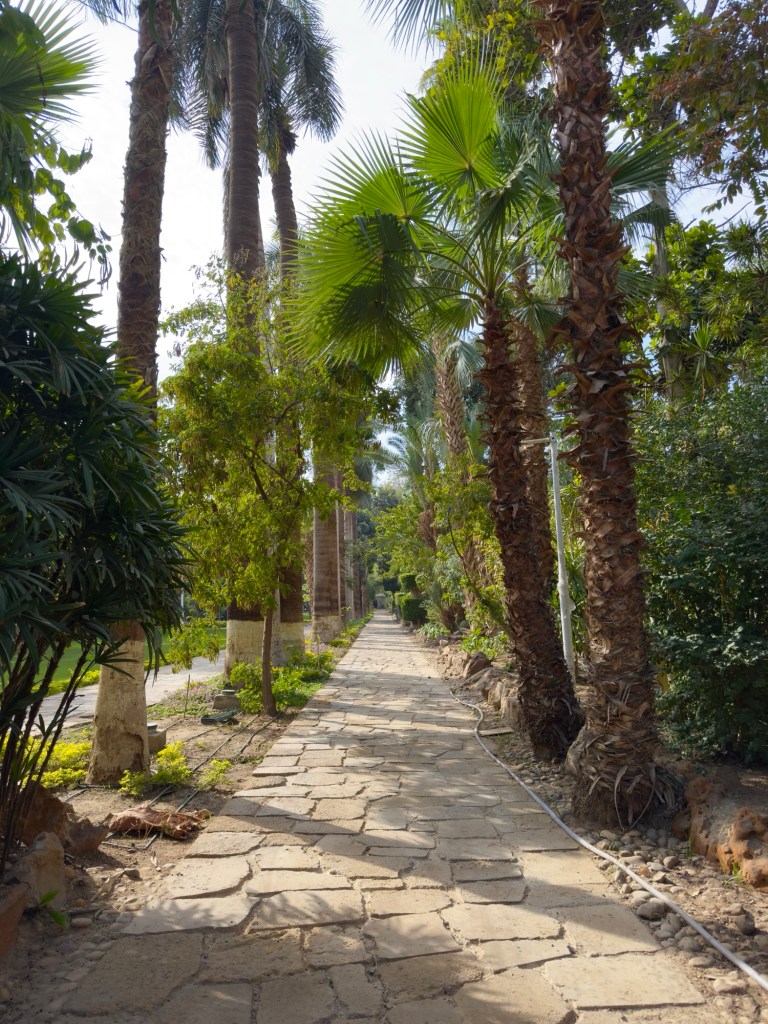
Compared to the grand, heavy weight of the Pharaonic sites, this was a breath of fresh tilework. A prince building his own lush green paradise on the Nile — less about power, more about poetic aestheticism.
Also, barely any crowds. A true Cairo rarity for only 180 EGP.
Grand Egyptian Museum
When I visited GEM, it was still in its pre-opening phase. While many main halls were open, I sadly missed the two major attractions: the complete Tutankhamun collection (to be displayed all together for the first time, only a few were on display in the Egyptian Museum in Tahrir), and the Solar Boat of Khufu, which was also relocated here. I’m still incredibly salty about it. But I guess that’s what future trips are for.
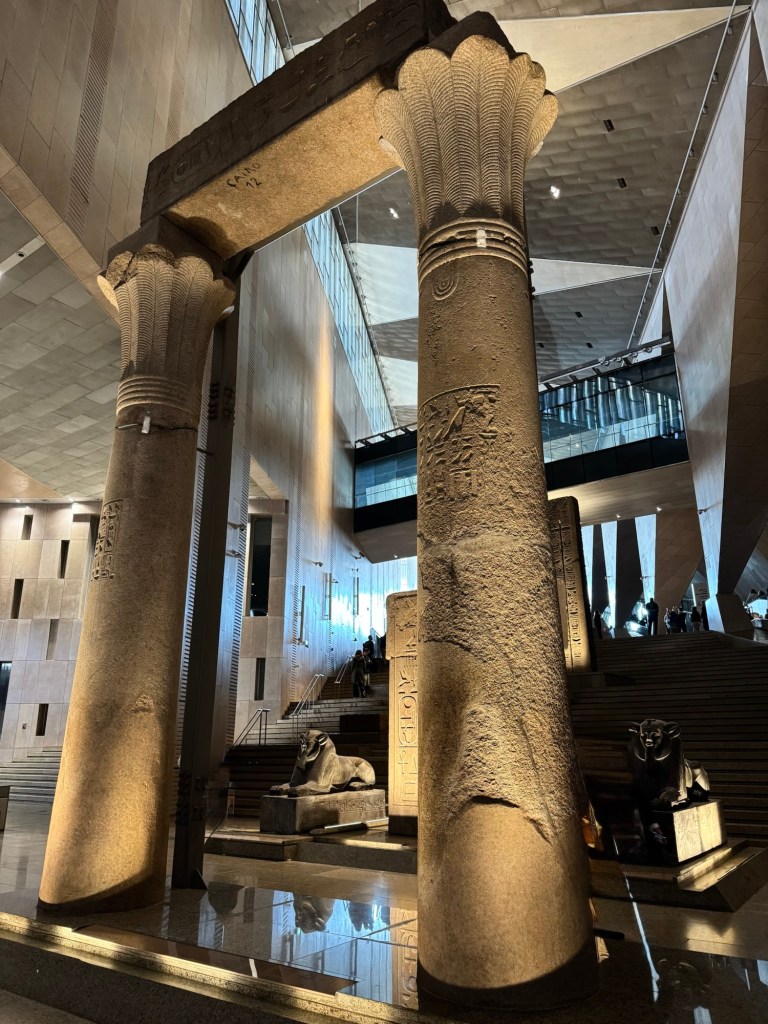
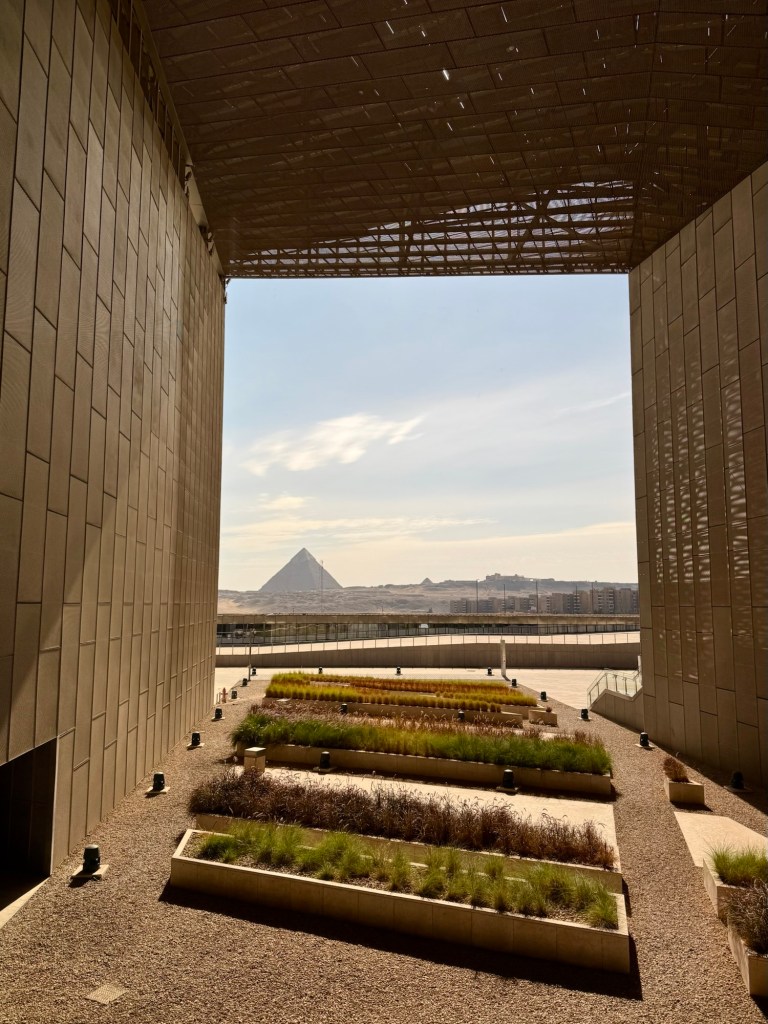
The museum itself is massive — it feels like it should have its own weather system. Positioned within sight of the pyramids, GEM is built to be the final word in Egyptology. Not just a museum, but a statement. A very expensive, $1 billion statement. And a hefty 1270 EGP entry ticket.
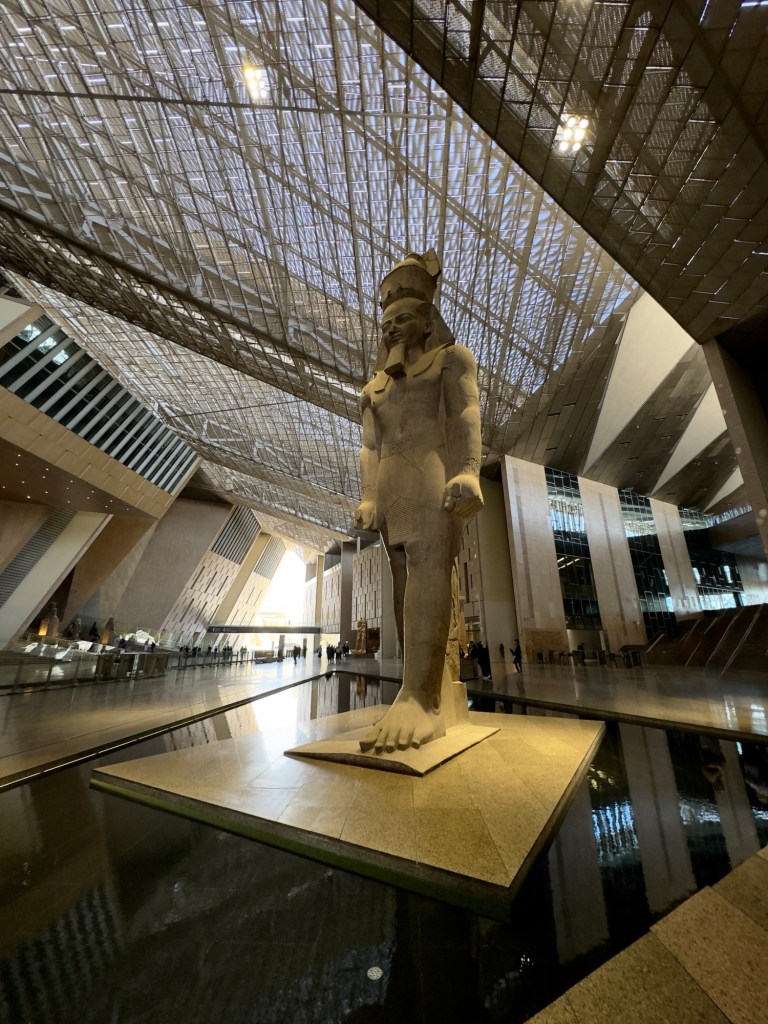
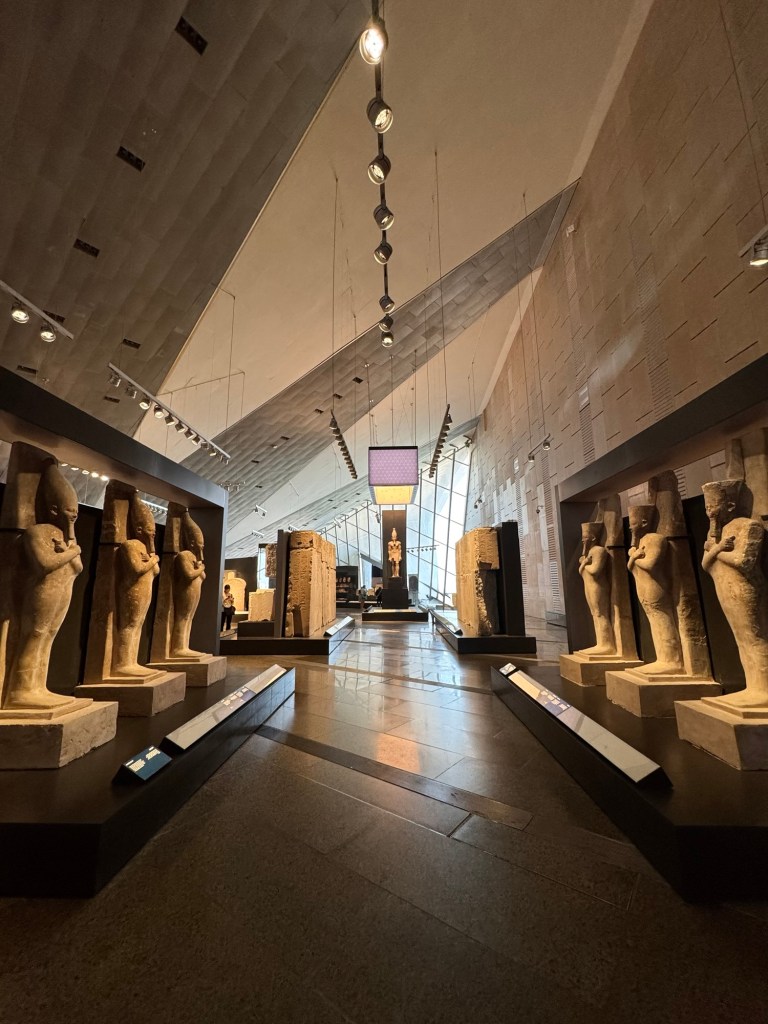
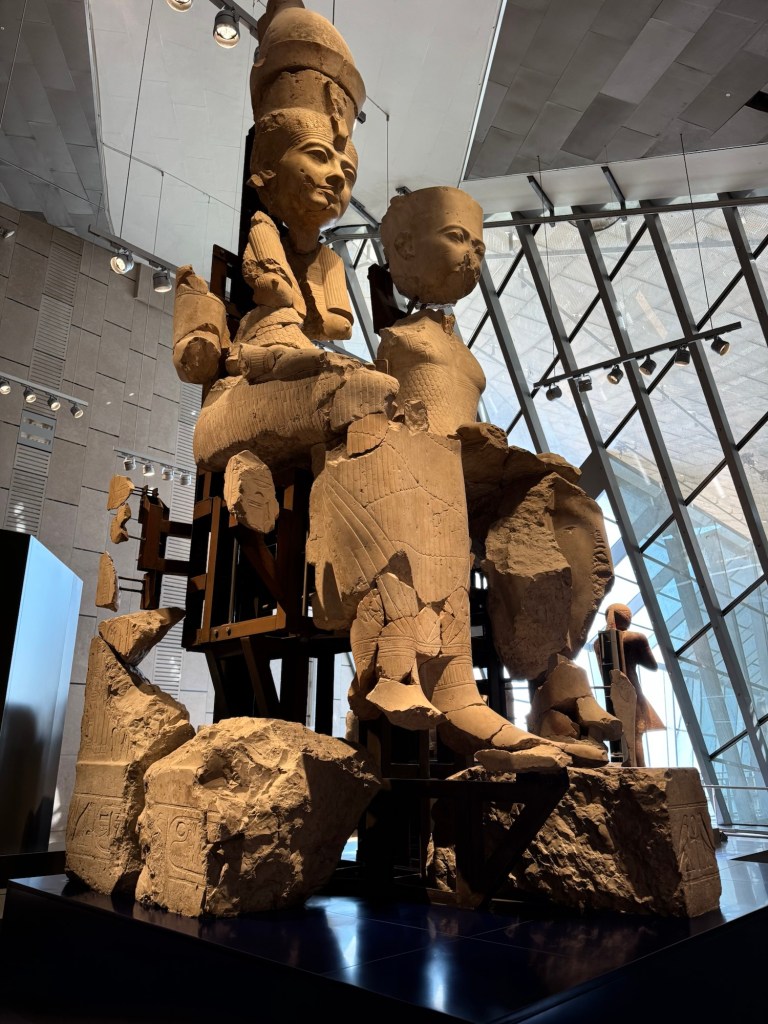
Walk in and the first thing you see is the colossal statue of Ramses II — the same one that used to stand in Ramses Square like a traffic cone for the gods. Now, it stands tall in a space that finally does it justice. And the main galleries are impeccably organized chronologically, from Prehistoric to the Greco-Roman period, and thematically, delving into society, kingship and beliefs.
What the Louvre is to France, GEM is meant to be for Egypt: not just a showcase of what was, but a symbol of what’s to come. It’s ambitious, modern, and long overdue.
It’s fairly easy to buy Grand Egyptian Museum tickets online, through their official website. Sometimes this website has glitches or issues, though, so you can always buy tickets in-person at the ticket office (with a Visa or Mastercard only – cash a no no).
Sensory Overload
Cairo can be overwhelming for first-time visitors — it definitely was for me. It’s a sensory assault, a whirlwind of emotions, and every pitstop on my itinerary felt like a breath of fresh air from the chaos of the city. But it was nothing — and everything — I imagined it to be.
Next stop? Let’s just say… the shadow of the pyramids is starting to feel a little closer.
Ahhhh, the Temple of Hathor — if there’s any temple that feels like it stepped straight out of a Tomb Raider fantasy (and then some), this is it. Crawling into crypts through holes in the walls, climbing the ritualistic steps of ancient priests, encountering strange, futuristic hieroglyphs, and being watched by many, many feline guardians… if there’s one reason I’d brave the EgyptAir fiasco again, this would be high on the list.
Located in Dendera, about 60 km from Luxor, the Temple of Hathor is the main temple of the Dendera Temple Complex. Hathor, goddess of love, beauty, music, fertility, and motherhood, had this as her principal cult center.
Construction began in the late Ptolemaic period under Ptolemy XII (Cleopatra’s father) and continued under Roman emperors like Augustus and Tiberius.
Tickets are available online for 300 EGP, but I’d again recommend buying them in person — you can’t purchase the Dendera panorama and crypts tickets online. They’re 100 EGP each and very much worth it.
Upon arrival, you’ll walk through what was once a garden in the open forecourt (or pronaos) just in front of the temple. It served as a transitional space between the outer world and the sacred interior. Archaeological evidence suggests that sacred trees — possibly sycamores or date palms — were once present here, both being sacred to Hathor.
It was also one of the first times I saw actual greenery still growing at a site like this. It genuinely brings life back into the space.
The Ceiling That Holds the Stars
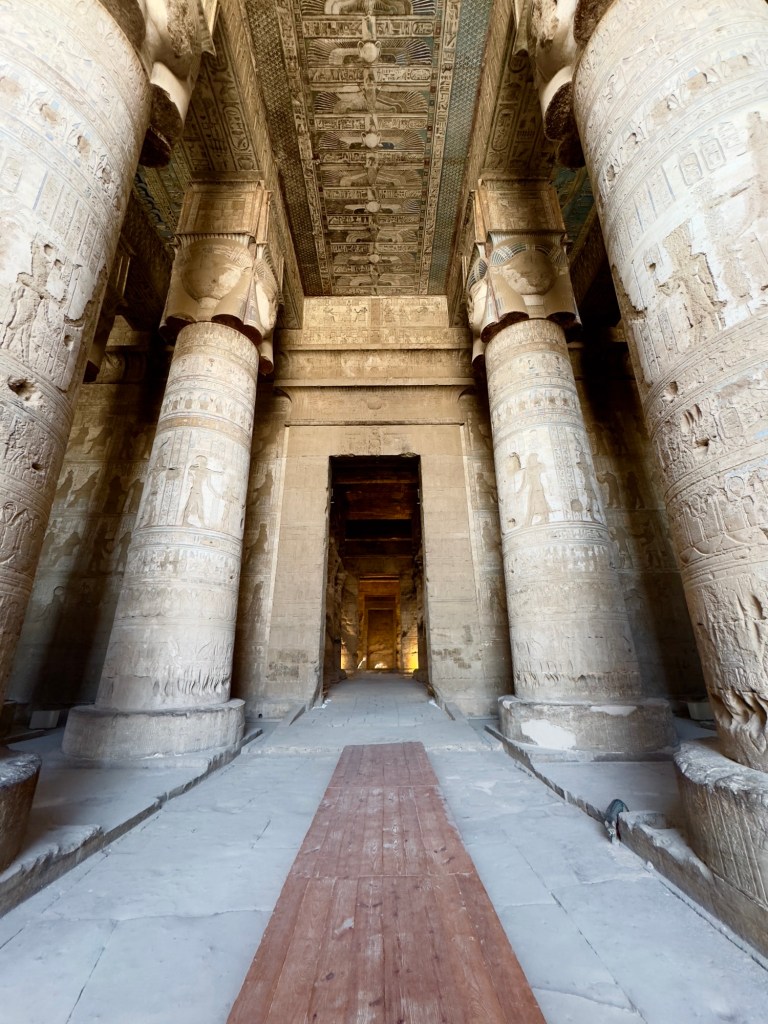
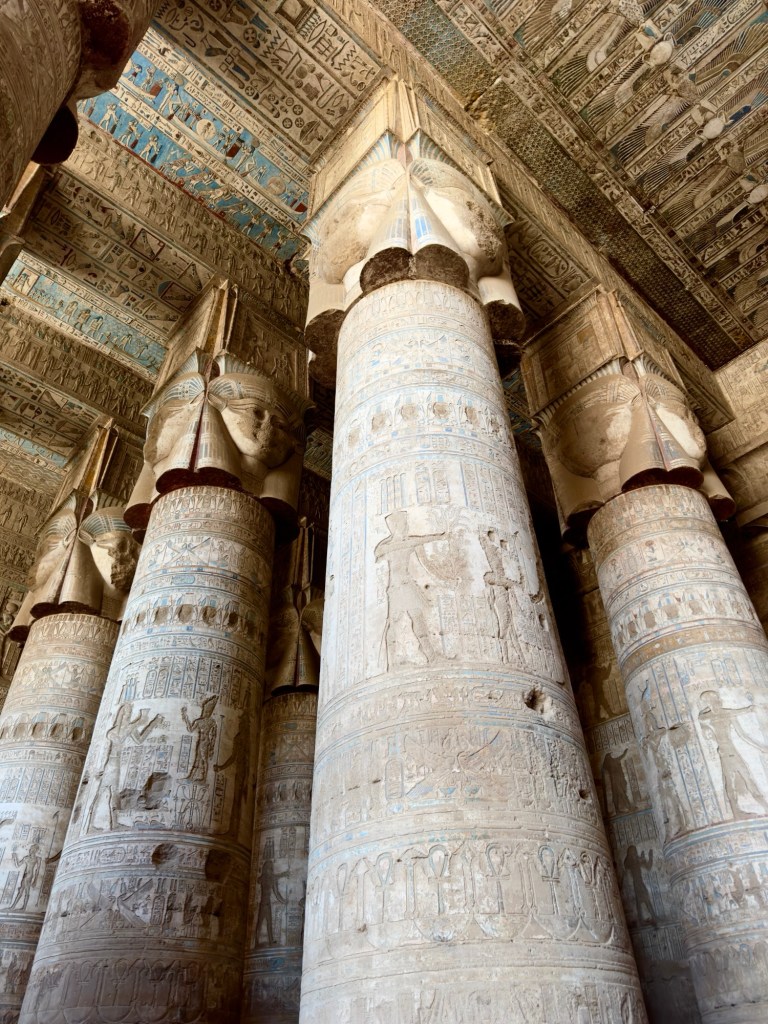
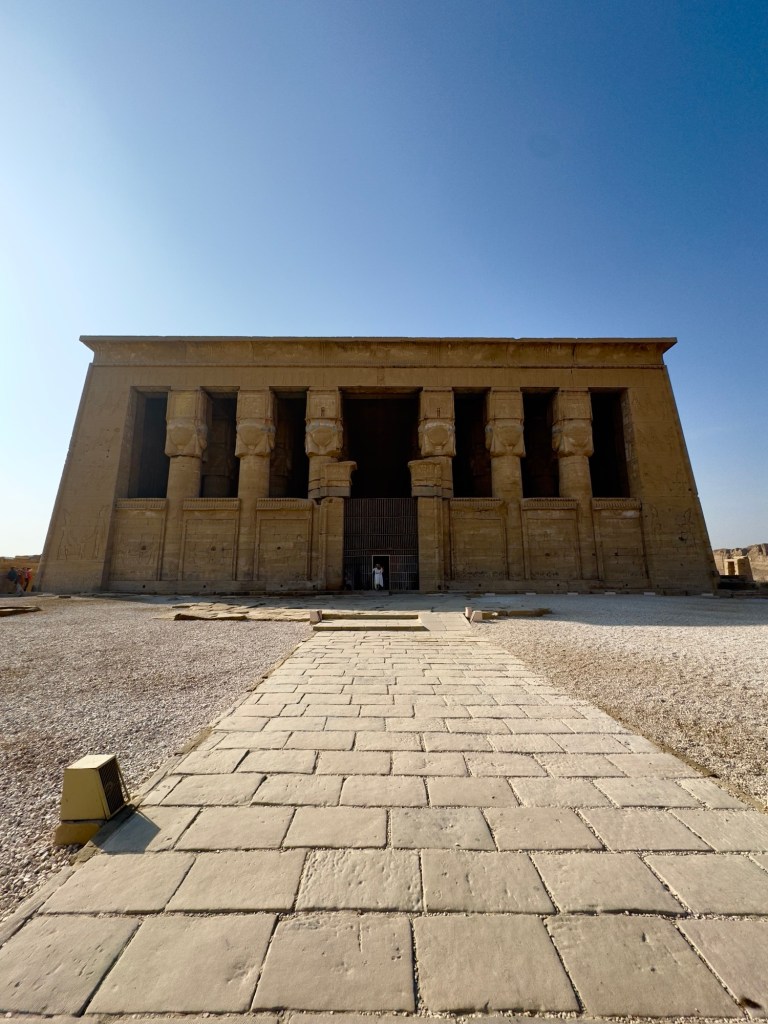
As you enter the massive hypostyle hall, each 24 ornate columns is topped with a capital featuring the face of Hathor, you’d naturally look up onto the famous decorated ceiling with the astronomical scenes carved upon its surfaces, including a zodiac—a rare example of Greco-Roman and Egyptian fusion in art and cosmology.
I went accompanied this time, with as you guessed it, my guide booked with GYG, and he gave me some wonderful insight about the zodiacs in the hall.
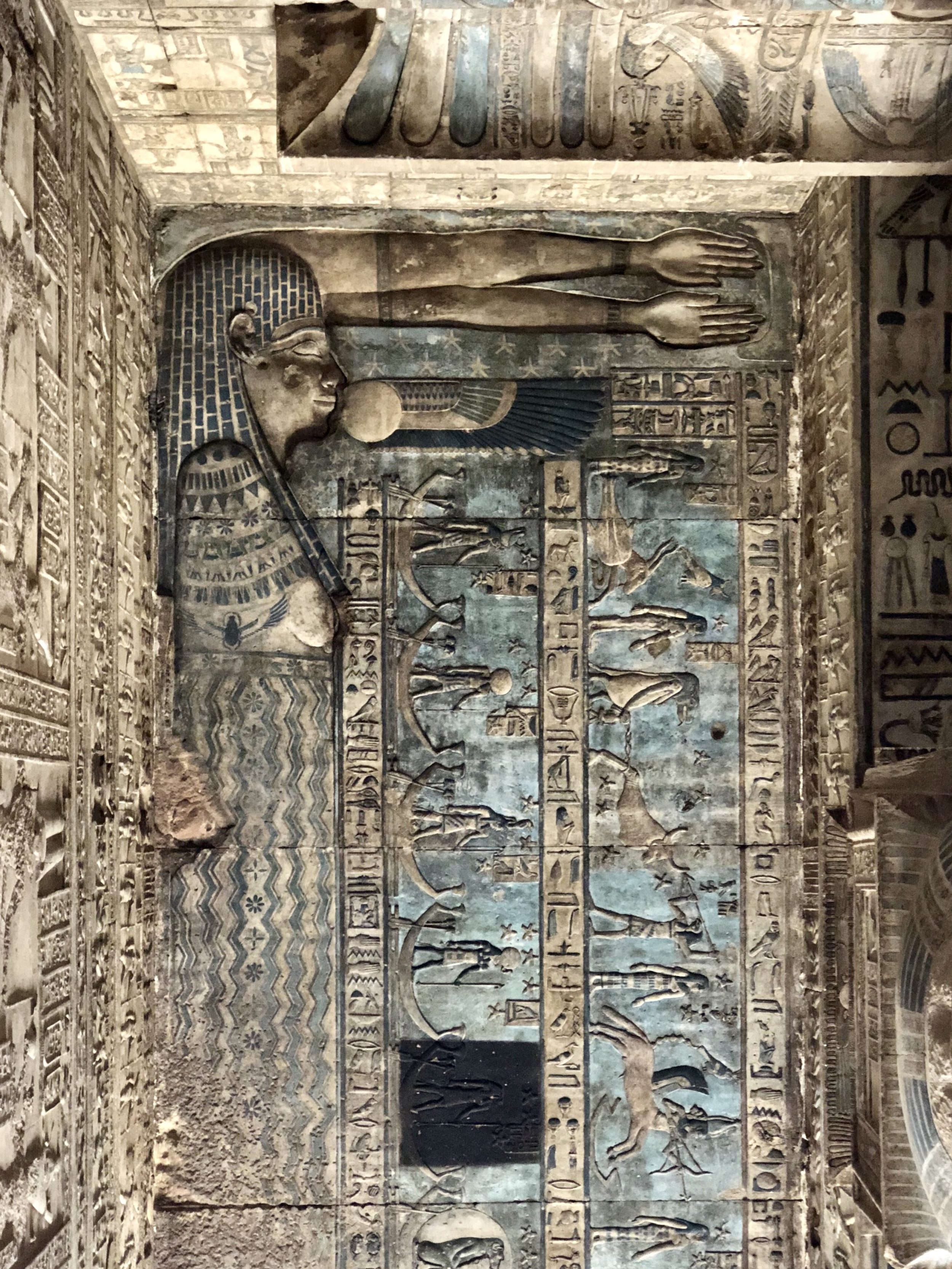
The ceiling is divided into seven long registers, each filled with intricately painted scenes that map the heavens, depict the solar cycle, and convey complex mythological cosmology. It’s one of the few ancient Egyptian ceilings to retain so much original color — vibrant, surreal, almost dreamlike.
The ceiling features star charts, planets, and constellations portrayed as gods in boats or animals, aligned with Egyptian beliefs. After much squinting and a mini quiz from my guide, I finally spotted my zodiac. You’d think two fishes would be easier to spot, ainnit?
There are a couple of routes to explore the temple from the main hall, but my guide immediately steered us toward the crypts — with a trail of temple cats following our steps — giving me a quick rundown of what was to come.
Into the Crypts We Go
There are around 12 known crypts or treasure caches at Dendera, though only two or three are open to the public. These tight, narrow chambers were originally accessible only to priests, designed to store sacred items like ritual instruments, cult statues, precious metals, and astrological devices — none of which survive today. My guide suggests they were likely “legally looted” and repurposed for ritual use elsewhere.
During my visit, only two crypts were open. And yes, I wasn’t joking — you’ll be crawling into literal holes in the walls. One crypt entrance is perched high up a wall, while the other begins as a small hole in the ground, followed by a second one and a short, steep staircase. Prepare to get on your hands and knees, dusty and squeeze a bit.
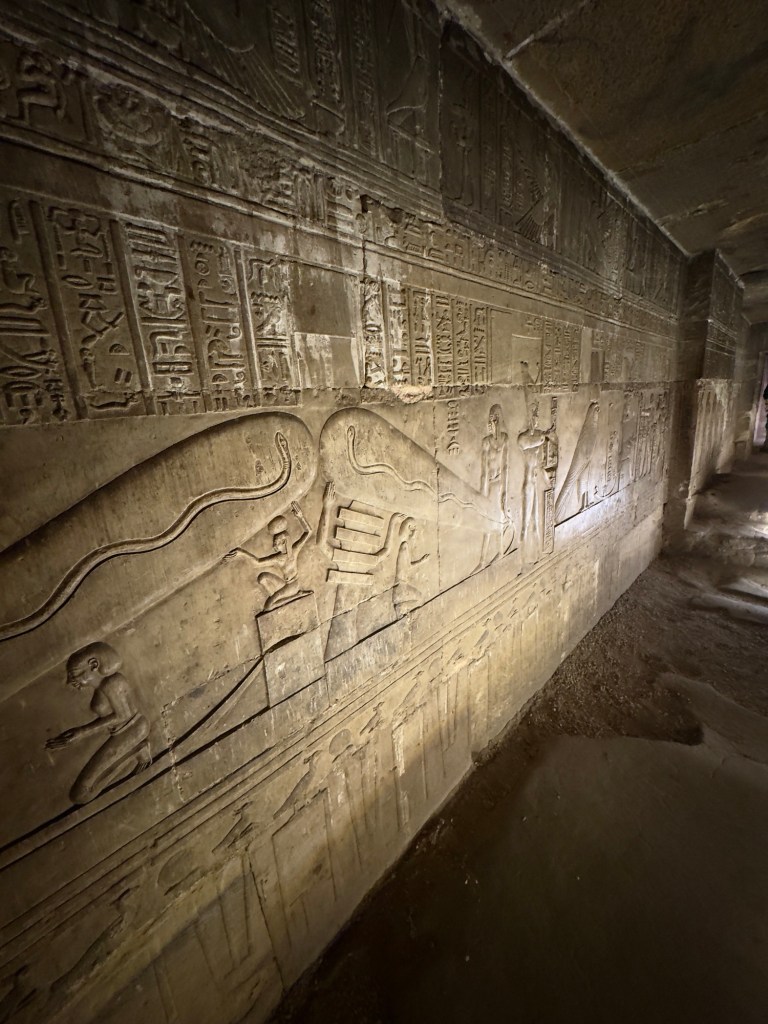
The most famous is the so-called “Dendera Light” crypt — named after a stone relief that resembles a light bulb. Egyptologists (and my guide) interpret it symbolically: Harsomtus (a form of Horus), in the form of a snake, emerging from a lotus flower.
The second crypt? Honestly, I remember little of what my guide said about it. He mentioned something about a procession, and that it was a recently reopened chamber, so there’s scarce info online. But it did scare the bejeezus out of me — crawling through a shaft only to be met with the faded stare of an ancient goddess is a jump-scare I didn’t expect.
Crypts done and literally dusted, we ascended to the roof chapels. Here’s how you know you have a great guide — I was so engrossed, I forgot to take photos. I still beat myself up over it. But let me paint a picture… or you could just Google “Melted Stairs Dendera.”
Sacred Ascent and Decent
Two staircases sit on opposite sides of the temple, built in a spiral (or helical?) pattern. One was for ascending to the roof chapels, the other for descent — designed to mirror ceremonial processions. The “melted” one (ascending) has a gentler incline, allowing priests to carry Hathor’s cult statue during festivals like New Year’s.
As always, nothing is without symbolism. The rising staircase represents the sun’s ascent and rebirth; the descending staircase symbolizes its descent into the underworld. Echoes of Nut’s myth — swallowing and birthing the sun — mirror this duality. East vs. West. Life vs. death. Earth vs. sky. Oxygen vs. my diminishing leg strength.
Balance and duality — cornerstones of Egyptian cosmology.
The walls of the ascending staircase are beautifully carved with reliefs of priests, musicians, and standard bearers in procession, giving us rare insight into ancient ritual movement and ceremony, and also really immerses you into the experience, as if you are reliving the procession of the priests themselves.
At Dendera, this is one of the rare instances where access to the roof is granted to visitors, with a ticket of course, and there you can find the Roof Chapel, during key festivals, the statue of Hathor would be taken from the inner sanctuary and processed up one staircase, where she could be symbolically reunited with the sun god at said Roof Chapel.
Most importantly, the Zodiac Room is up here.
The Zodiac Debacle
The original Dendera Zodiac, a bas-relief ceiling panel, was carved in the 1st century BCE during Ptolemy XII’s reign. It shows a celestial map: the 12 Greco-Roman zodiac signs, Egyptian gods as planets, Nut, solar boats, and lunar cycles, all arranged in a circular rotation around the celestial north pole.
This is where the real drama is, and boi do i love some drama.
I first saw the original Zodiac in the Louvre years ago. Naturally, I came to see the “other side of the story.” as naturally the narrative that was at the Louvre, well, is typical of for most items that were ‘collected’.
In 1820–1821, French engineer Jean-Baptiste Lelorrain, under the patronage of Sebastián Louis Saulnier, oversaw the extraction of the Zodiac ceiling from the rooftop chapel of the Temple of Hathor. The Zodiac was cut out of the sandstone ceiling using saws and explosives — a highly invasive method that left visible scars on the original site, that you can actually see on site.
The removed artifact was shipped to France and ‘acquired’ by King Louis XVIII, who donated it to the Louvre Museum, where it sits in a secluded corner on display in Room 325 of the Sully Building. But here’s a link to their online archive.
Needless to say, Egypt wasn’t pleased. The act was viewed even then by some as controversial, especially by Egyptian scholars and early nationalists who considered it a theft. And in recent decades, Egypt has made formal and informal calls for the return of the Dendera Zodiac as part of its broader campaign to reclaim key antiquities held abroad, along with the Rosetta Stone from the British Museum, and the Bust of Nefertiti from the Neues Museum, Berlin.
France, like many European institutions, maintains that these artifacts were legally acquired under the laws of the time and is preserved and displayed responsibly.
Only time will tell if Egypt will get these artifacts back.
Personal opinion? Ethically, yeah they should go back. It belongs to Egypt — it’s their cultural legacy. Realistically? I’m torn. The disparity in funding and preservation standards makes me question whether repatriation is always the best route.
I shan’t elaborate further as this could end up a very long conversation, but if you’d like to know about more about my thoughts, let me know in the comments below, otherwise, let’s get back on topic.
Back on the rooftop in the Zodiac room, where this very same heated conversation took place between me and my guide, we descended the western stairs to the rear of the temple.
Cleopatra and Caesarion
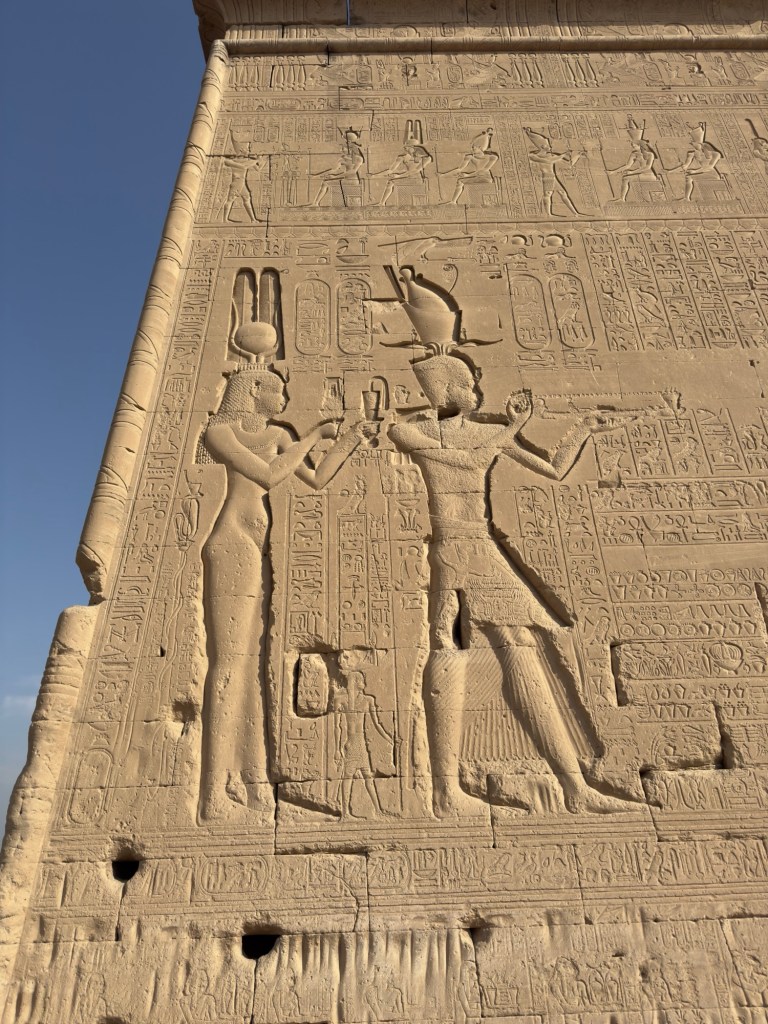
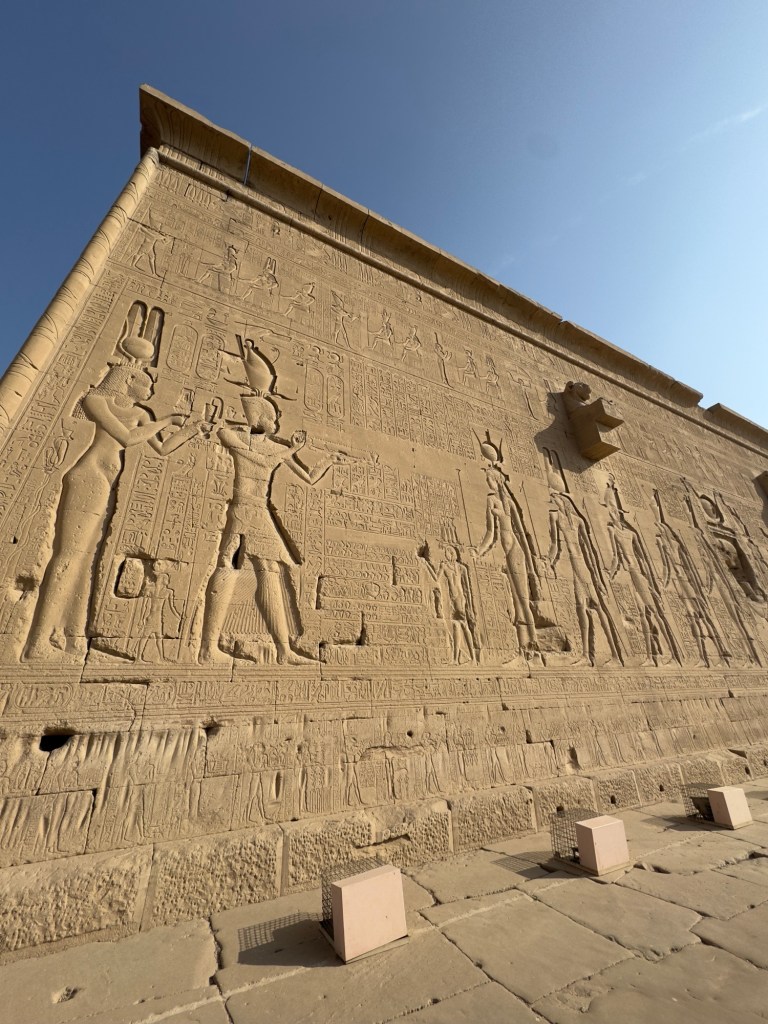
On the rear wall of the temple, this is where the best-preserved depiction of Cleopatra and Caesarion still remains, showing them making offerings to the gods. This remains the clearest visual confirmation of her reign as pharaoh in the traditional Egyptian style, and is one of the most remarkable and rare full depictions of the queen in an Egyptian temple.
This is significant as it is the only known temple relief showing Cleopatra and Caesarion together in such traditional style. It is one of the last monumental representations before Egypt fell to Rome following Cleopatra’s death.
It stands as a testament to Cleopatra’s political genius: adept at speaking to multiple audiences, Egyptian priests, Roman leaders, and her own people through sacred art and architecture. By associating herself with the goddess Hathor, Cleopatra was aligning her rule with a powerful mother-goddess figure: nurturing, regal, and cosmic. The inclusion of Caesarion in the same scene was politically potent, It emphasized her dynastic legitimacy as a descendant of the Ptolemies.
It visually declared Caesarion as heir to both Julius Caesar and the Egyptian throne. But alas, we all know how that story came to an end.
For us, however, the story continues — next stop: The Temple of Seti I at Abydos.
From Hathor to Osiris
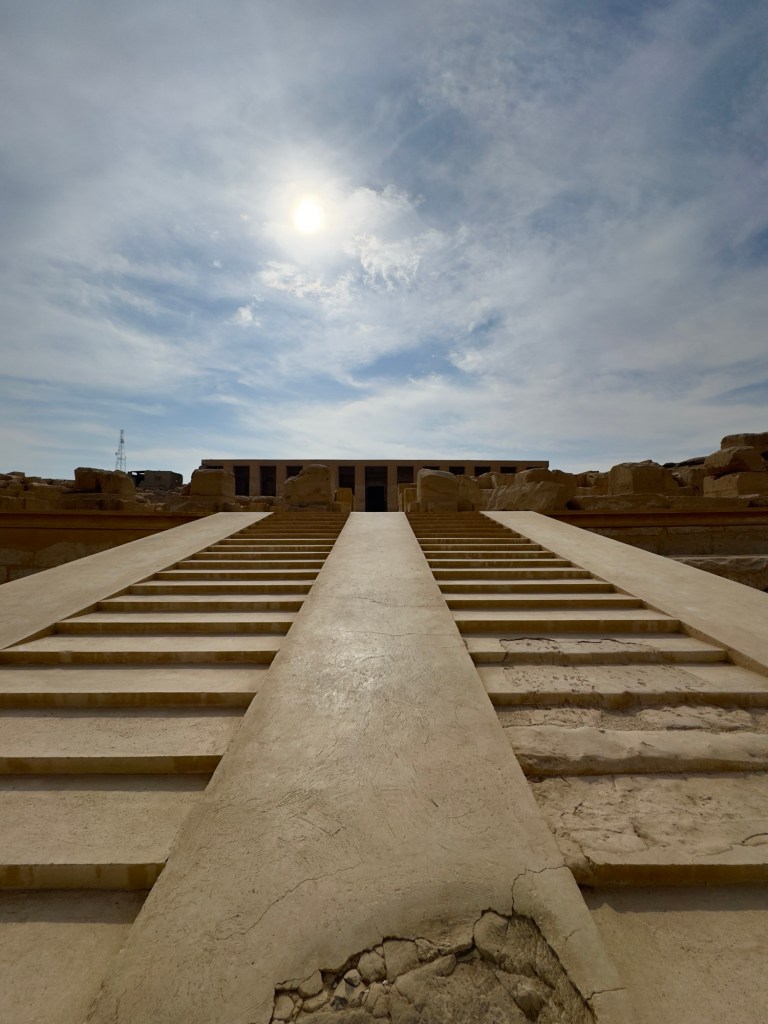
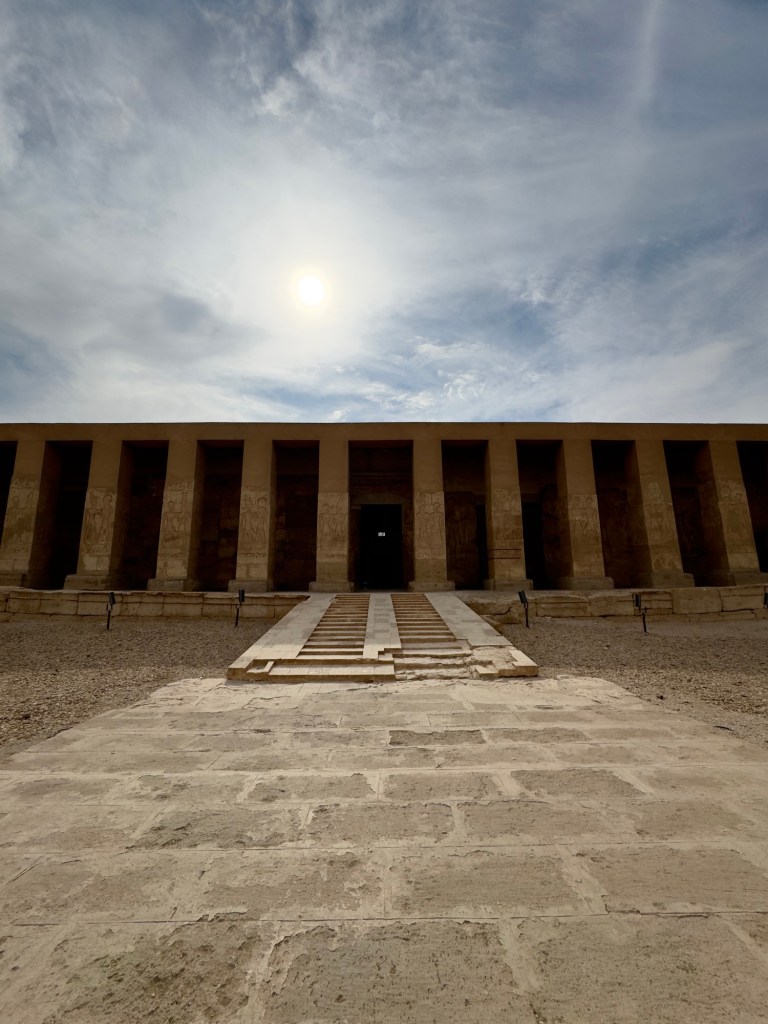
Located in Abydos, the Temple of Seti I was dedicated primarily to Osiris, the god of the afterlife, and was intended as a sacred center for funerary worship, divine kingship, and eternal remembrance.
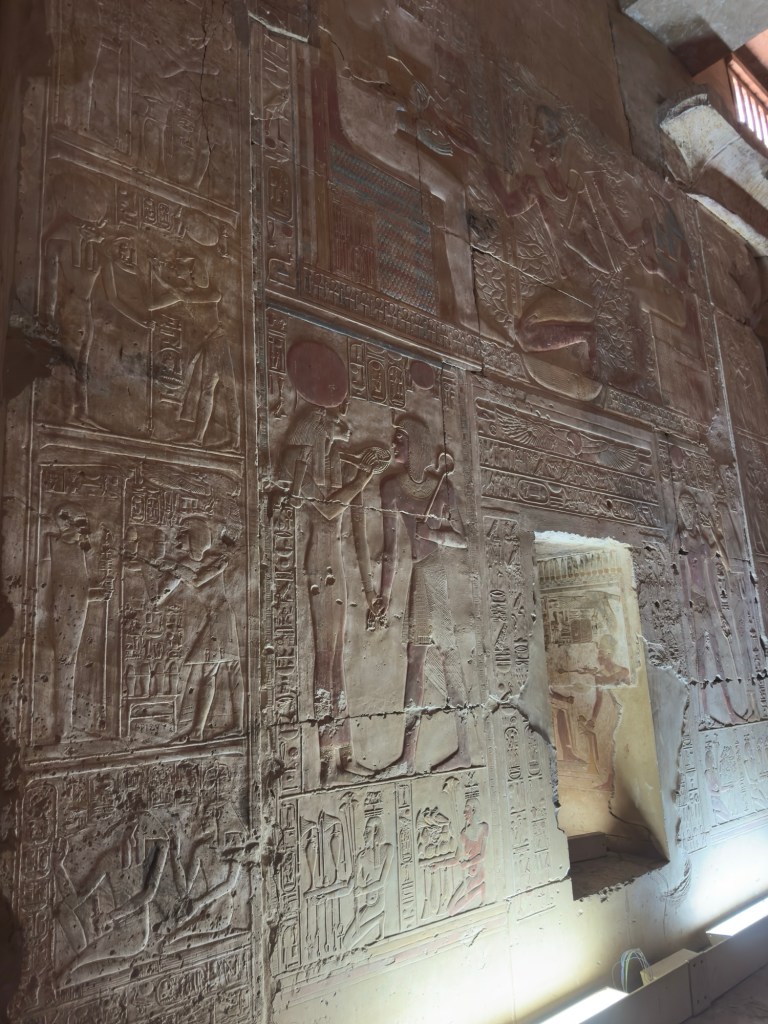
But what’s unique about this temple is that while it is dedicated primarily to Osiris, it contains seven shrines, each dedicated to a major deity: Osiris, Isis, Horus, Amun, Re-Horakhty, Ptah, and Seti I himself. The temple’s design is unique as well with its unusual L-shaped layout.
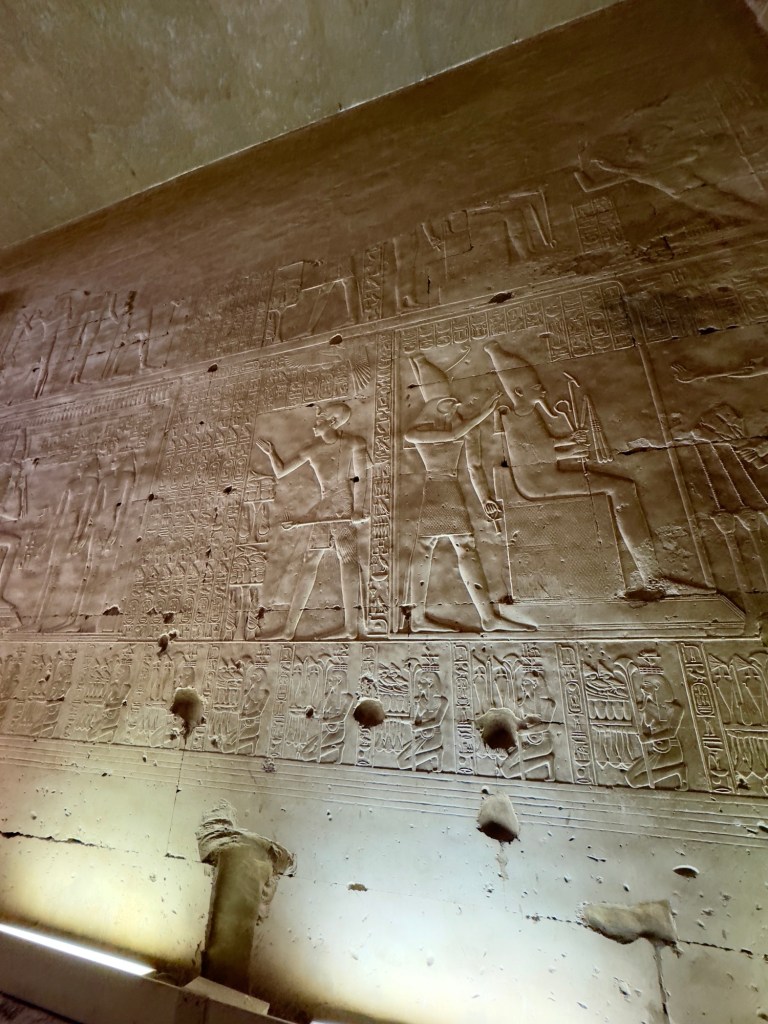
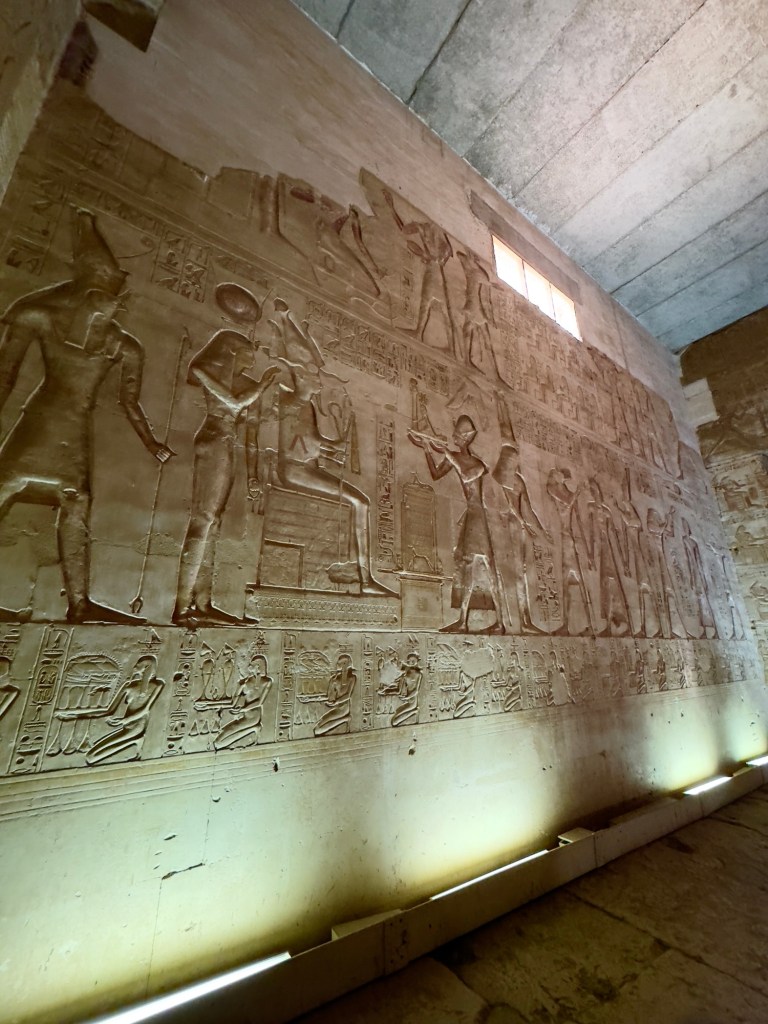
The reliefs inside are some of the most exquisite in all of Egypt, deeply carved and finely detailed, showcasing the peak of New Kingdom craftsmanship. The dimensionality is astonishing: individual plaits in garments, the translucent quality of fabric, and the almost 3D placement of ceremonial implements are unlike anything I’ve seen in other temples.
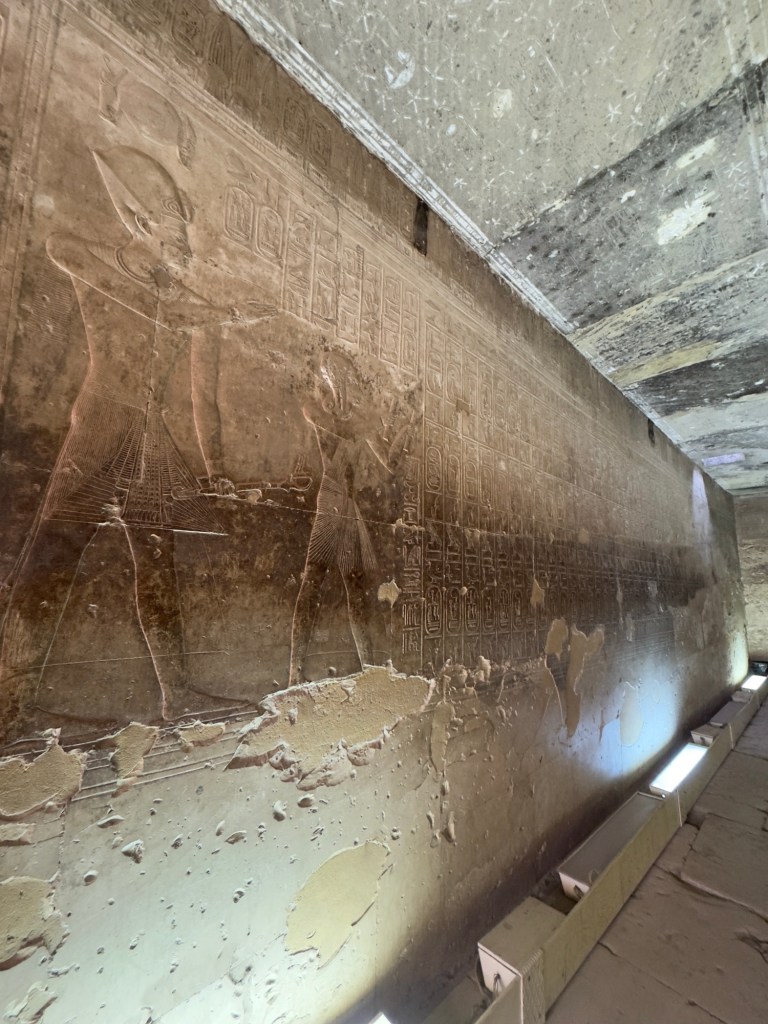
The temple also houses the Abydos King List, a chronological list of 76 pharaohs from Narmer to Seti I, a goldmine for Egyptologists — and a hotbed for controversy.
A Tale in Reliefs
Built during the reign of Seti I and completed by his son Ramesses II, the temple was a pilgrimage site for ancient Egyptians seeking closeness to Osiris. And because it was completed by two kings, you can see the artistic differences particularly in the first and second hypostyle hall.
Seti I’s reliefs at Abydos are among the most beautifully executed in all of Egypt. Figures are finely proportioned, naturalistic, and softly modeled with elegant lines and subtle expressions. Reliefs in Seti’s portion of the temple — especially in the seven chapels and first hypostyle hall — show exceptional detail, symmetry, and precision. Even the inscriptions are neatly rendered and consistent.
Ramesses II’s additions — particularly in the outer courtyards and second hypostyle hall — display a heavier hand. Figures are more rigid, muscular, and square, with less subtle modeling. While still religious in nature, Ramesses’ scenes shift toward royal glorification, including larger-than-life depictions of the pharaoh smiting enemies, dominating ritual scenes, and asserting his divine legitimacy.
This contrast between Seti I and Ramesses II offers a rare look at evolving royal priorities:
Seti focused on religious legacy and sacred beauty.
Ramesses focused on monumental legacy and royal propaganda.
The fact that both styles coexist in the same temple makes Abydos a living textbook of artistic and ideological evolution within a single dynasty.
Secret Rites and Silent Chambers
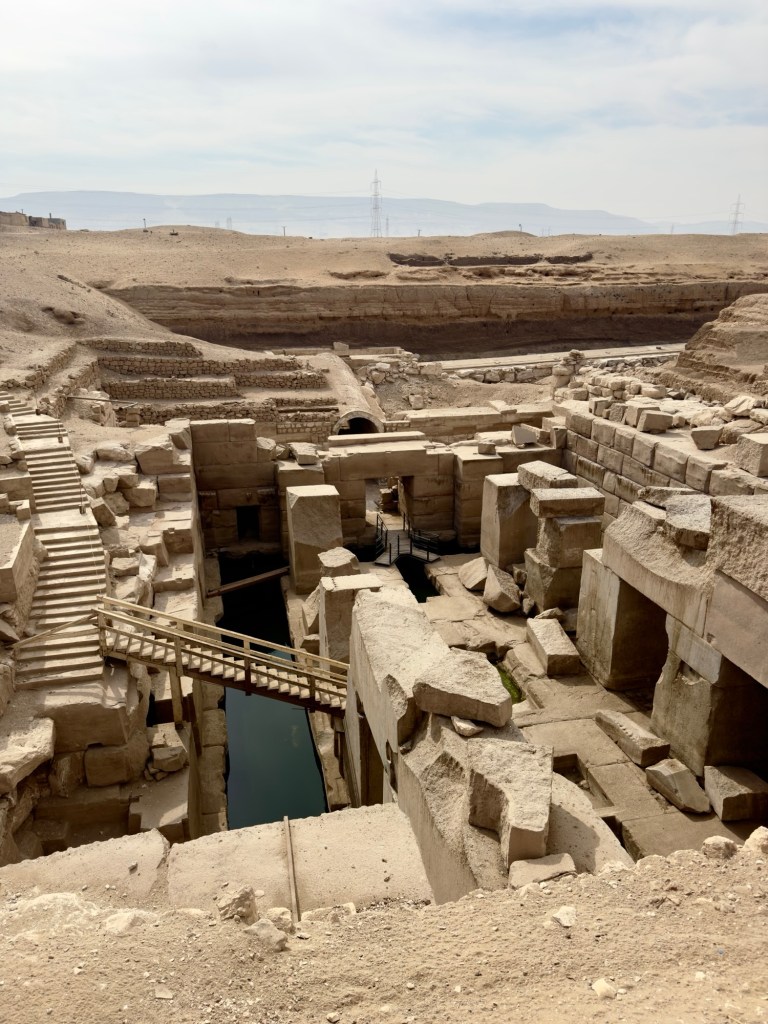
Abydos was also believed to be Osiris’ mythic burial site, making it incredibly sacred. Behind the temple lies the Osireion, a symbolic tomb to Osiris with massive granite blocks and a central island-like sarcophagus chamber.
It represents the mound of creation emerging from the primordial waters of chaos — Nun. Rituals of rebirth likely took place here. My guide even claims that on rare occasions, he’s seen modern-day Osirian priests performing rites nearby.
Access is not granted to the public… officially. But, as my guide cryptically said, “everything can be done — for the right price.”
King List Debacle
Now, about that King List…
Carved in two horizontal rows, it starts with Narmer and ends with Ramesses I. Seti and Ramesses are shown offering to their predecessors. It’s a rare native chronology — most others come from Greek historians like Manetho.
So why the controversy?
Several pharaohs were deliberately excluded, particularly those considered heretical, illegitimate, or politically inconvenient, such as Hatshepsut (a female pharaoh), Akhenaten (the “heretic” king who introduced monotheism), Smenkhkare, Tutankhamun, and Ay — all linked to the Amarna Period and its religious reforms.
This deliberate omission reflects a politically curated version of history, aimed at erasing rulers who were seen as ‘threats’ to Ma’at (cosmic order), legitimizing Seti I’s rule by aligning him with a sanitized, idealized lineage.
So yes, even Hatshepsut — successful, wise, female — got booted.
What better example of: “History is written by the victors.”
Forgotten Temples, Unforgettable Stories
All in all, the Temple of Hathor in Dendera and Temple of Seti I in Abydos are two absolutely essential day-trip destinations from either Luxor or Cairo. Both are severely underrated, yet bursting with historical depth and cultural insight.
With the sun setting, it was time to move on to my next destination: Cairo — where something massive awaits in the shadows.
Move along Kings, now its the Queens time to shine, and into the Valley of the Queens we go.
Although only three or four tombs are currently open to visitors, the Valley of the Queens contains at least 75 tombs belonging to queens of the 19th and 20th Dynasties, as well as other royal family members, including princesses and Ramesside princes. The most famous is the Tomb of Nefertari, and the others include those of Titi, Khaemwaset, and Amunherkhepshef.
Nefertari’s tomb is often called the “Sistine Chapel of ancient Egypt” for its vibrant, detailed artwork, and it was meant to be one of the highlights of my trip. Until I found out it was closed.
This is where I get a little miffed about the lack of clear, up-to-date information when planning trips to places where such info isn’t exactly so readily available. So, consider this a bit of a PSA too.
The Tomb of Nefertari is like Seti I’s tomb in the Valley of the Kings: expensive, expansive, impressive, and frequently closed. It’s not included in the Valley of the Queens general ticket (which covers the other three tombs) and requires a separate 2000 EGP ticket—for just 10 minutes inside.
It’s said to be one of the best-preserved historical sites in all of Egypt. Though relatively small—only three accessible chambers—the paintings are so pristine, they look like they were just finished. I was genuinely excited to see it.
At the time of my visit (January 2025), it was marked “Temporarily Closed” on Google Maps that morning, and when I arrived, the caretakers confirmed it had shut down just three days prior for urgent restoration. And honestly, I completely understand and appreciate how quickly they act at even the slightest signs of deterioration—even if it did rain a little on my parade.
What I don’t appreciate, though, is the black hole of information surrounding these closures. As I write this (April 2025), I’ve been periodically checking Google Maps, forums, and every other possible channel for updates over the past four months. And let me tell you—the closure schedule is as spontaneous as it gets. Right now? “Temporarily Closed” again. Five days ago? “Open during usual hours.”
Moral of the story? Be flexible i guess. As much as you’re on holiday and have your heart set on certain sites, things happen. At least you know they’re doing what’s best for the preservation of these incredible monuments.
So rather than simmering in disappointment, i moved onto the Mortuary Temple of Hatshepsut, and the word ‘impressive’ doesn’t even begin to cover it.
Legacy Etched In Stone
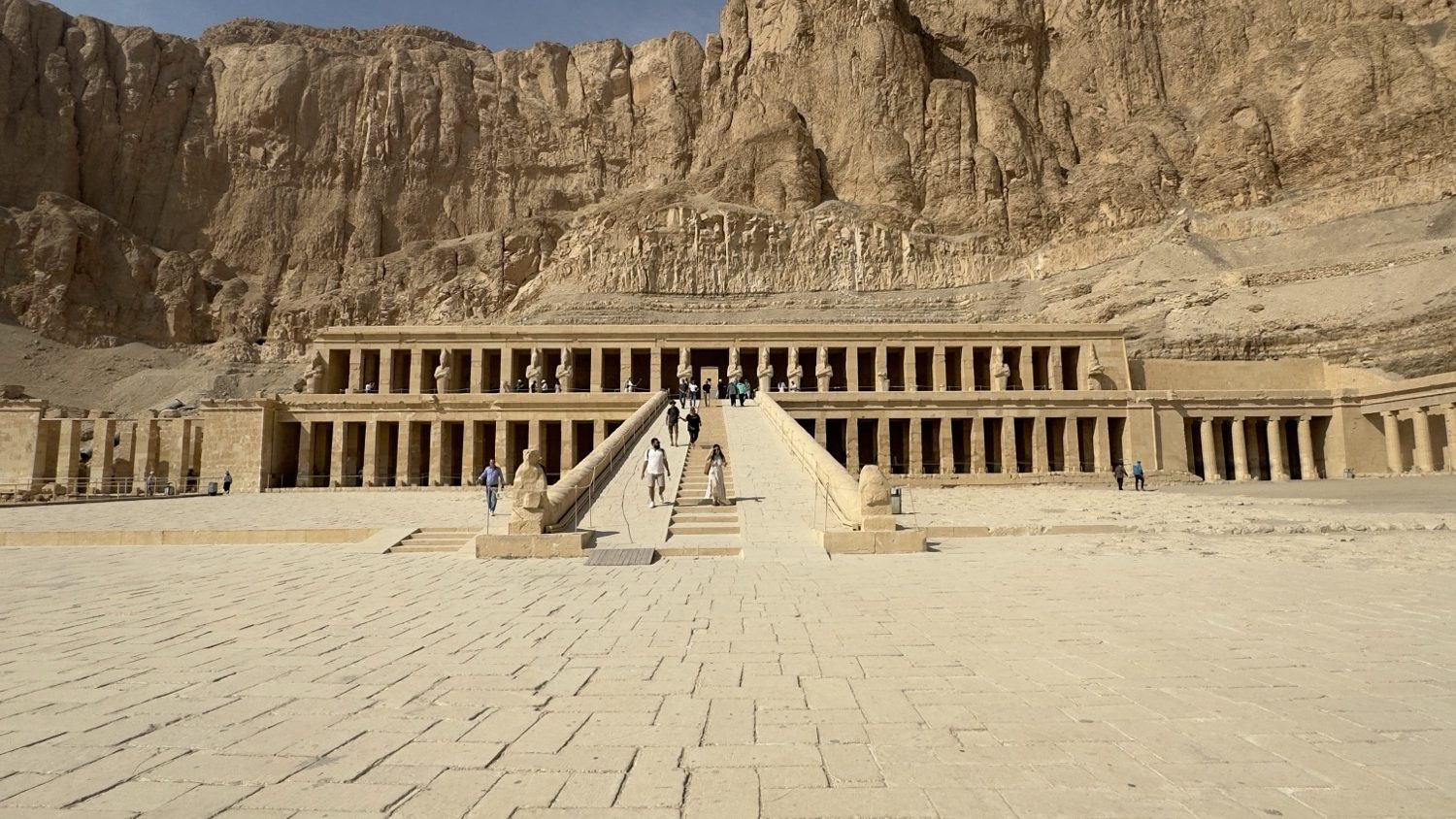
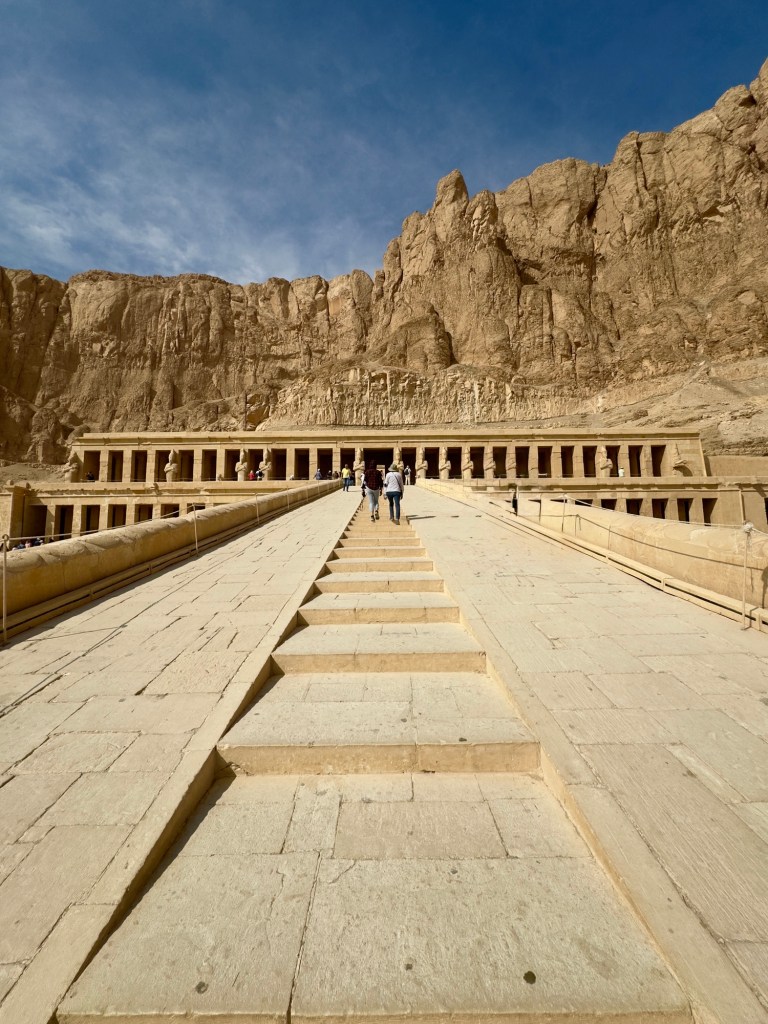
From the ticket office, you can already catch a slight glimpse of its grandeur in the distance, as rising up almost 30m from the desert floor, the Temple of Hatshepsut, also called Djeser-Djeseru (“Holy of Holies”), is one of ancient Egypt’s greatest architectural masterpieces. Commissioned by Queen Hatshepsut, Egypt’s most successful and my personal favorite female pharaoh, the tomb was designed by her royal architect Senmut.
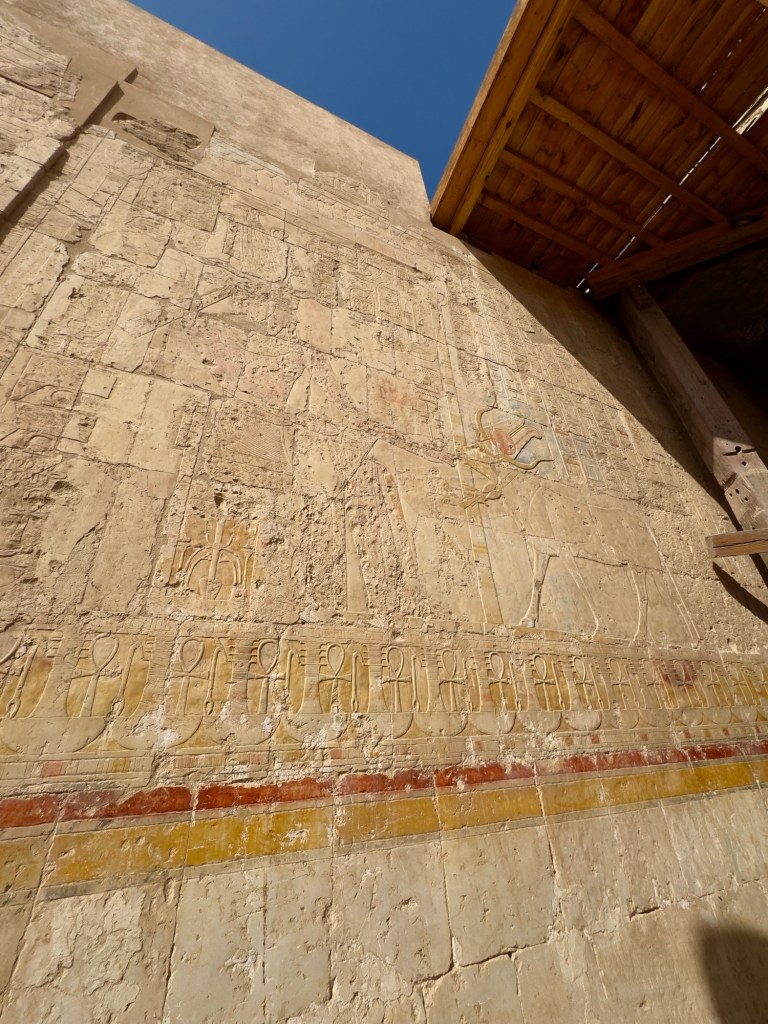
The temple is famous for its stunning, modern-looking design—three colossal terraces rising directly against a backdrop of towering limestone cliffs, almost as if it were carved straight of the rock cliffs themselves. And as with many monuments in Egypt, it wasn’t spared from the usual historical vandalism: Tuthmosis III removed his stepmother’s name whenever he could; Akhenaten removed all references to Amun; and the early Christians turned it into a monastery, you know, the usual stuff.
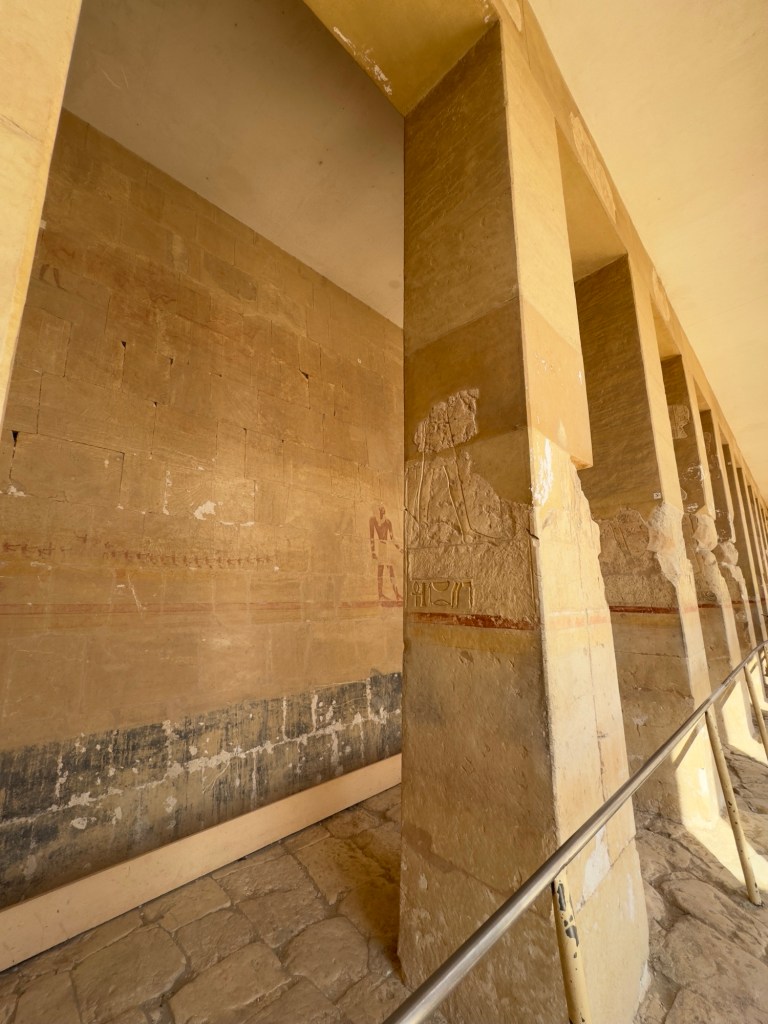
Wide ramps connect each terrace, and elegant colonnades frame reliefs that narrate her divine birth, expeditions to the rich land of Punt, and her unprecedented rule as a female king. The temple was not just a memorial for Hatshepsut, but a place to honor the gods, especially Amun-Ra, to whom it was primarily dedicated.
The terraces were originally lined with gardens and incense trees. Hatshepsut imported frankincense and myrrh from Punt (modern Eritrea/Somalia). Near the entrance, you can even spot a fenced-off stump from one of these ancient trees.
By the time I arrived, it was midday, and the crowds were out in full force. Pockets 360EGP lighter, I began what I can only describe as a pilgrimage. Not in the religious sense—though the sunlight bouncing off the white stone was so blinding I nearly found God(s). (Bring sunglasses. Seriously.)
The approach up the two ramps feels symbolic, like retracing the path of ancient priests—while simultaneously dodging modern-day tour groups and overly committed photographers.
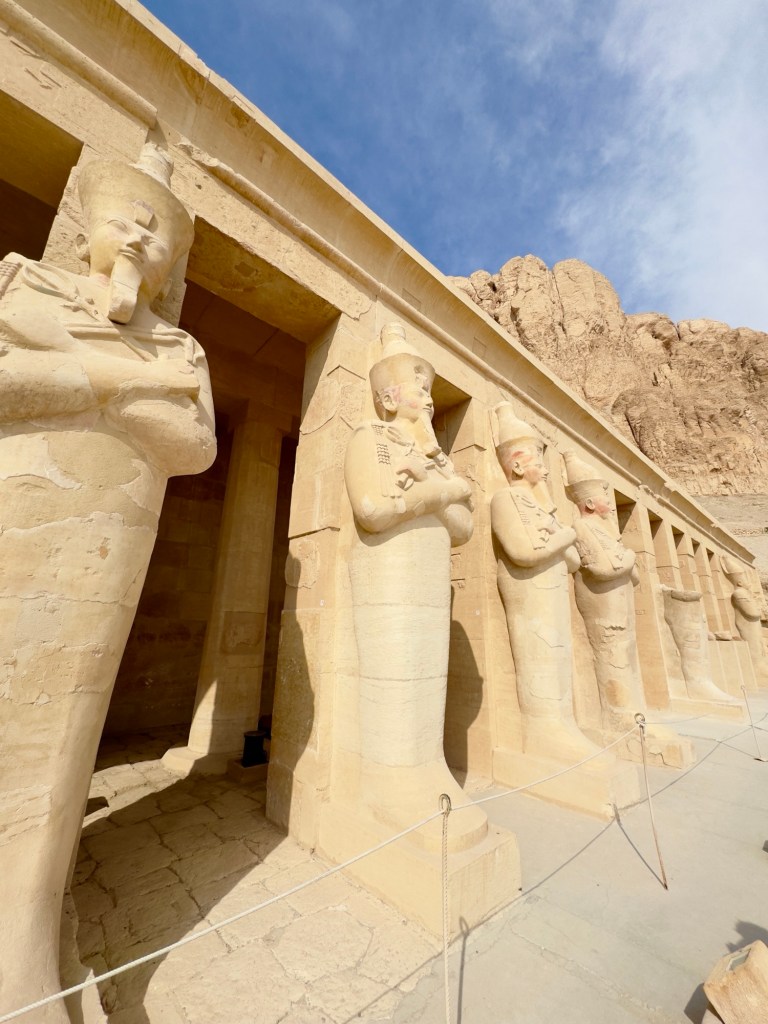
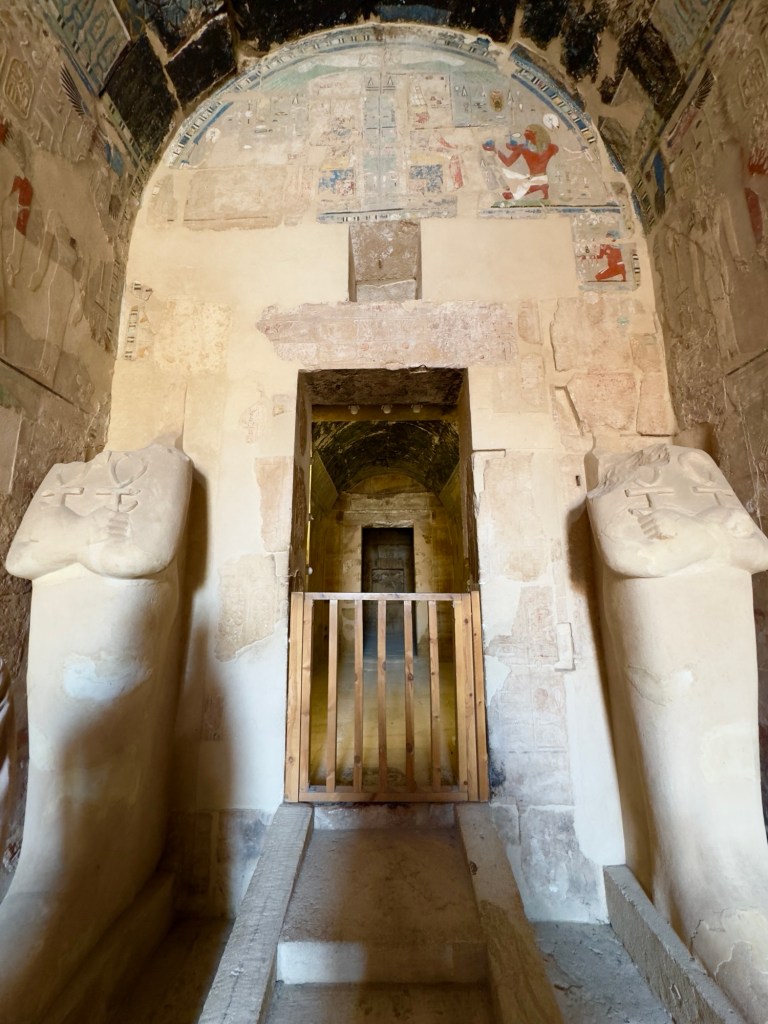
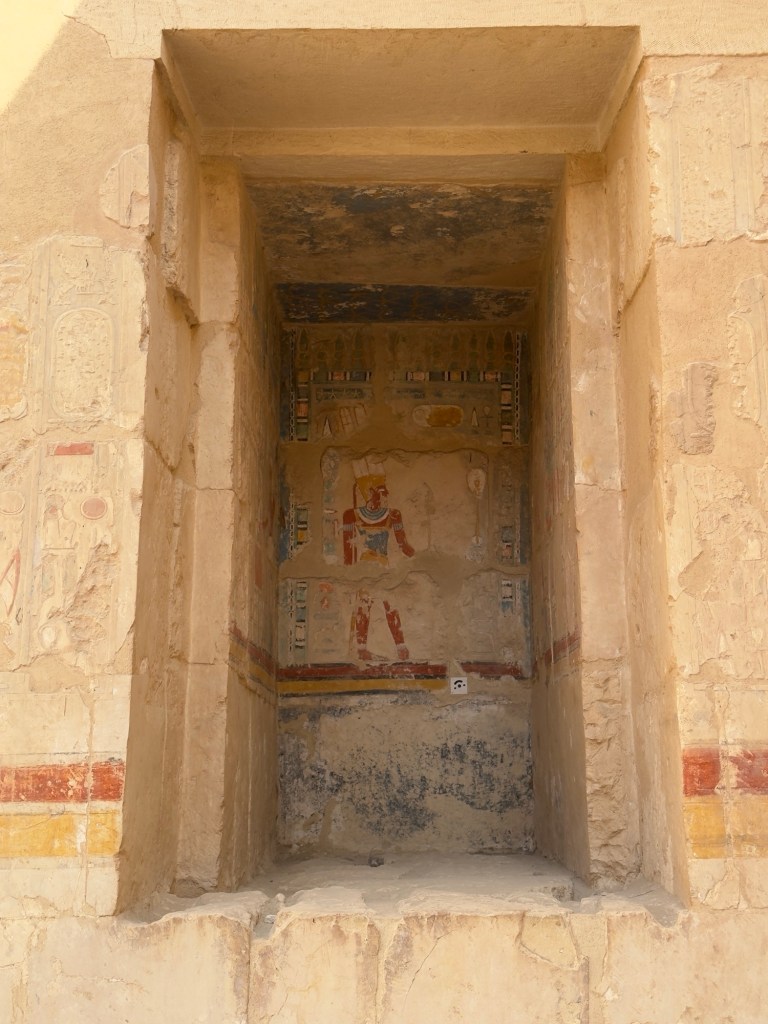
Once at the top, the cliffs of Deir el-Bahari loom 300 something meters above the desert, forming a dramatic backdrop that amplifies the temple’s stature. On the third terrace, some of the 24 colossal Osiris statues still stand, leading to the Sanctuary of Amun. It’s modest compared to the outer temple—carved into the cliff, with minimal decoration—but still retains ancient pigments, especially the blue-painted starry ceiling.
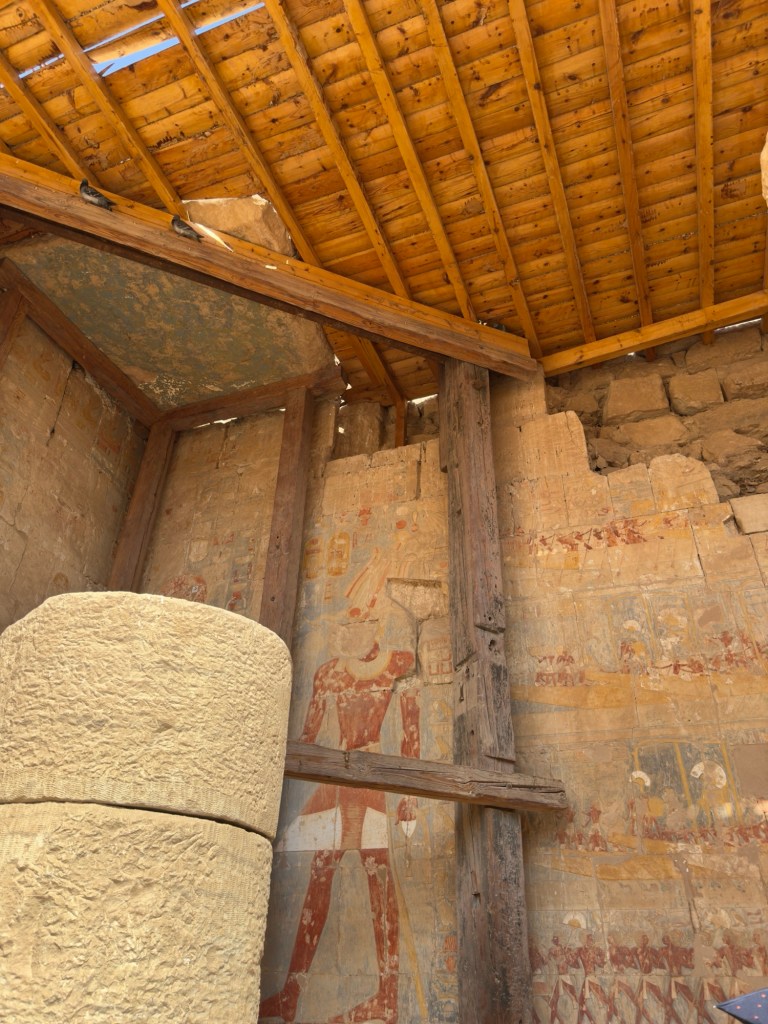
Other than the main sanctuary of the temple, the best-preserved reliefs are on the middle terrace. On the north colonnade record Hatshepsut’s divine birth and at the end of it is the Chapel of Anubis, with well-preserved colorful reliefs of a disfigured Hatshepsut and Tuthmosis III in the presence of Anubis, Ra-Horakhty and Hathor.
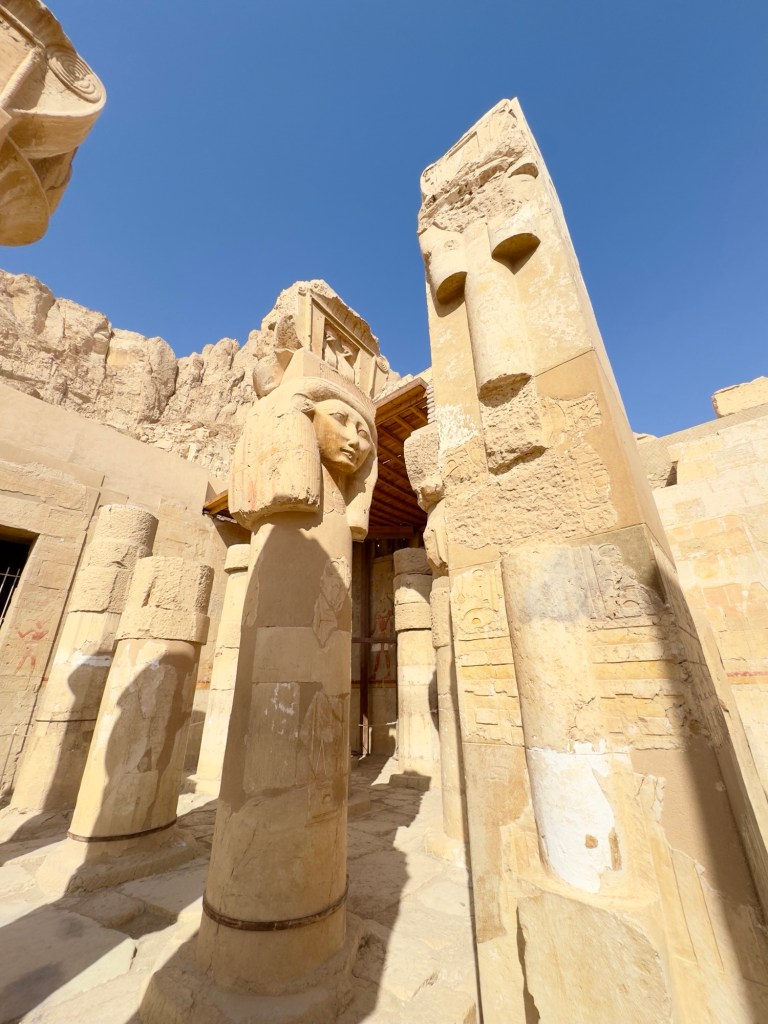
The Punt Colonnade to the left of the entrance tell the story of the expedition to the Land of Punt to collect myrrh trees needed for the incense used in temple ceremonies. There are depictions of the strange animals and exotic plants seen there, the foreign architecture and landscapes as well as the different-looking people. At the end of this colonnade is the Hathor Chapel, with two chambers both with Hathor-headed columns. Reliefs on the west wall show Hathor as a cow licking Hatshepsut’s hand, and the queen drinking from Hathor’s udder. On the north wall is a faded relief of Hatshepsut’s soldiers in naval dress in the goddess’ honor.
How did i know all this? Well, the blessing (and curse) of being surrounded by tour groups is that while they’re a navigational nightmare, their guides are loud enough that you can get a free tour just by existing near them.
Silver linings, mates. Silver linings.
Stories Written In Blood
Medinat Habu was the next stop.
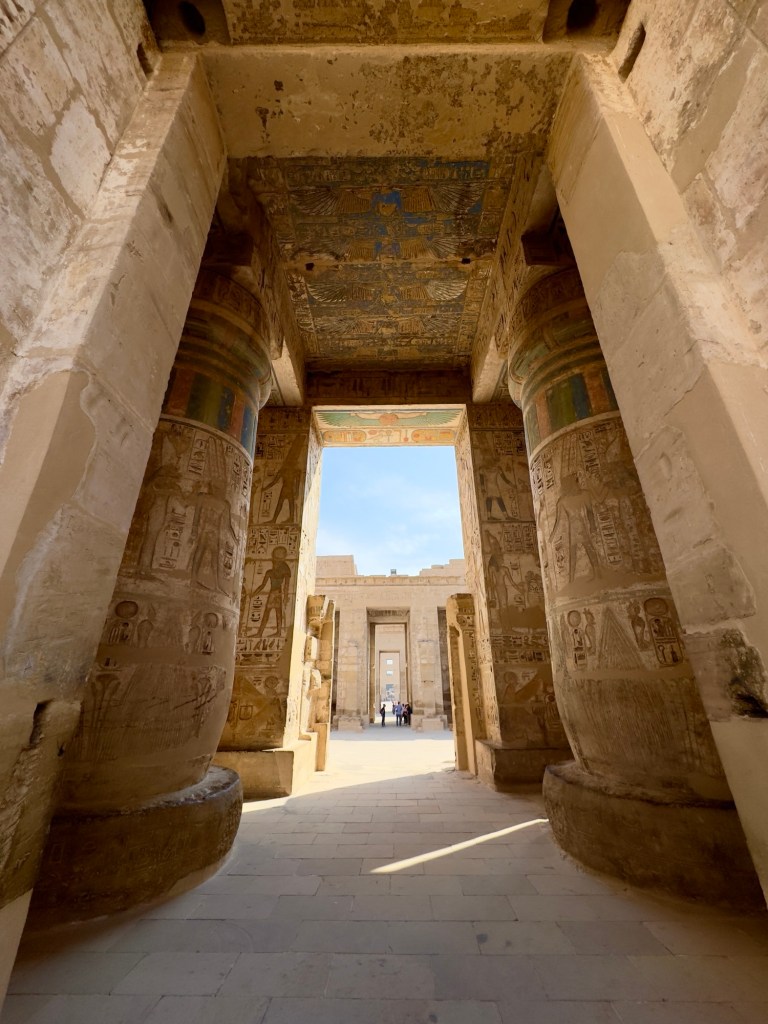
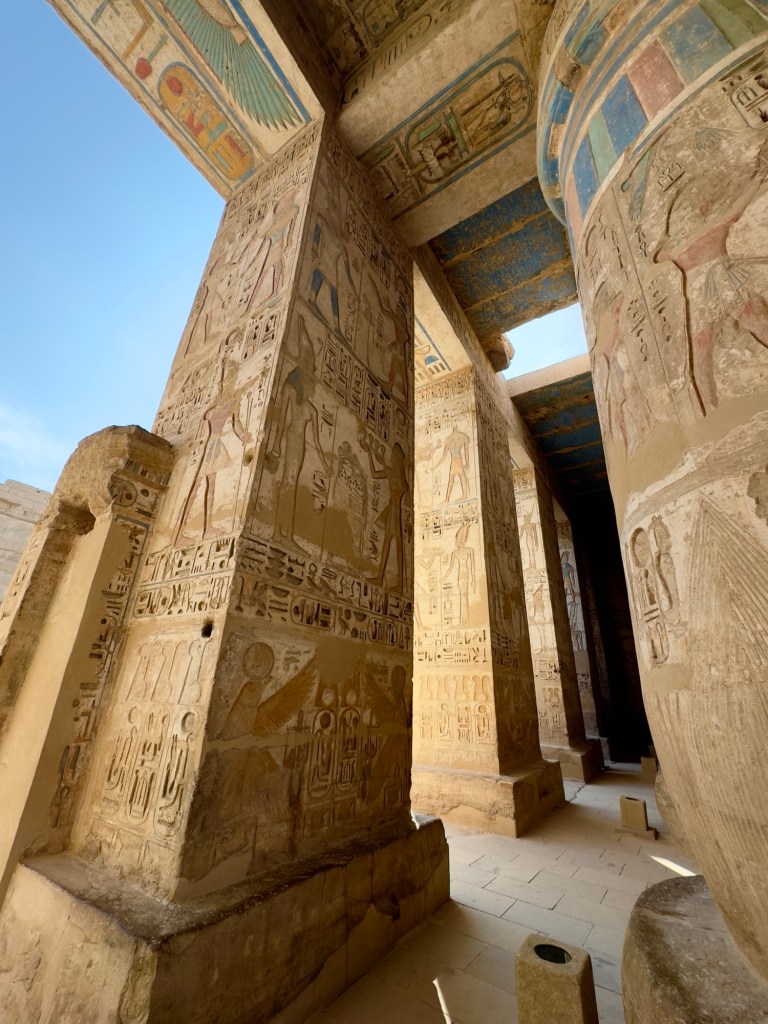
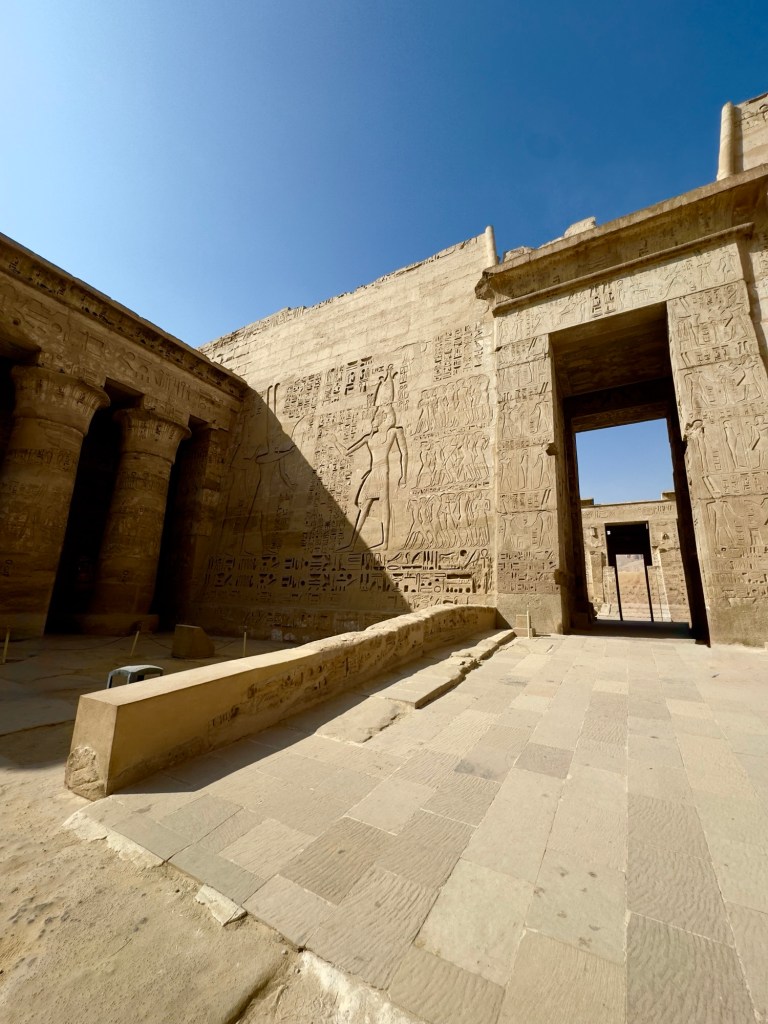
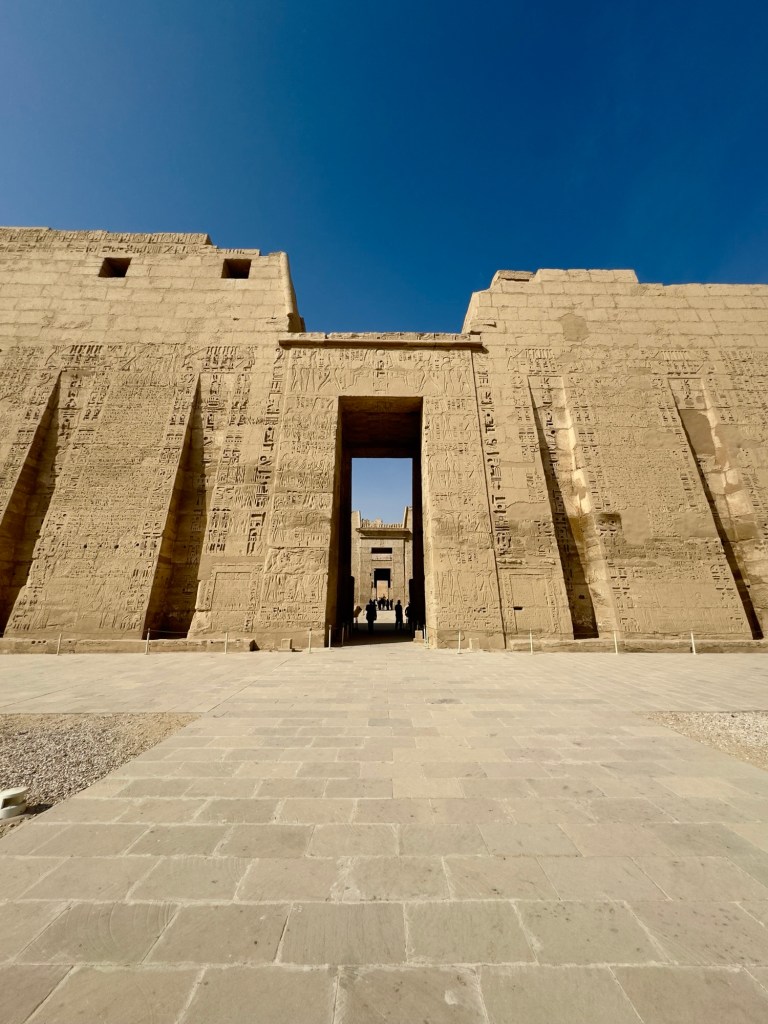
Originally built by Hatshepsut and Tuthmosis III as the Temple of Amun, it was repurposed as the Mortuary Temple of Ramesses III. The temple complex served as both a place of worship and a fortified administrative center during Ramses III’s reign, reflecting both his power and the turbulence of the time. The temple itself follows the traditional layout: monumental pylons, open courtyards, hypostyle halls, and an inner sanctuary.
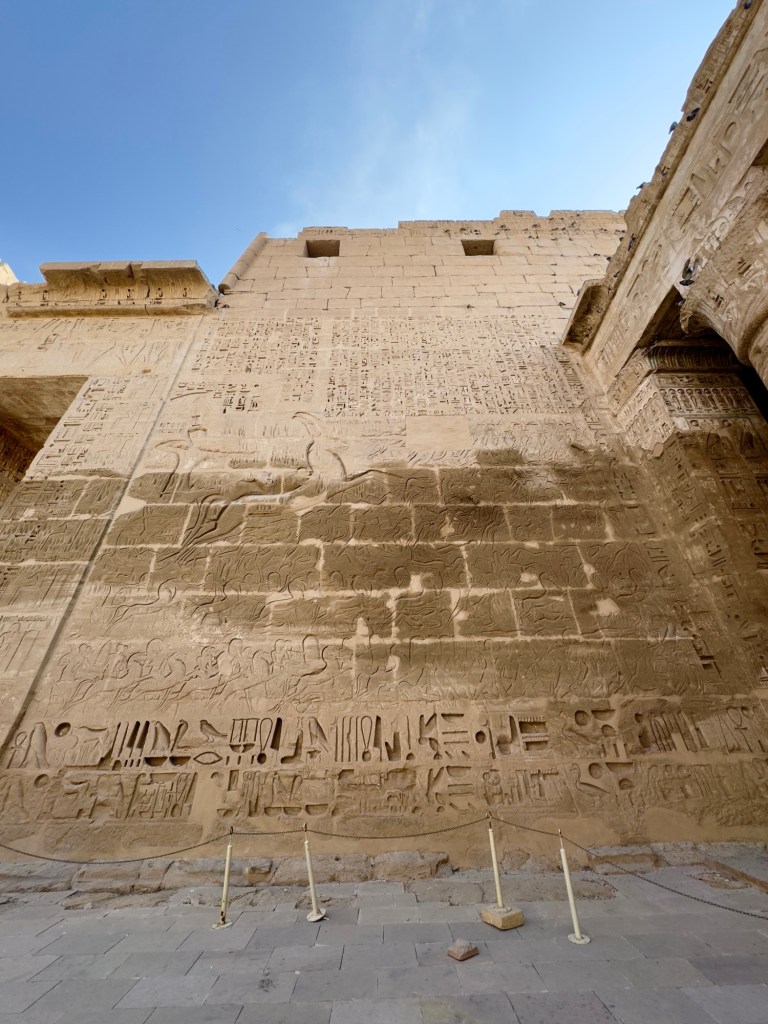
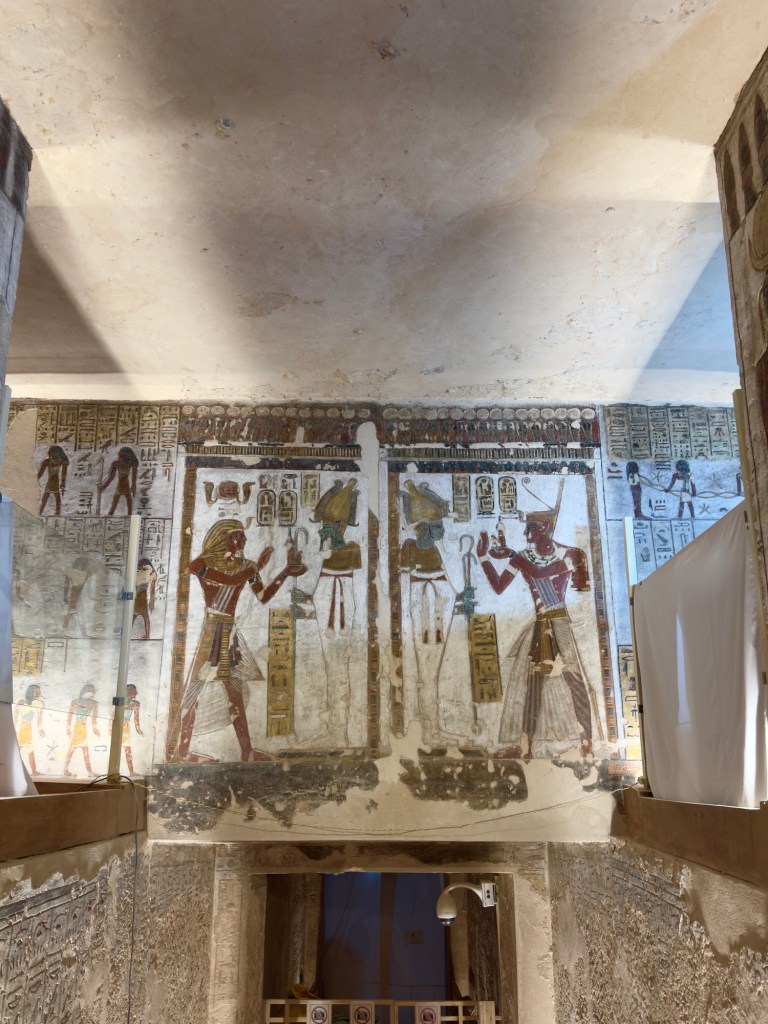
In my previous post i briefly described how Ramesses III tomb contained inscriptions depicting the tales of when he defended Egypt against the Sea Peoples, but here you can find that same story but fully blown out in stone carved upon the first pylon, adorned with dramatic scenes of Ramses III defeating the invaders whose defeat helped secure Egypt’s borders. One of the most striking and gruesome scenes shows rows of severed hands and genitals, counted as trophies from defeated enemies, a graphic representation of military triumph.
It served not just as his mortuary temple, but also as a political statement about Egypt’s strength and divine protection. Many of the reliefs still retain their original colors as well, a much needed reprise from shades of beige and brown, and offering a glimpse of how the carvings and art were colored back in the day,
Something i found personally quite fascinating about this temple is in its particularly deep carving style. The carvings are not just shallow reliefs like the ones that can be found in almost all the other temples, they are deeply incised into the stone, creating an almost three-dimensional effect that is particularly striking under the Egyptian sunlight, The deep carving style also made it more difficult for later rulers to erase or modify these depictions, contributing to their preservation. I believe this type of carvings are called sunk reliefs, according to one of the guides there, and are used more on exterior walls exposed to sunlight, whereas raised reliefs appears more often in interiors, allowing paint to adhere better.
Legacy left in Shambles
Last stop on my West Bank adventure: the Colossi of Memnon.
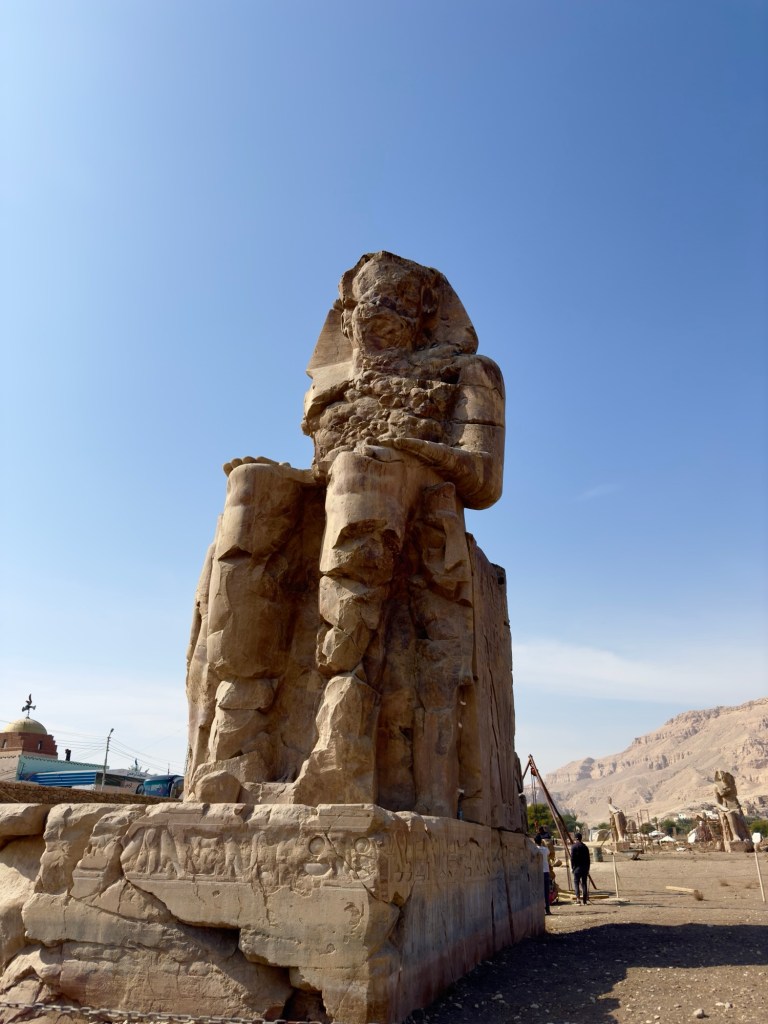
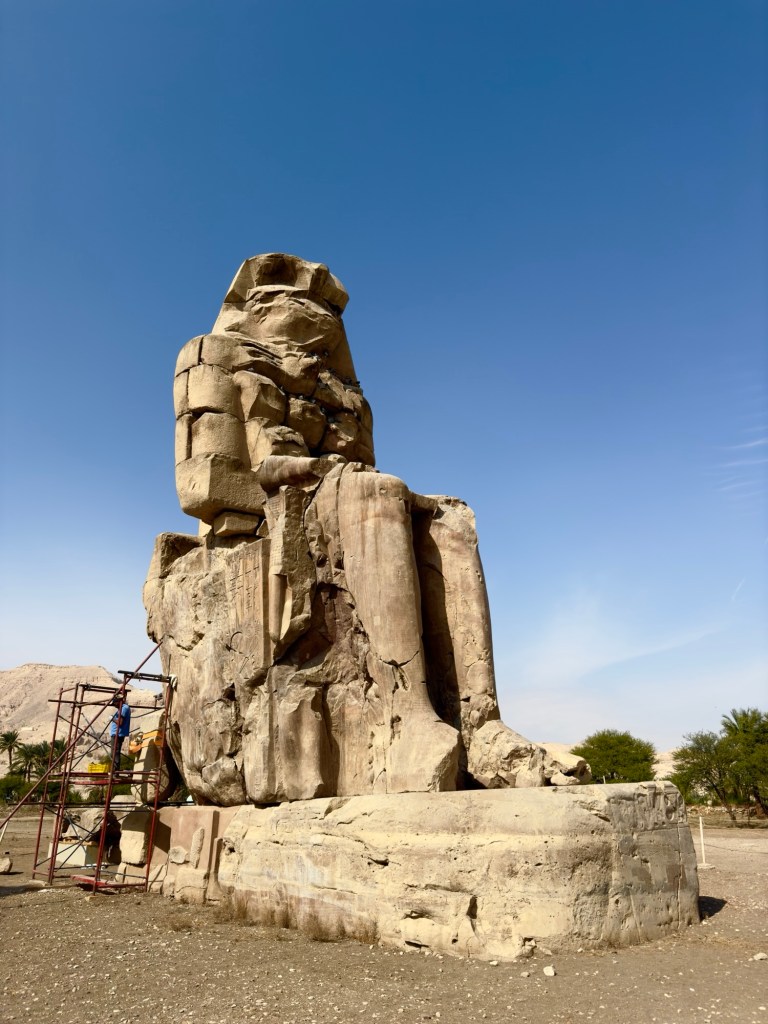
Not going to lie, i was expecting more. Don’t get me wrong, the sentinel statues of the Colossi of Memnon stands an impressive 18m tall, and were originally constructed to guard the entrance to Amenhotep III’s mortuary temple. With such lofty descriptions scattered bout the interwebs you’d naturally have some vague but fairly glorified assumptions of what they would be like. But alas, reality is cruel.
The actual statues themselves are impressive yes, but its surroundings are unfortunately not. Situated smack in the middle of what seems like a dumping ground of stone and industrial waste, and literally surrounded by the commercial hustle and bustle of vendors who set up shop in the near vicinity selling their wares and trinkets, the semi derelict statues are perhaps the most well preserved items in the entire complex. The complex is supposedly ‘still undergoing’ excavation, but with the most recent report of it being from 2011 stating ‘halted due to lack of funds’, i do not foresee much work going to preserving these magnificent statues, as well upholding public order in the vicinity.
Entry into the space is free, there are no gates, checkpoints, nor tickets required to visit the statues, and security is lackluster, it kinda is everyone’s land there. Just getting in and out to snap a couple pictures felt like i just signed up for the Hunger Games dodging grabby hands and eager vendors instead of arrows and projectiles.
A sad state of things for the Colossi of Memnon, which is actually quite rich in history as the statues once flanked the entrance to what was one of the largest temples in ancient Egypt, after an earthquake, the northern statue began to emit mysterious whistling sounds, which the Greeks interpreted as the voice of the mythological hero Memnon, a hero of the Trojan War, giving the statues their famous name. Though the “singing” ceased after the Romans repaired it. It is only a shadow of its grand legacy, basically decimated with nothing but scraps and the two statues left.
What’s Next?
After a rather anti-climatic end to what was a breathtaking experience at the West Bank, it was time to recharge and reset once again, for it was going to be yet another long day to another two unmissable temples near Luxor – The Temple or Hathor at Dendera, and the Temple of Seti I at Abydos.
If the cover picture wasn’t obvious enough, in this post we’re heading into the Land of the Dead laddies. So buckle up, grab your Indiana Jones hats, and stay hydrated for we’re about to head deep under.
In the previous post, I was gallivanting around with the living on the East Bank, reset for the night, and kicked off another early morning to re-explore Karnak Temple in natural light—free of those cheap 80s “Egyptian-inspired” audio tracks and cringy visuals from the Light and Sound show. After that peaceful reboot, it was time to meet my designated driver for the day and head west—into the Land of the Dead.
The necropolis is on the West Bank for symbolic reasons: it lies beneath the pyramid-shaped peak of al-Qurn (“The Horn”), reinforcing spiritual connections to resurrection and the sun god Ra.
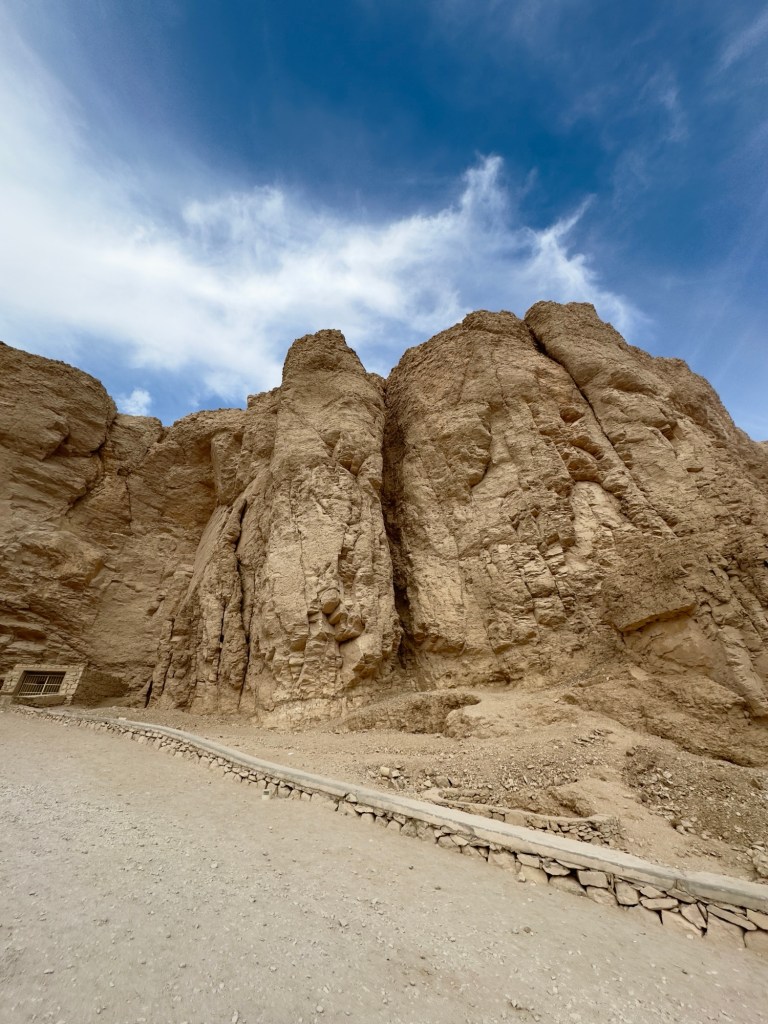
On a practical level, the valley’s remote and rugged terrain made it ideal for hiding and protecting royal tombs from looters—unlike the very conspicuous pyramids of earlier dynasties. The limestone cliffs made for perfect rock-cut tombs, and it was just a stone’s throw from Deir el-Medina, where the tomb builders and artisans lived, worked, and were eventually buried themselves.
And that’s where the journey truly begins: The Valley of the Kings.
Land of the Dead
The Valley of the Kings is one of the most iconic archaeological sites in the world, serving as the royal burial ground for pharaohs and elite nobles of Egypt’s New Kingdom, it replaced the earlier pyramid tombs of the Old and Middle Kingdoms and marked a shift to hidden, rock-cut tombs to protect against tomb robbers.
The tombs aren’t just burial chambers—they play a vital role in the art of the Egyptian afterlife. The walls are covered in spells from the Book of the Dead, constellations, gods, serpents, and elaborate scenes guiding the pharaoh’s soul through the underworld. Even thousands of years later, the colors are so vivid you’d swear they were painted last week. Many tombs were plundered in antiquity, but the wall art and architecture remain significant sources of religious and historical insight.
Over 60 something tombs have been discovered, ranging from simple pits to multi-chambered maze structures. Your general entrance ticket allows you to visit three tombs of your choice from a rotating list of open tombs. Do note, certain high-profile tombs require separate, additional tickets due to their significance, preservation needs, or popularity.
These tombs are: KV62 – Tutankhamun (King Tut) KV9 – Ramses V & VI KV17 – Seti I
If you wish to visit more than three tombs, you need to purchase an additional standard entry ticket, while i would only recommend this for true tomb raiders only, as going from tomb to tomb to tomb can can rather repetitive after awhile and may lose its initial wow factor, each tomb is still individually unique and no one tomb is exactly the same.
As of 2025 the currently accessible tombs are:
KV1 – Ramesses VII KV2 – Ramesses IV KV6 – Ramesses IX KV8 – Merenptah KV11 – Ramesses III KV14 – Tausert and Setnakht KV15 – Seti II KV16 – Ramesses I KV43 – Thutmose IV KV47 – Siptah
But before I dive into the tombs I explored and the reasons behind my choices, let’s talk logistics.
Logistics Talking
While you can buy the general Valley of the Kings ticket online through the Egypt Monuments site, I’d actually recommend getting to the Valley early and purchasing your tickets in person. Why? Because if you want to visit the tombs of Ramses V & VI or Seti I, you must buy those tickets on-site—they’re not available online. Plus, the list of accessible tombs can change due to ongoing conservation work, excavations, or restoration. It’s best to check current availability at the visitor center upon arrival since much of that info isn’t available online.
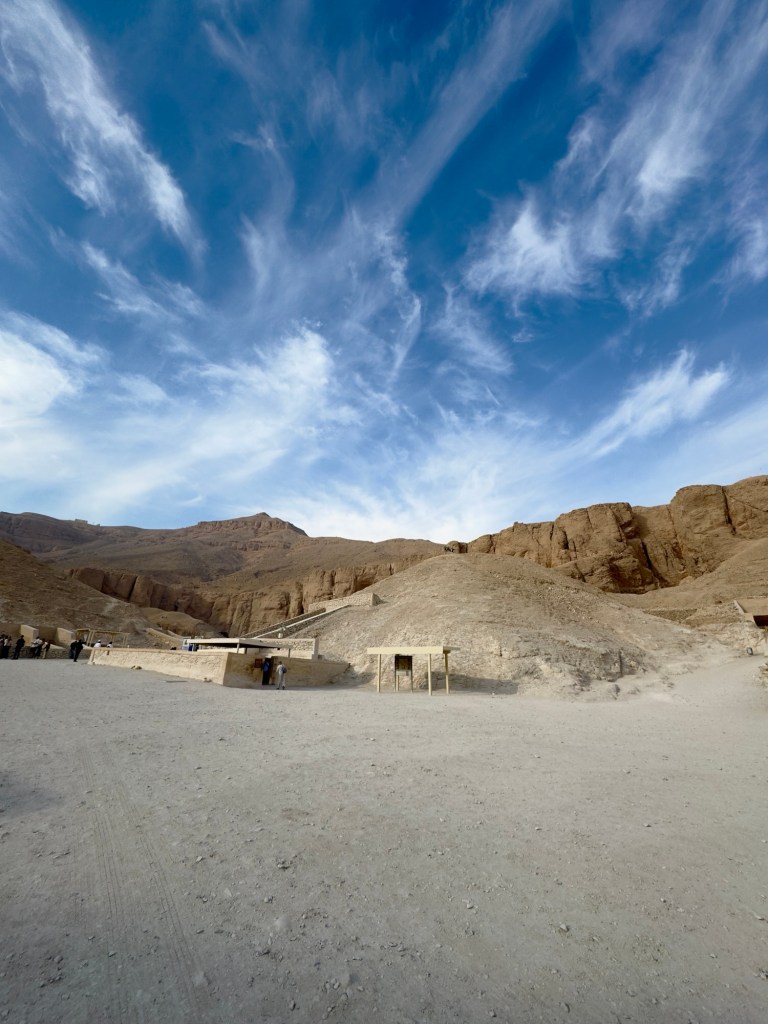
Regardless of the season, the Valley of the Kings gets hot by midday. You’re exposed to the elements, and unless you’re inside a tomb or at a rest stop, shade is extremely limited.
The Valley of the Kings is also one of the highlights of any Egypt trip, needless to say, everyone and anyone will have the same idea of ‘beating the crowd’ by either getting there early or late. So if you can’t beat the crowd, at least stay ahead of it. Trust me, the tombs are not exactly spacious, the last thing you need is being sardined 40m deep underground with a throng of equally sweaty tired tourists (yourself included). The air outside may be hot and arid, but within the tombs, depending on the crowd, can be either fairly cool, or toasty and humid.
Upon arrival at the Valley of the Kings, once you pass through the ticket checkpoint, make sure you have cash for the tram ride. The tram costs 20 EGP per person for a round trip ride. From the tram, it’s a relatively short, uphill walk to get to the entrances of the tombs.
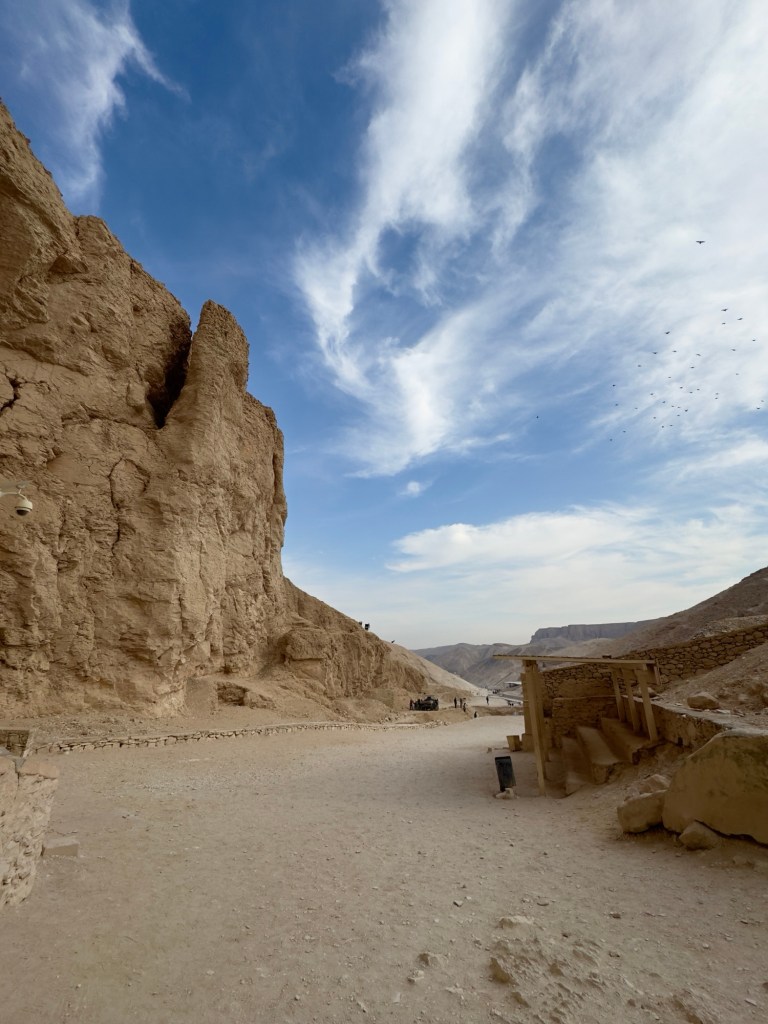
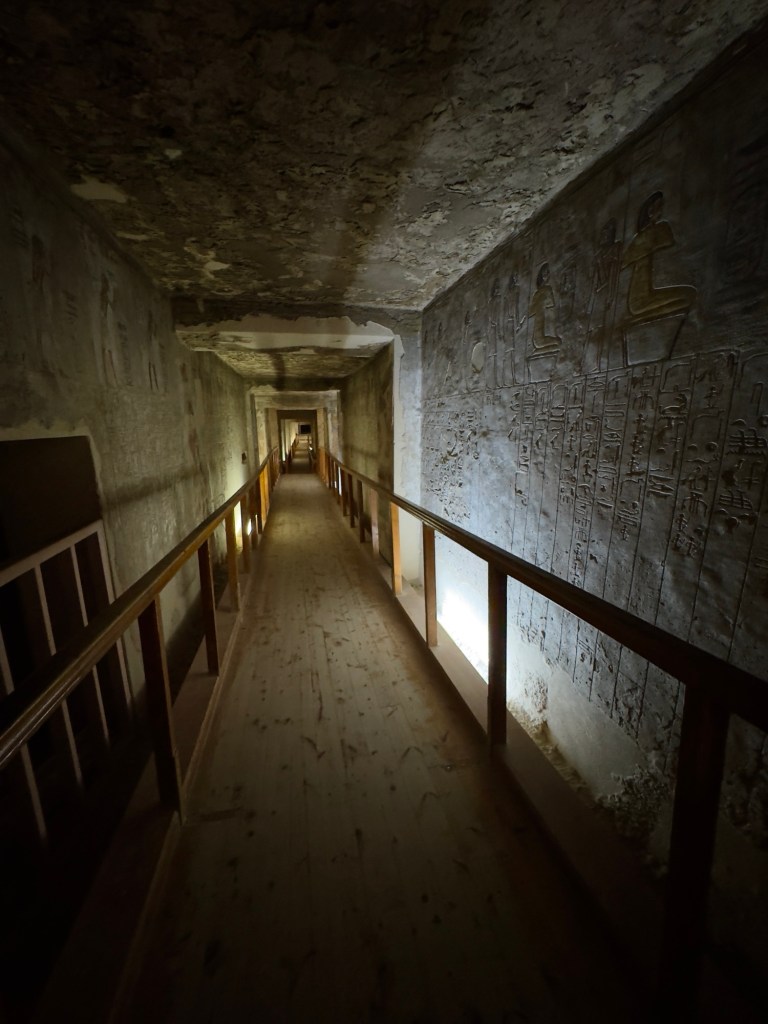
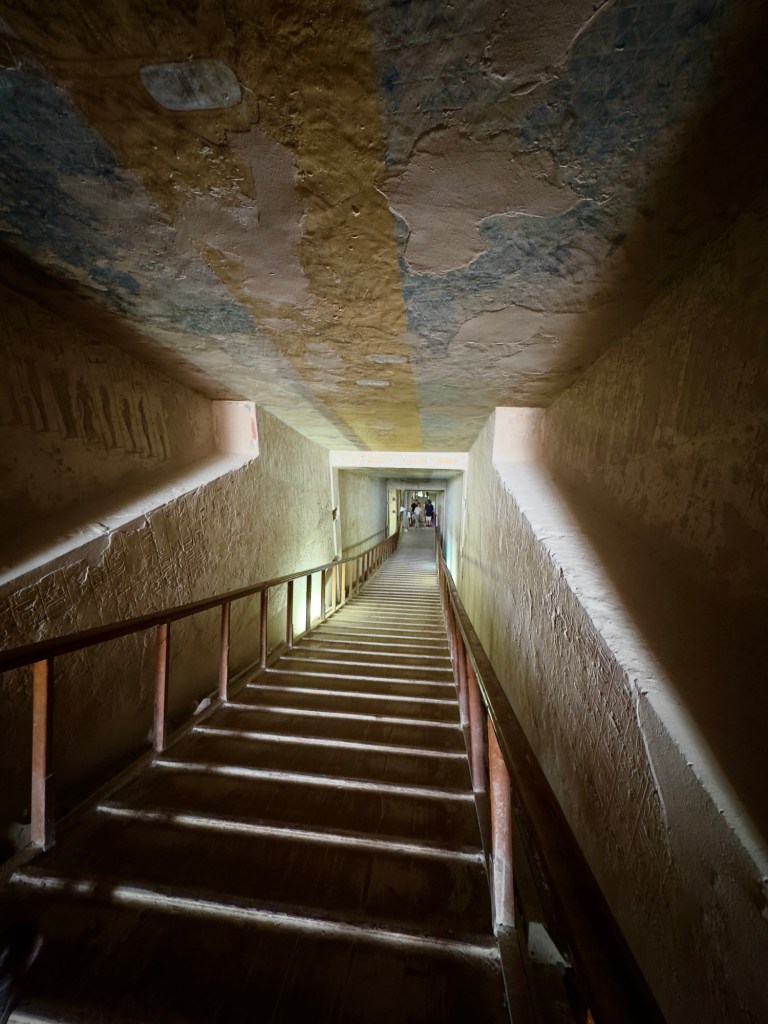
Most tombs are relatively low-mobility friendly (take that with a grain of salt). They typically have wooden planks with steps to help you descend, which—while not exactly ergonomic—add to the tomb raider atmosphere. However, this does make accessibility difficult for those with mobility challenges. Some physical activity is necessary; you’re descending 20–40 meters into the earth, after all. Wear comfortable shoes and clothes, and bring a light jacket for removable layers. Temperatures vary wildly depending on the time of day and whether you’re inside or outside a tomb.
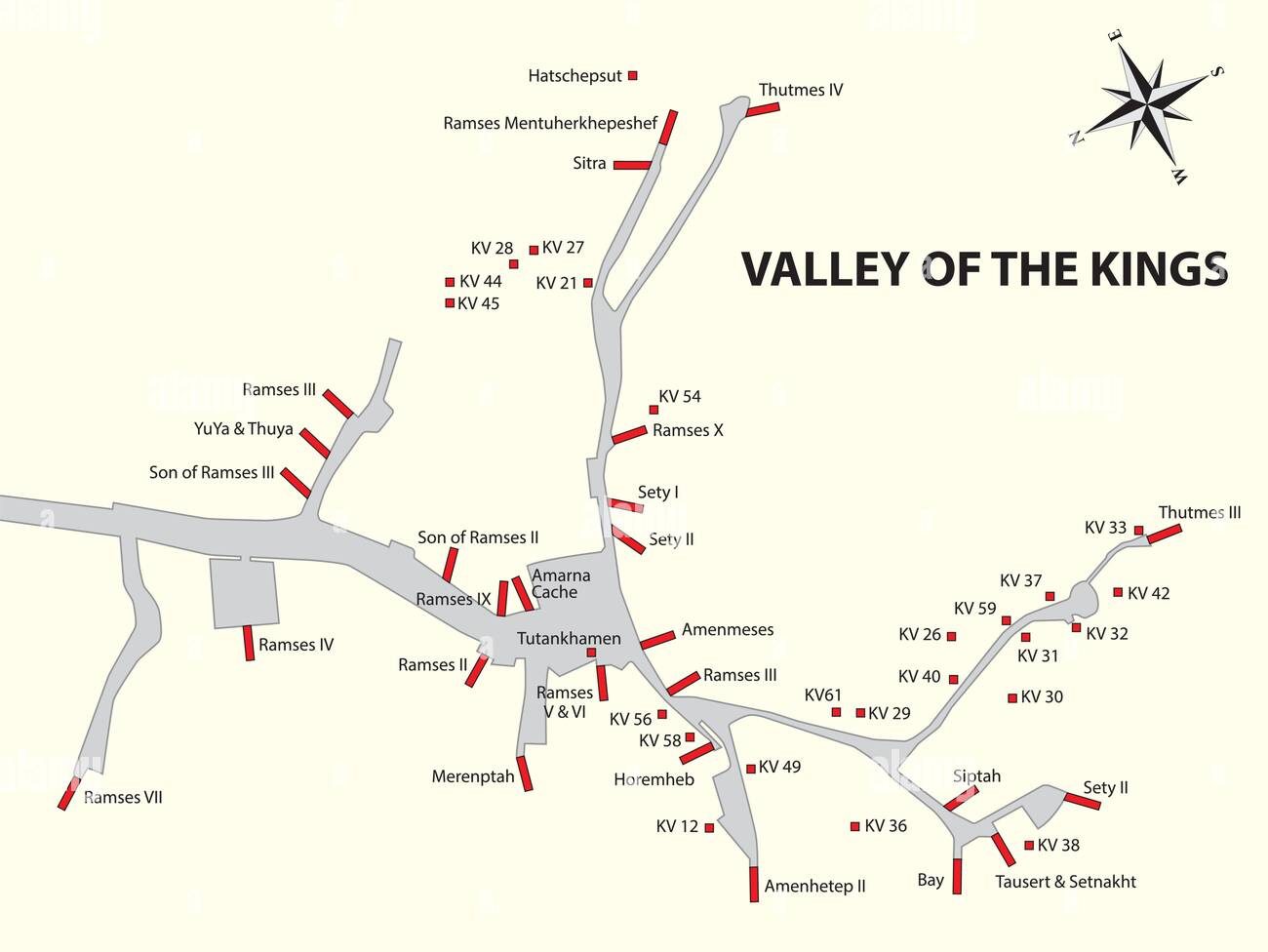
Some tombs are also located a little off the main path, so some light hiking may be required too. Here is a map of the valley just to give you an idea
No matter how fit you are, you will find that, especially in neglected tombs without proper air circulation equipment due to lack in popularity, the air can get rather thin and humid if the tomb’s crowded. Don’t force yourself to move at the pace of others. Explore at your own speed. The last thing you want is to become one of the Valley’s newest residents.
Now that the exposition is out of the way, let’s talk tombs.
The ones i visited were: KV17 – Seti I (Separate Ticket) KV9 – Ramses V & VI (Separate Ticket) KV11 – Ramses III (General Admission) KV2 – Tomb of Ramses IV (General Admission) KV14 – Tausert & Setnakht (General Admission) KV 8 – Merenptah (General Admission)
Noticed I skipped Tutankhamun? Yeah, about that…
KV62 – Tutankhamun
As famous as it is, I believe it’s the discovery of Tutankhamun’s tomb that made it legendary—not the tomb itself. It’s small and modest compared to its neighbors. He died young and unexpectedly, so his burial was rushed and far from grand. The artwork is limited to a single chamber and, while historic, lacks the intricacy found in tombs like Seti I or Ramses VI. So for the 500 EGP price tag? Not worth it in my opinion.
The famous treasures found in the tomb—including the gold mask, chariots, and shrines—are no longer there. They’re now housed in the Egyptian Museum or the Grand Egyptian Museum in Cairo, so other than an elaborately decorated room, the actual mummified body of Tutankhamun inside a climate-controlled glass case in the antechamber, that’s pretty much it.
It’s also very crowded due to its fame, which can turn the whole experience into a claustrophobic mess. I’d rather spend that money on something with more historical and visual impact.
Like the Tomb of Seti I.
KV17 – Seti I
Remember how i said 500 EGP is ridiculous? Well to enter the Tomb of Seti I, it is a whopping 1800 EGP. Now hold your horses and un-clutch your pearls, there’s a reason for the hefty price tag.
The Tomb of Seti I is considered the crown jewel of the Valley—arguably onde of the most elaborate and beautifully decorated tomb ever discovered in Egypt. But it’s also incredibly fragile, and limiting visitor numbers helps preserve its artwork. Restoration has been ongoing for decades, involving cutting-edge conservation techniques. Entry is limited to reduce environmental damage (from CO₂, humidity, and human contact), tickets can only be purchased in person, and only a small number of visitors are allowed each day—another reason to arrive early.
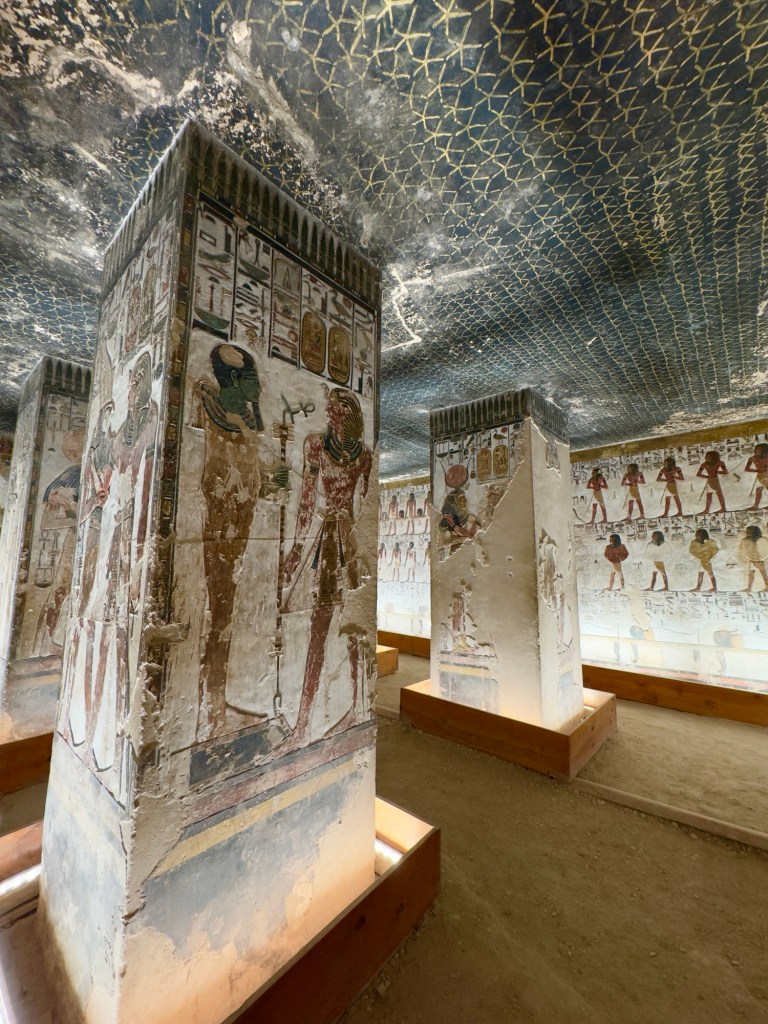
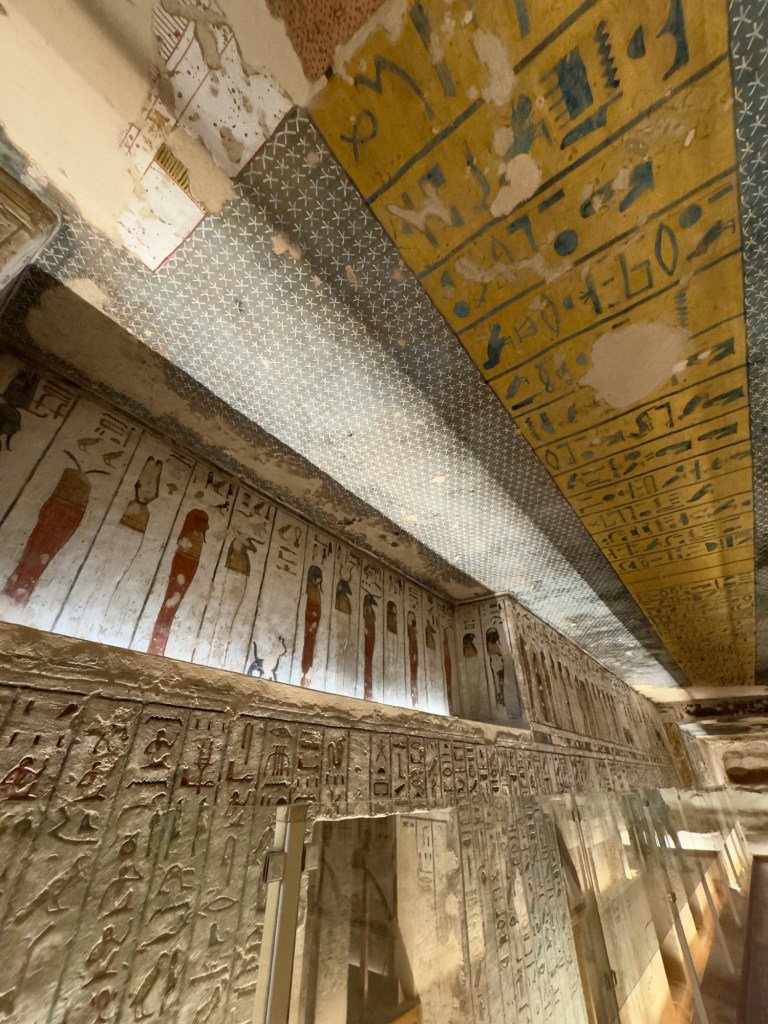
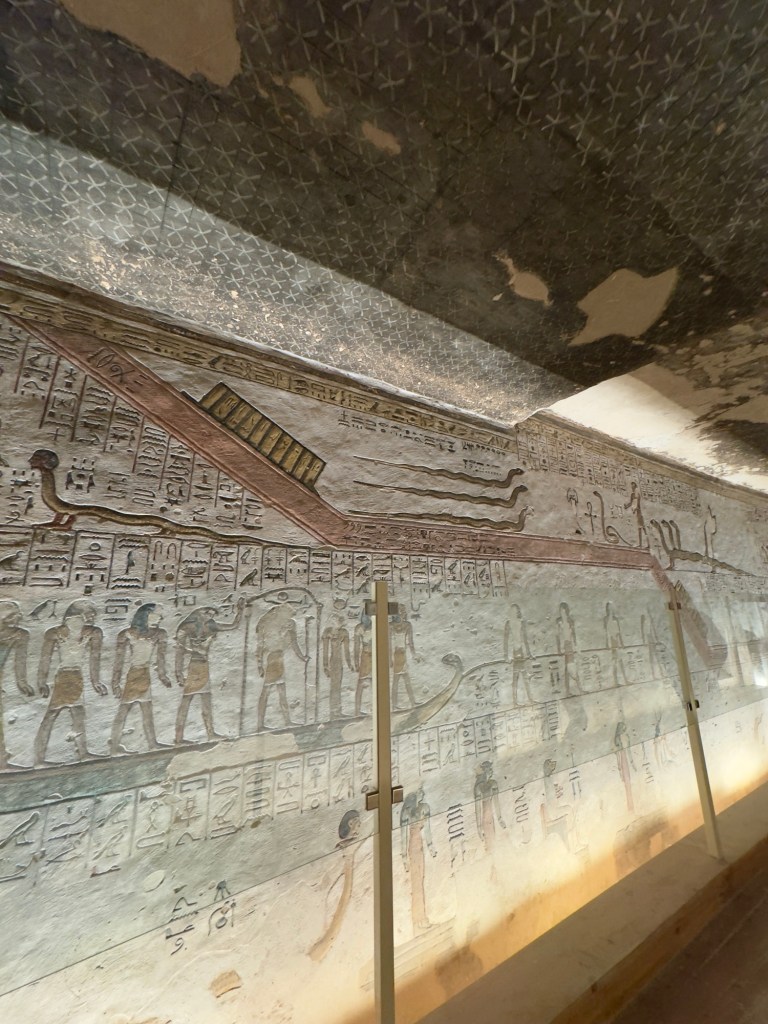
You get your money’s worth. The tomb is well-lit and ventilated. Glass barriers line the initial path down to protect the walls without blocking the view. The tomb extends over 137 meters into the bedrock and features more than 100 meters of painted corridors, carved walls, and chambers adorned with stunning reliefs. It’s the longest, deepest, and most intricately decorated tomb in the valley.
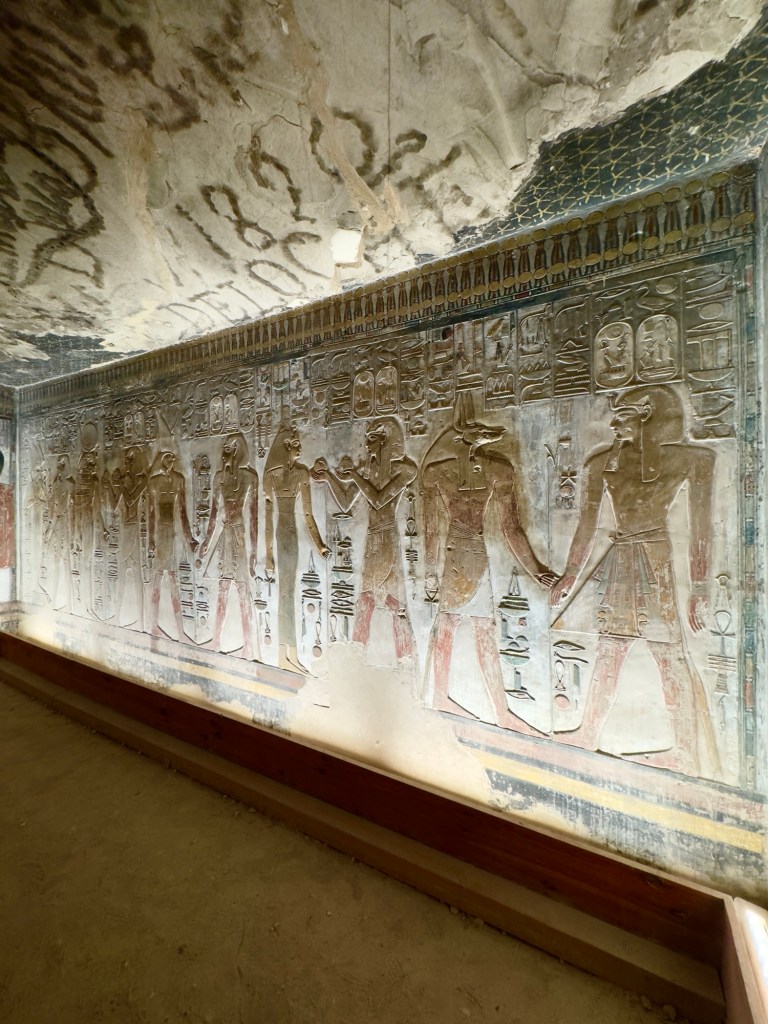
The artwork shows Seti I interacting with gods in richly detailed, symmetrical compositions—still vibrant after 3,000 years. The burial chamber originally held a massive alabaster sarcophagus (now in London’s Sir John Soane’s Museum) and is crowned with celestial ceiling art.
This tomb includes nearly every known funerary text of the period: the Book of the Dead, Amduat, Book of Gates, Book of the Heavenly Cow, and Litany of Ra. It reflects a deep spiritual dedication and desire to ensure Seti I’s safe passage into the afterlife—or just how determined he was to earn that golden ticket to heaven.
It’s less crowded due to the steep extra ticket price, which makes the experience even better. I had moments where it was just me and the silence of 3,000 years.
Tomb KV9 – Ramses V & VI
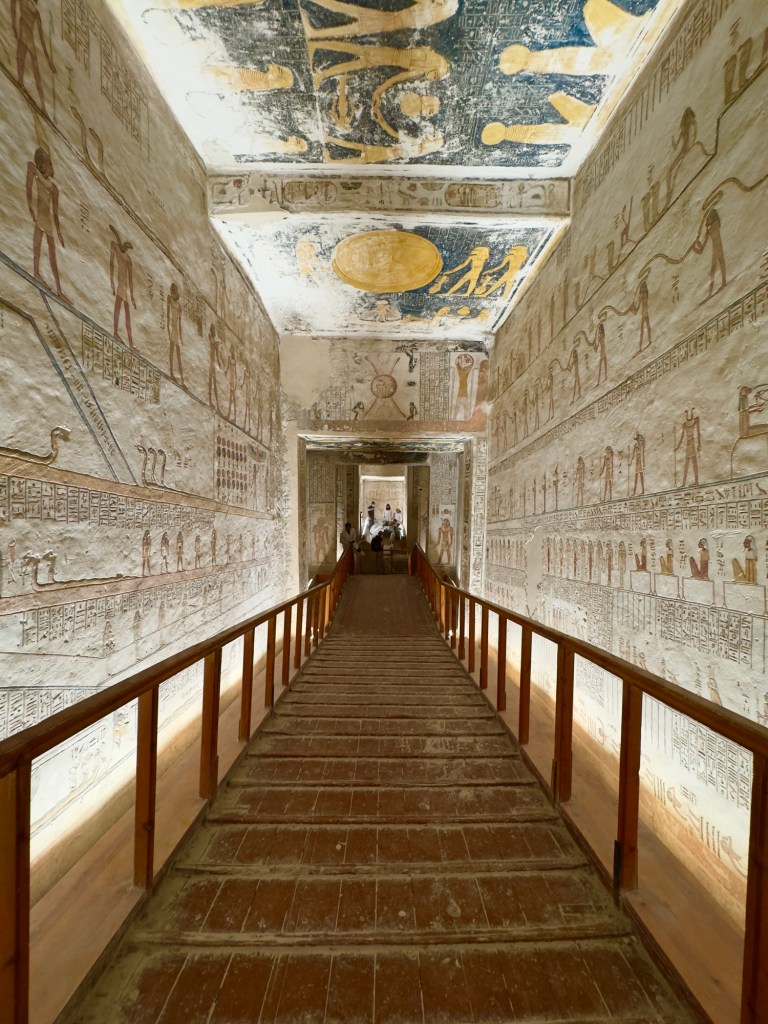
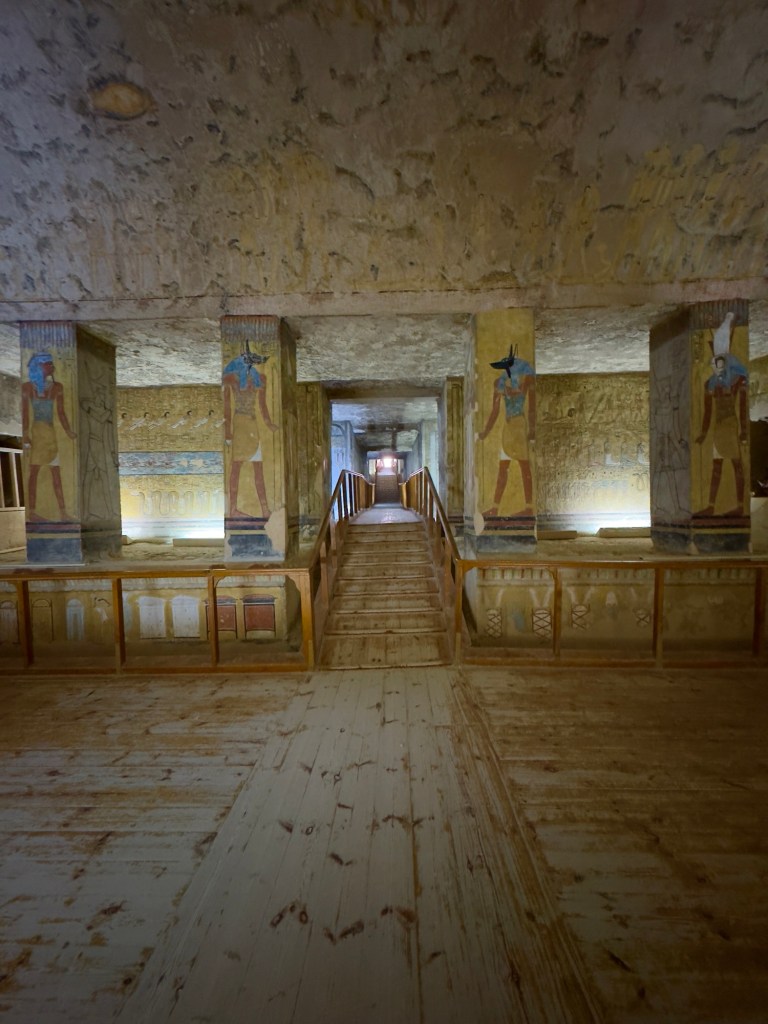
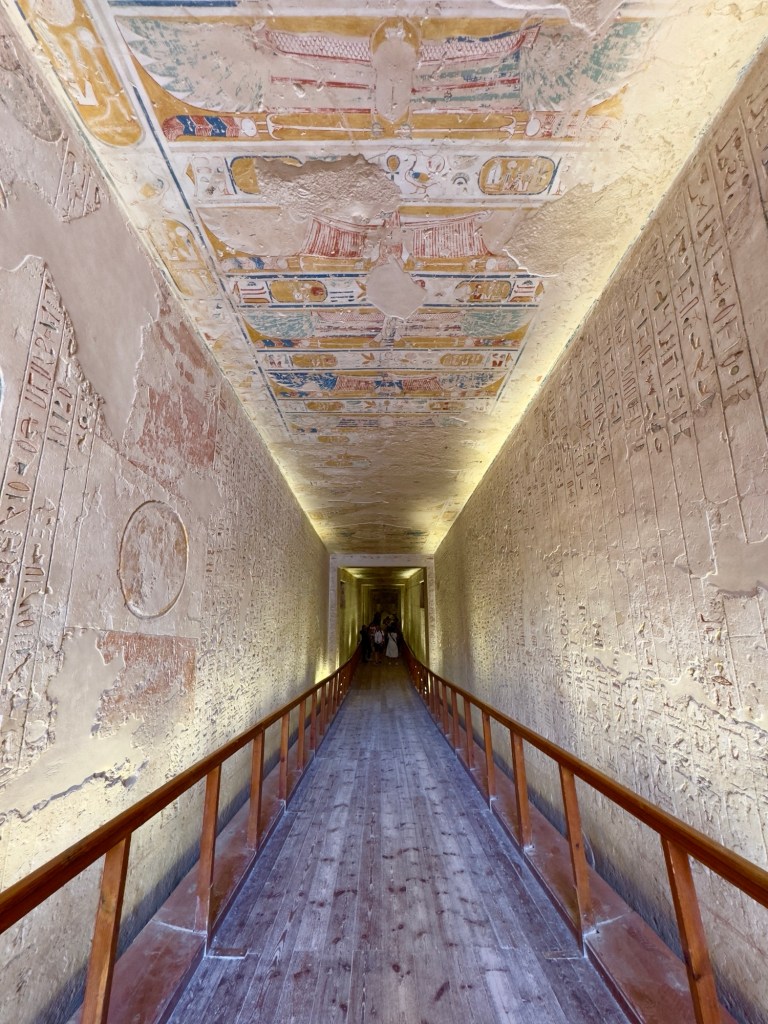
Originally built for Ramses V, then expanded by Ramses VI. While not as grand as Seti I’s, this tomb still spans 117 meters and is more straightforward in layout—one long corridor leading to a grand burial chamber.
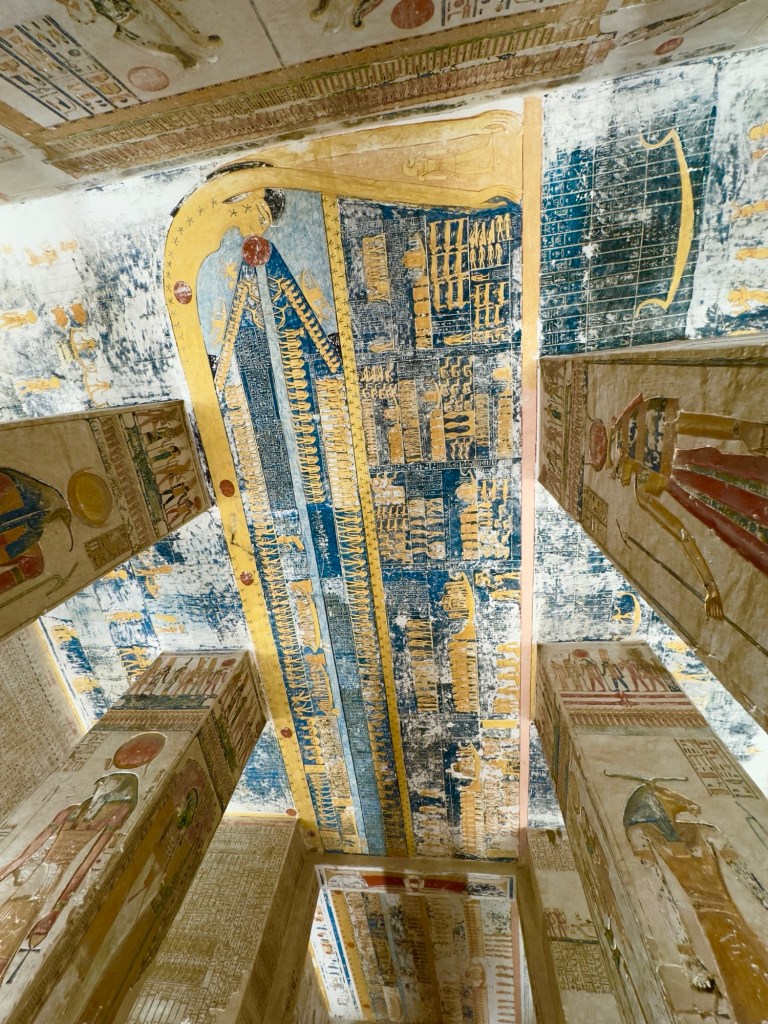
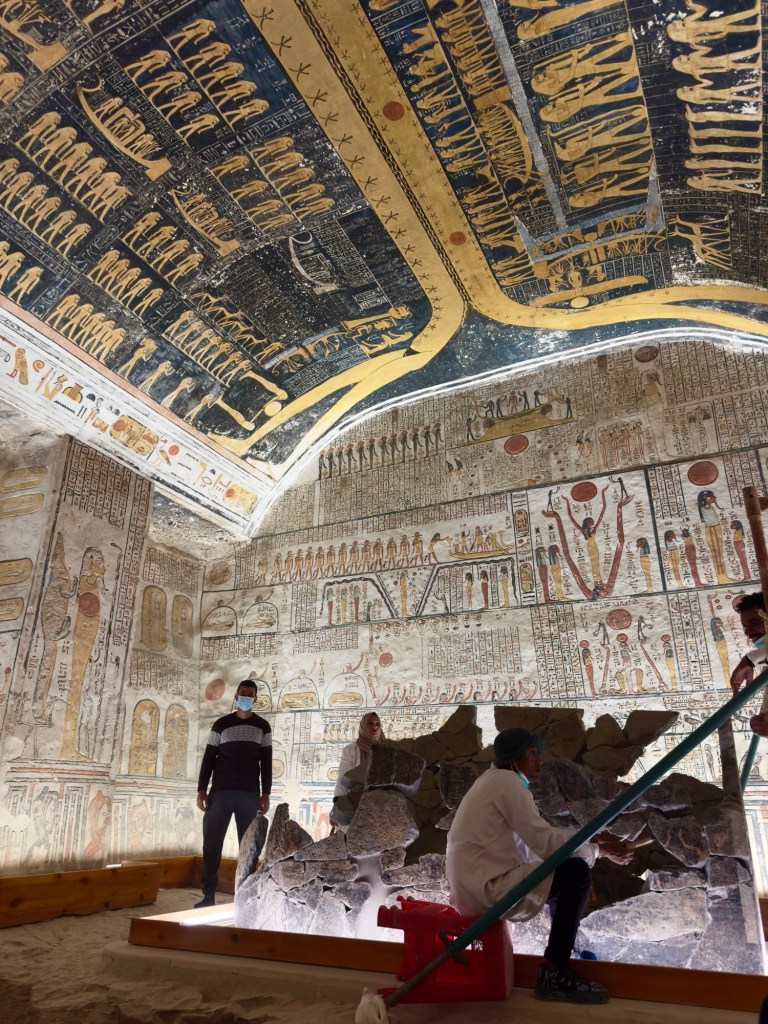
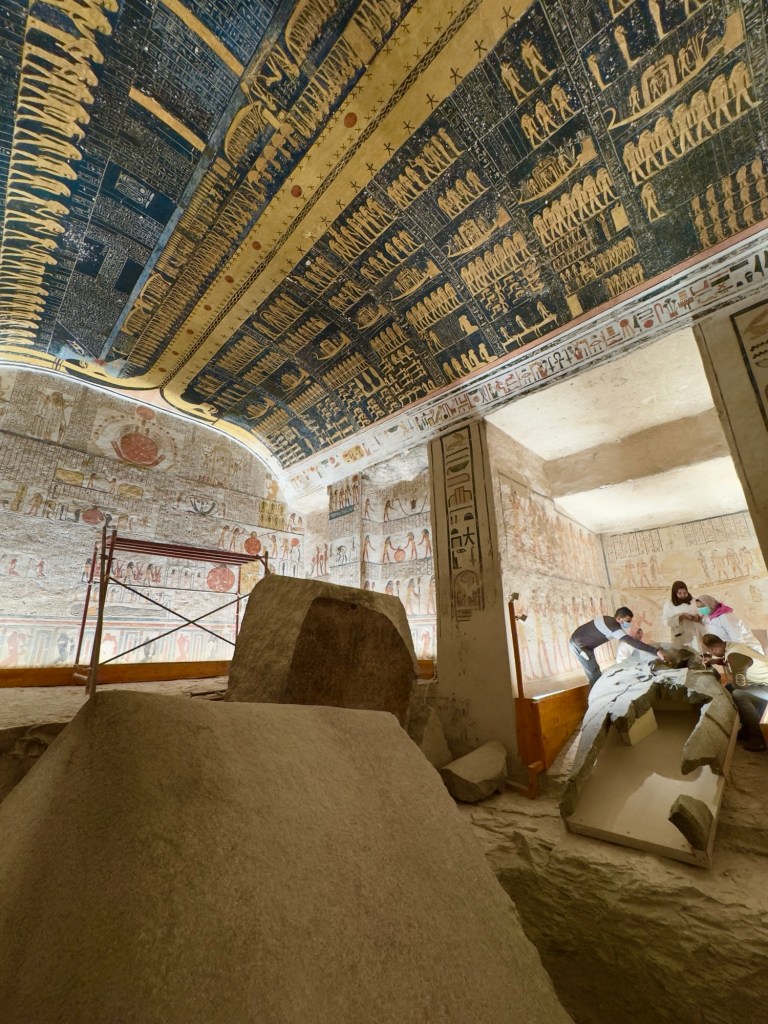
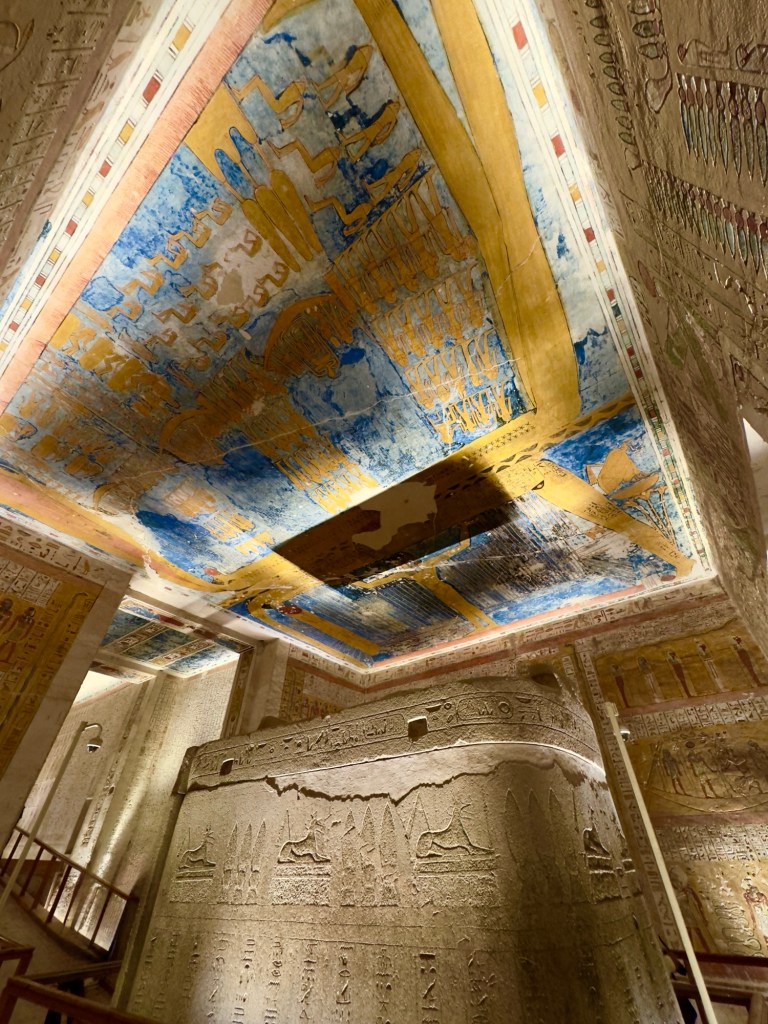
The walls and ceilings are lavishly painted, not carved like Seti I’s, with large-scale illustrations with vivid astronomical ceilings and cosmic depictions. The artwork is bold and symbolic, designed to make an impression through color and celestial imagery, much of the color still remains impressively pigmented till this day, and restorers are hard at work to ensure it remains this way. At the time of my visit, i was fortunate enough to catch a glimpse of a team of restorers hard at work to preserve the tombs conditions, ensuring the longevity and integrity of the tomb for generations to come.
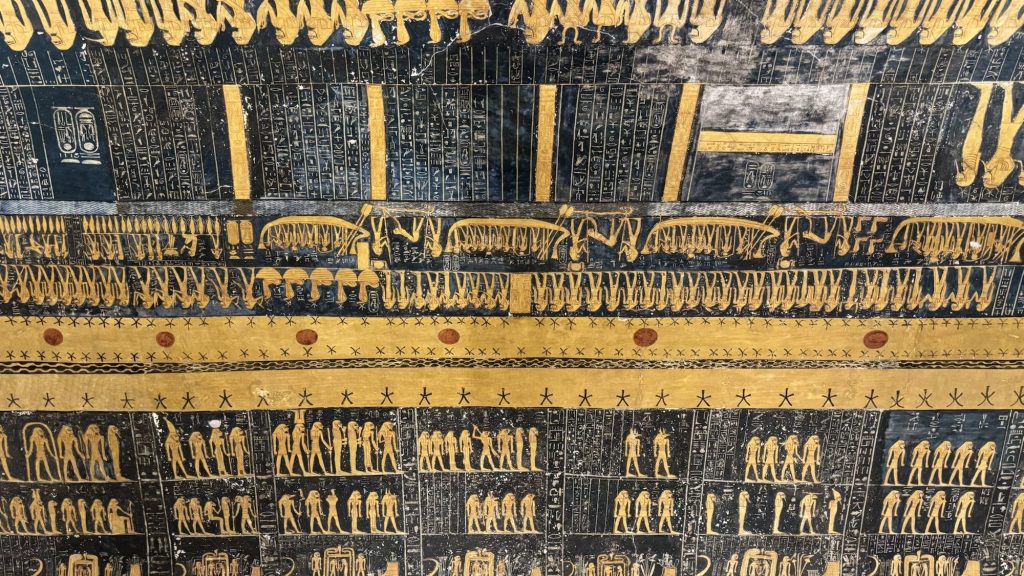
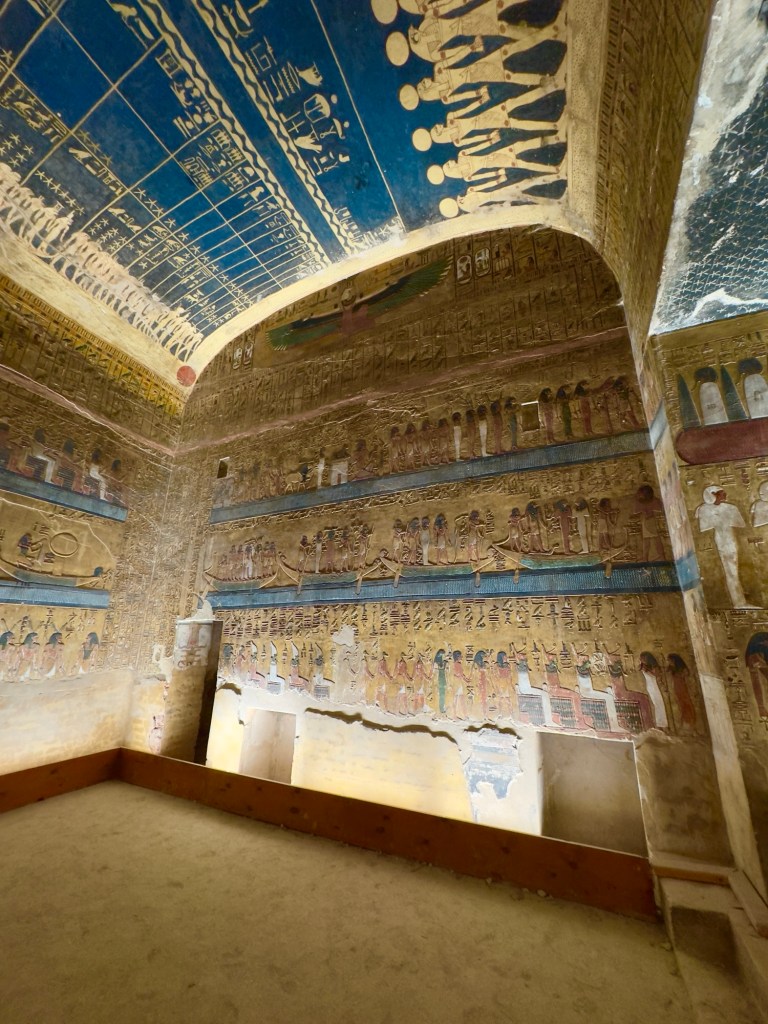
The central feature is the sky goddess Nut, arching over the chamber, painted in rich blues and golds. She is shown swallowing the sun at night and birthing it in the morning, symbolizing the sun’s eternal cycle and rebirth—core to ancient Egyptian cosmology. This visual story wraps across the ceiling, making it one of the most detailed and iconic depictions of the heavens in any royal tomb.
The burial chamber itself is impressive in its own right too, flour to ceiling inscriptions and painted text cover the walls with large, dramatic illustrations from the sacred texts of The Book of Gates & Book of Caverns, which detail the sun god Ra’s journey through the underworld, and serving as powerful spiritual maps, meant to guide the pharaoh’s soul to rebirth.
At just 180 EGP, this tomb is far more affordable and very accessible—it’s just one long (bumpy) slope down. If you’re short on time and want a showstopper tomb, this is your guy.
General Admission With a Perk
Next up are the General Admission tombs. For 600 EGP, you can visit up to three tombs with a single ticket. The ones I visited were KV14 (Tausert & Setnakht), KV11 (Ramses III), KV2 (Ramses IV), and KV8 (Merenptah).
Hold on—didn’t I say you could only visit three with one ticket? Well, I got lucky.
At the entrance of every tomb, there’s usually a caretaker/security guy/tomb bouncer. They’ll ask to see your ticket so they can punch a hole in it, indicating how many tombs you’ve visited.
One of the first tombs I checked out was KV14, the tomb of Tausert & Setnakht. It’s located a little off the main route and requires a short 5-minute uphill hike to reach.
When I arrived, the gates were wide open… but no one was around. So, in typical horror film fashion, I walked right into the tomb. Halfway down the stairs, I got jump-scared by something white fluttering in the shadows—turns out it was Mr. Caretaker himself. I guess i found him.
Luckily, I was his first visitor of the day, and he let me off without punching my ticket—free tomb visit unlocked. At the mild expense of a potential heart attack, of course.
Quick PSA about these tomb ‘guardians’: They might wave you over and offer to show you cool features or share stories about the tombs, since licensed tour guides aren’t allowed inside, and can get quite pushy about it. You’re free to listen or not, but just know they’ll likely expect a tip afterward if you do.
Tomb KV14 – Tausert & Setnakht
This one’s unique because it was originally constructed for a queen—Tausert—who ruled as a pharaoh, and later usurped and expanded by Setnakht. Because of this odd pairing, the tomb has an irregular and extended layout. You’ll notice a shift in decorative style partway through.
It’s interesting from both an artistic and political perspective. The idea of a woman ruling as pharaoh wasn’t exactly popular, and Setnakht seems to have literally bulldozed over her legacy by claiming her tomb and slapping his name all over it. Classic dude move.
Here in this tomb you can see the interesting contrasts between dynasties, while the walls are adorned with vivid reliefs and painted scenes from key funerary texts like the Book of the Dead, Book of the Gates, and Amduat, Tausert’s sections reflect the 19th Dynasty artistic style—elegant, colorful, and detailed, and Setnakht’s additions are more restrained but still include rich symbolic scenes of the afterlife journey.
The 19th Dynasty was known to be riddled with political instability and succession disputes, and Setnakht came to power after a period of chaos, marking the beginning of the 20th Dynasty, it is believed that he seized the throne through force or political maneuvering, possibly after the collapse of Tausert’s regime, and there’s no record of him being related to Tausert or her husband, Seti II.
His usurpation of her tomb (KV14) is seen as a symbolic erasure of her legacy, possibly to legitimize his own rule by taking over royal burial grounds. So though not as elaborately decorated as KV17 or KV9, it’s spacious, historically significant, and you get a sense of how tombs evolved—or were retrofitted—based on who ended up in them.
Tomb KV11 – Ramses III
Following Setnakht, Tomb KV11 belonged to his son, Ramses III. If there is one must see in your general admission ticket, it’s this one.
Ramesses III was one of the most powerful pharaohs of the 20th Dynasty and was often considered the last great ruler of the New Kingdom. He managed to delay Egypt’s decline through military might and strong imagery even though the foundations of the empire were already eroding beneath him.
Ramesses III’s reign was marked by invasion, famine, economic collapse, and labor unrest. It is alleged that toward the end of his reign, assassination was the cause of his death. Known as the Harem Conspiracy, Queen Tiye (not to be confused with the Great Royal Wife of the Egyptian pharaoh Amenhotep III), one of his secondary wives, tried to install her son Pentawer as pharaoh, and the plot involved high officials, priests, and even members of the royal harem.
While the plan ultimately failed, Ramesses III was likely injured or murdered during this plot as CT scans of his mummy show a deep cut to the throat. Talk about some cut throat royal drama.
Even so, his tomb is one of the more resplendent, and elaborately decorated tombs in the Valley of the Kings. This reflects his desire to match or outdo earlier pharaohs, especially in the tradition of monumental burial. I would even say it has similarities to the tomb of Seti I. The tomb features nearly every major funerary text necessary to ensure safe passage for the king into the Egyptian afterlife, and also includes images of Ramesses III when he defended Egypt against the Sea Peoples (people from the Mediterranean) and maintained the empire during turbulent times – some of the most famous land and naval campaign from his reign are depicted in the Medinet Habu temple, a temple he heavily invested in constructing.
The last chamber, two pillared halls leading to the burial chamber (which is closed off to the public), were partially blockaded at the time of my visit as they were undergoing conservation by a team of German egyptologists, but i would love to see the tomb again should i ever go back again.
Tomb KV2 – Ramses IV
The tomb of Rameses IV is the closest to the entrance (of those open at the moment), and naturally this makes it one of the most popular.
Ramesses IV came to the throne after the assassination of his father, Ramesses III, he tried to present himself as a strong ruler in the tradition of his predecessors, especially Ramesses II and III, but his efforts were mostly symbolic. Egypt during his reign was still suffering the aftershocks of the Sea Peoples invasions and economic collapse and the power of the priesthood of Amun was rising dramatically, gradually eclipsing that of the pharaoh.
His reign only lasted a mere 6-7 years, cause of death unknown.
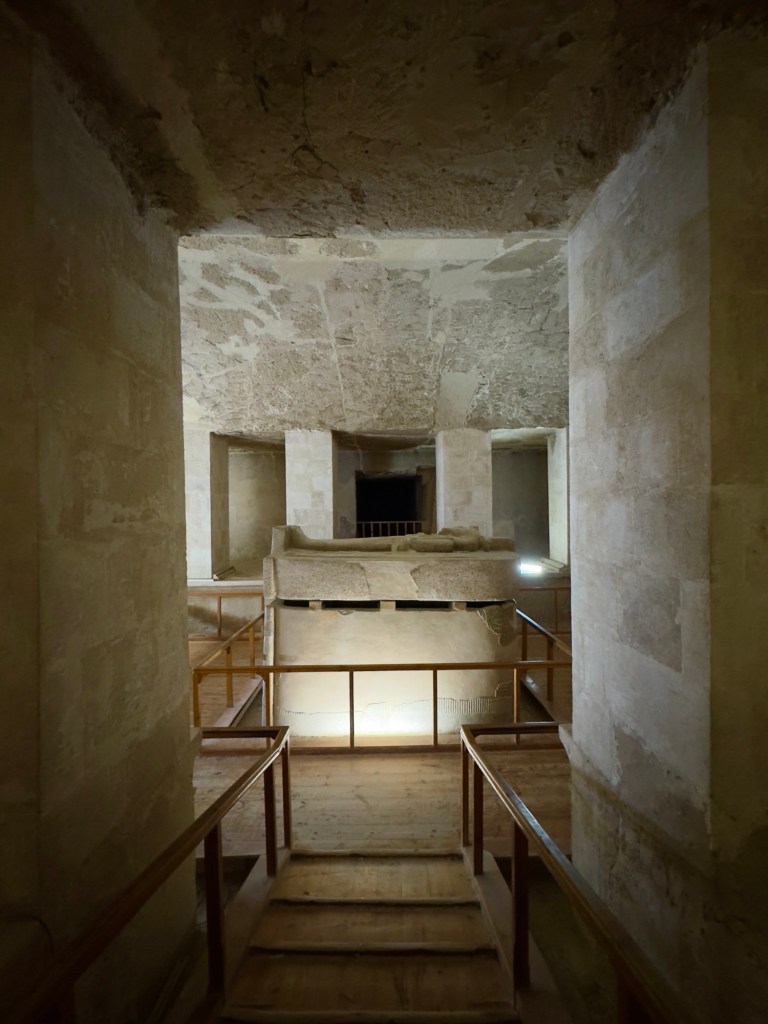
The tomb is a great introduction to the Valley of the Kings, built as a long corridor that culminates in the impressive burial chamber, relatively short and straightforward in layout, especially compared to the winding tombs of his predecessors.
While the art and inscriptions at the start of the tomb have faded, it’s better preserved as you walk down towards the burial chamber. Here you’ll find his red granite sarcophagus, although damaged and without the lid, and surprisingly (and thankfully) not in France or UK.
At this point, i was a little stuck, my research only went as far as reading the history and looking for the tombs i wanted to visit, but with one more tomb visit still available to use from my general admission ticket, and 7 available options to choose from, a decision had to be made, one i left to a random tour guide waiting outside one of the tombs.
Tomb KV8 – Merenptah
Tomb KV8 of Merenptah isn’t one of the best in the Valley of the Kings, but it is one of the quietest in the first section of the valley, and is still worth visiting. Sadly, a lot of the art has deteriorated, but there are interesting sections of hieroglyphs and paintings still to see.
Merenptah was the 13th son of Ramesses II and became the fourth pharaoh of the 19th Dynasty. He ruled for roughly a decade, ascending to the throne late in life, around his 60s or 70s, due to his father’s unusually long reign. By then he had plenty of experience by the time he became pharaoh as he had previously been overseer of the army, Crown Prince and then Prince Regent for the last 12 years of Rameses II’s life.
After the victories of his father, Merenptah faced a series of challenges and revolts on the frontiers of Egypt, which he successfully repelled. He was the last stable ruler in the 19th dynasty as he was followed by three pharaohs (his son Seti II, grandson Siptah and daughter in law Tausert) who saw short reigns and disruption.
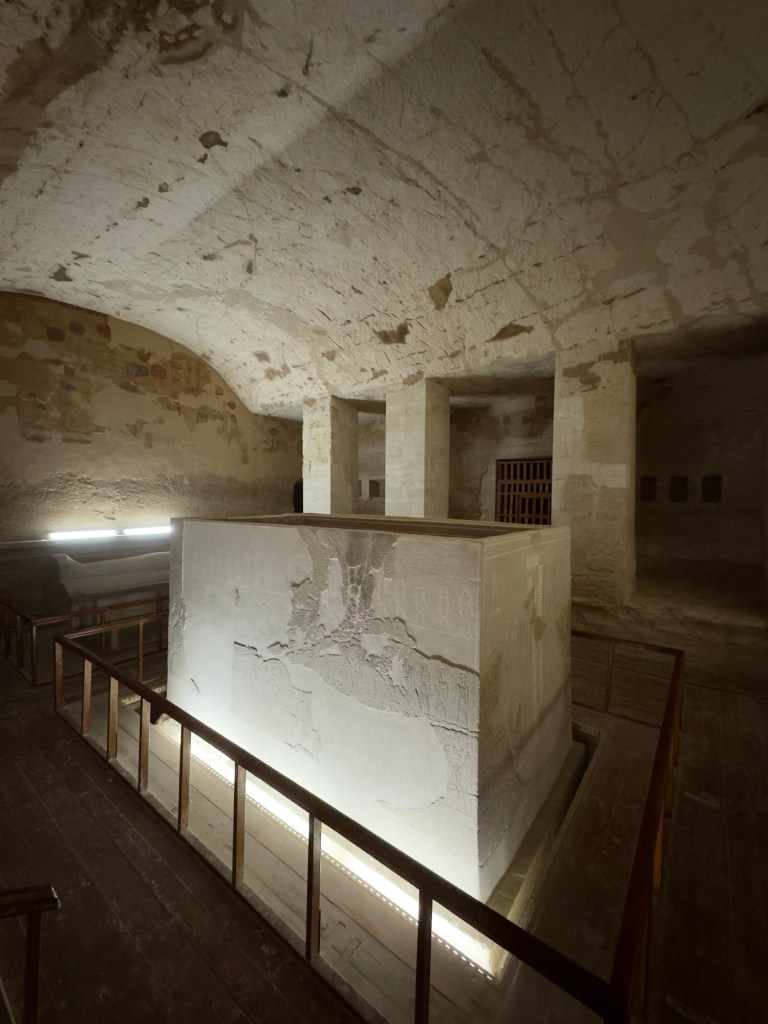
The tomb is huge and has a long corridor which leads down to two chambers. The first chamber has the lid of a sarcophagus, which has a mirror below it to show a carving of the goddess Nut.
Then there’s another corridor that finishes at the burial chamber, which still has the huge base of the sarcophagus in it and an impressive lid to the side. The burial chamber is huge and has a cathedral like feel to it, however a lot of the artwork on the walls has deteriorated, but remains accessible and contains elements typical of New Kingdom royal tombs
While the reliefs are softer and the colors more subdued, the tomb is still deep and dramatic. If you’re into moody, atmospheric ruins, this one has a bit of a “forgotten grandeur” vibe that’s oddly beautiful.
Let There Be Light
By the time I emerged back into the sunlight, I felt like I’d just completed a gauntlet. These tombs may not involve sand traps and rolling boulders, but they’ll absolutely test your endurance. Between the stairs, the stale air, and the emotional weight of being surrounded by millennia-old artwork meant to guide souls through the afterlife… it’s a lot.
Would I do it again? Absolutely. Would I wear better shoes next time? Also yes.
If Karnak is where the gods walked the Earth, then the Valley of the Kings is where the kings tried to join them in the stars. But i was nowhere near done with the Land of the Dead yet.
Next stop: Hatshepsut’s mortuary temple, Médinet Habou, and The Colossi of Memnon.




















 Shenanigans Abroad