Shadows of Gods and Pharaohs
Nature’s Burial Grounds
If the cover picture wasn’t obvious enough, in this post we’re heading into the Land of the Dead laddies. So buckle up, grab your Indiana Jones hats, and stay hydrated for we’re about to head deep under.
In the previous post, I was gallivanting around with the living on the East Bank, reset for the night, and kicked off another early morning to re-explore Karnak Temple in natural light—free of those cheap 80s “Egyptian-inspired” audio tracks and cringy visuals from the Light and Sound show. After that peaceful reboot, it was time to meet my designated driver for the day and head west—into the Land of the Dead.
The necropolis is on the West Bank for symbolic reasons: it lies beneath the pyramid-shaped peak of al-Qurn (“The Horn”), reinforcing spiritual connections to resurrection and the sun god Ra.
On a practical level, the valley’s remote and rugged terrain made it ideal for hiding and protecting royal tombs from looters—unlike the very conspicuous pyramids of earlier dynasties. The limestone cliffs made for perfect rock-cut tombs, and it was just a stone’s throw from Deir el-Medina, where the tomb builders and artisans lived, worked, and were eventually buried themselves.
And that’s where the journey truly begins: The Valley of the Kings.
Land of the Dead
The Valley of the Kings is one of the most iconic archaeological sites in the world, serving as the royal burial ground for pharaohs and elite nobles of Egypt’s New Kingdom, it replaced the earlier pyramid tombs of the Old and Middle Kingdoms and marked a shift to hidden, rock-cut tombs to protect against tomb robbers.
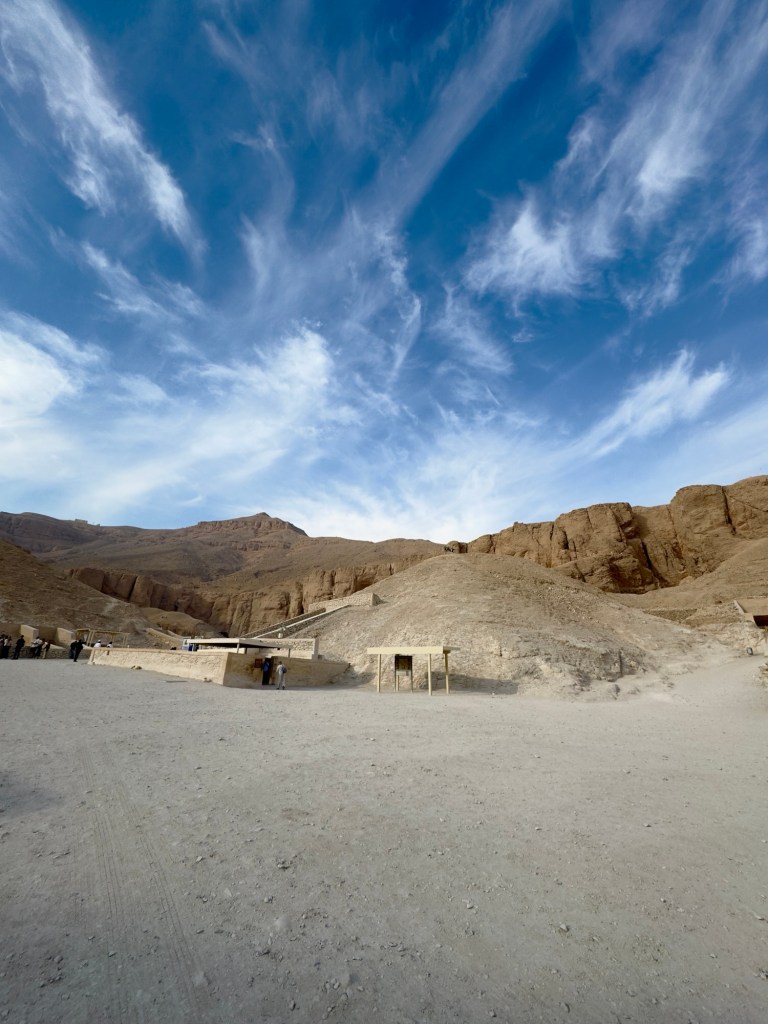
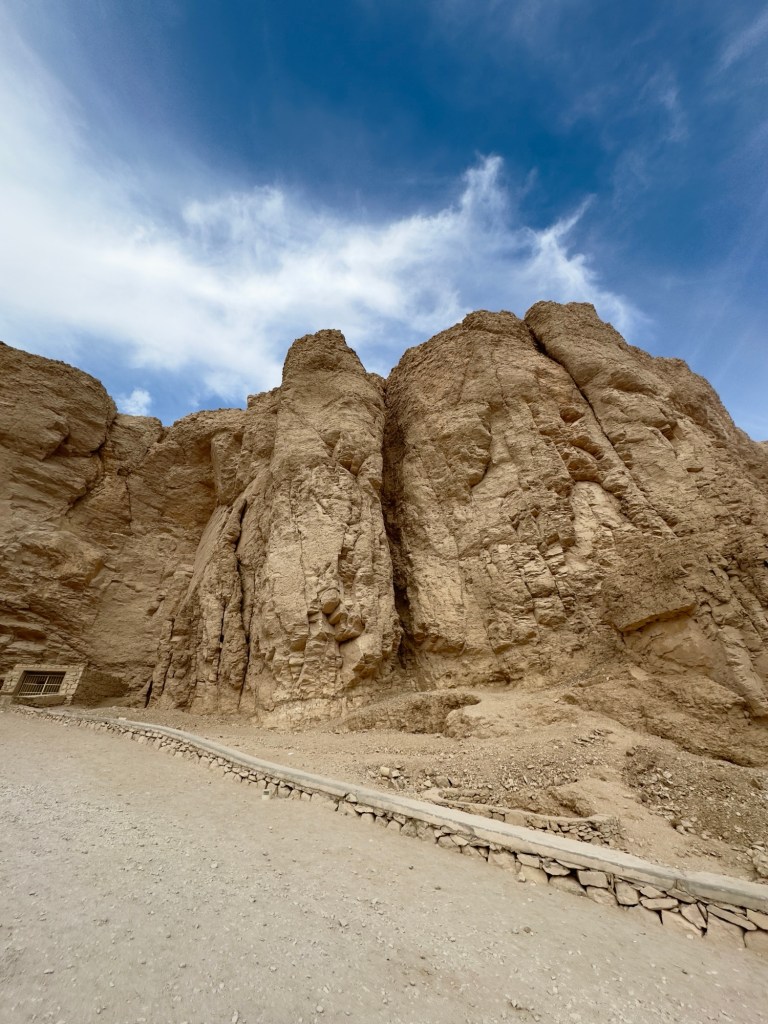
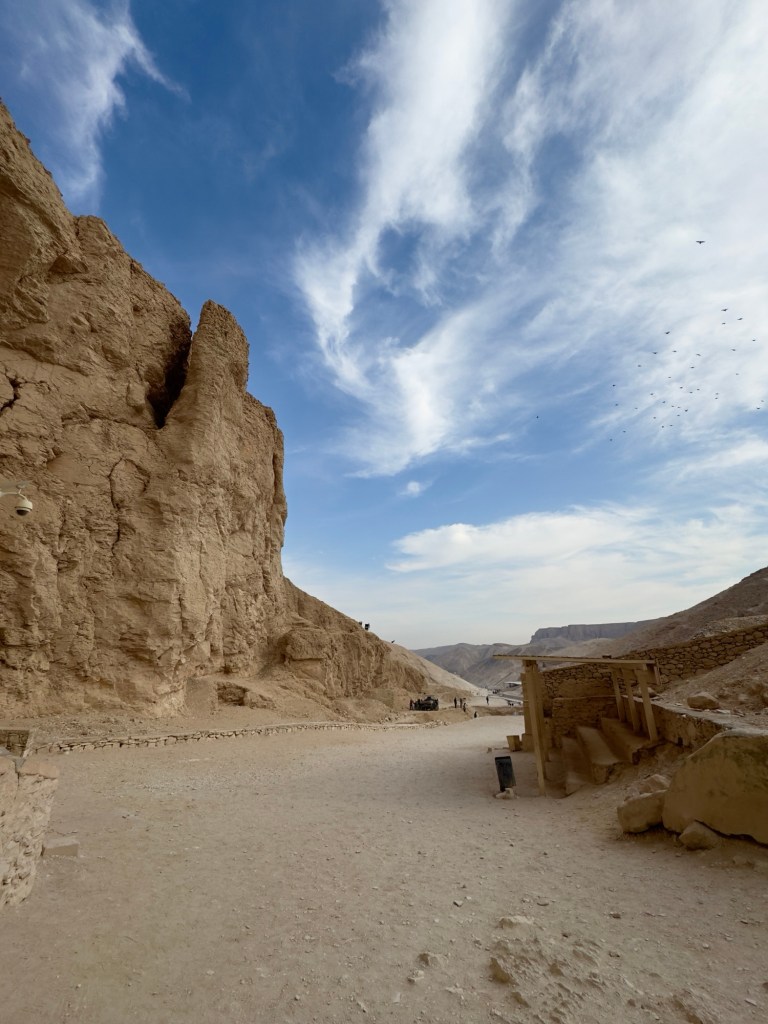
The tombs aren’t just burial chambers—they play a vital role in the art of the Egyptian afterlife. The walls are covered in spells from the Book of the Dead, constellations, gods, serpents, and elaborate scenes guiding the pharaoh’s soul through the underworld. Even thousands of years later, the colors are so vivid you’d swear they were painted last week. Many tombs were plundered in antiquity, but the wall art and architecture remain significant sources of religious and historical insight.
Over 60 something tombs have been discovered, ranging from simple pits to multi-chambered maze structures. Your general entrance ticket allows you to visit three tombs of your choice from a rotating list of open tombs. Do note, certain high-profile tombs require separate, additional tickets due to their significance, preservation needs, or popularity.
These tombs are:
KV62 – Tutankhamun (King Tut)
KV9 – Ramses V & VI
KV17 – Seti I
If you wish to visit more than three tombs, you need to purchase an additional standard entry ticket, while i would only recommend this for true tomb raiders only, as going from tomb to tomb to tomb can can rather repetitive after awhile and may lose its initial wow factor, each tomb is still individually unique and no one tomb is exactly the same.
As of 2025 the currently accessible tombs are:
KV1 – Ramesses VII
KV2 – Ramesses IV
KV6 – Ramesses IX
KV8 – Merenptah
KV11 – Ramesses III
KV14 – Tausert and Setnakht
KV15 – Seti II
KV16 – Ramesses I
KV43 – Thutmose IV
KV47 – Siptah
But before I dive into the tombs I explored and the reasons behind my choices, let’s talk logistics.
Logistics Talking
While you can buy the general Valley of the Kings ticket online through the Egypt Monuments site, I’d actually recommend getting to the Valley early and purchasing your tickets in person. Why? Because if you want to visit the tombs of Ramses V & VI or Seti I, you must buy those tickets on-site—they’re not available online. Plus, the list of accessible tombs can change due to ongoing conservation work, excavations, or restoration. It’s best to check current availability at the visitor center upon arrival since much of that info isn’t available online.
Regardless of the season, the Valley of the Kings gets hot by midday. You’re exposed to the elements, and unless you’re inside a tomb or at a rest stop, shade is extremely limited.
The Valley of the Kings is also one of the highlights of any Egypt trip, needless to say, everyone and anyone will have the same idea of ‘beating the crowd’ by either getting there early or late. So if you can’t beat the crowd, at least stay ahead of it. Trust me, the tombs are not exactly spacious, the last thing you need is being sardined 40m deep underground with a throng of equally sweaty tired tourists (yourself included). The air outside may be hot and arid, but within the tombs, depending on the crowd, can be either fairly cool, or toasty and humid.
Upon arrival at the Valley of the Kings, once you pass through the ticket checkpoint, make sure you have cash for the tram ride. The tram costs 20 EGP per person for a round trip ride. From the tram, it’s a relatively short, uphill walk to get to the entrances of the tombs.
Most tombs are relatively low-mobility friendly (take that with a grain of salt). They typically have wooden planks with steps to help you descend, which—while not exactly ergonomic—add to the tomb raider atmosphere. However, this does make accessibility difficult for those with mobility challenges. Some physical activity is necessary; you’re descending 20–40 meters into the earth, after all. Wear comfortable shoes and clothes, and bring a light jacket for removable layers. Temperatures vary wildly depending on the time of day and whether you’re inside or outside a tomb.
Some tombs are also located a little off the main path, so some light hiking may be required too. Here is a map of the valley just to give you an idea
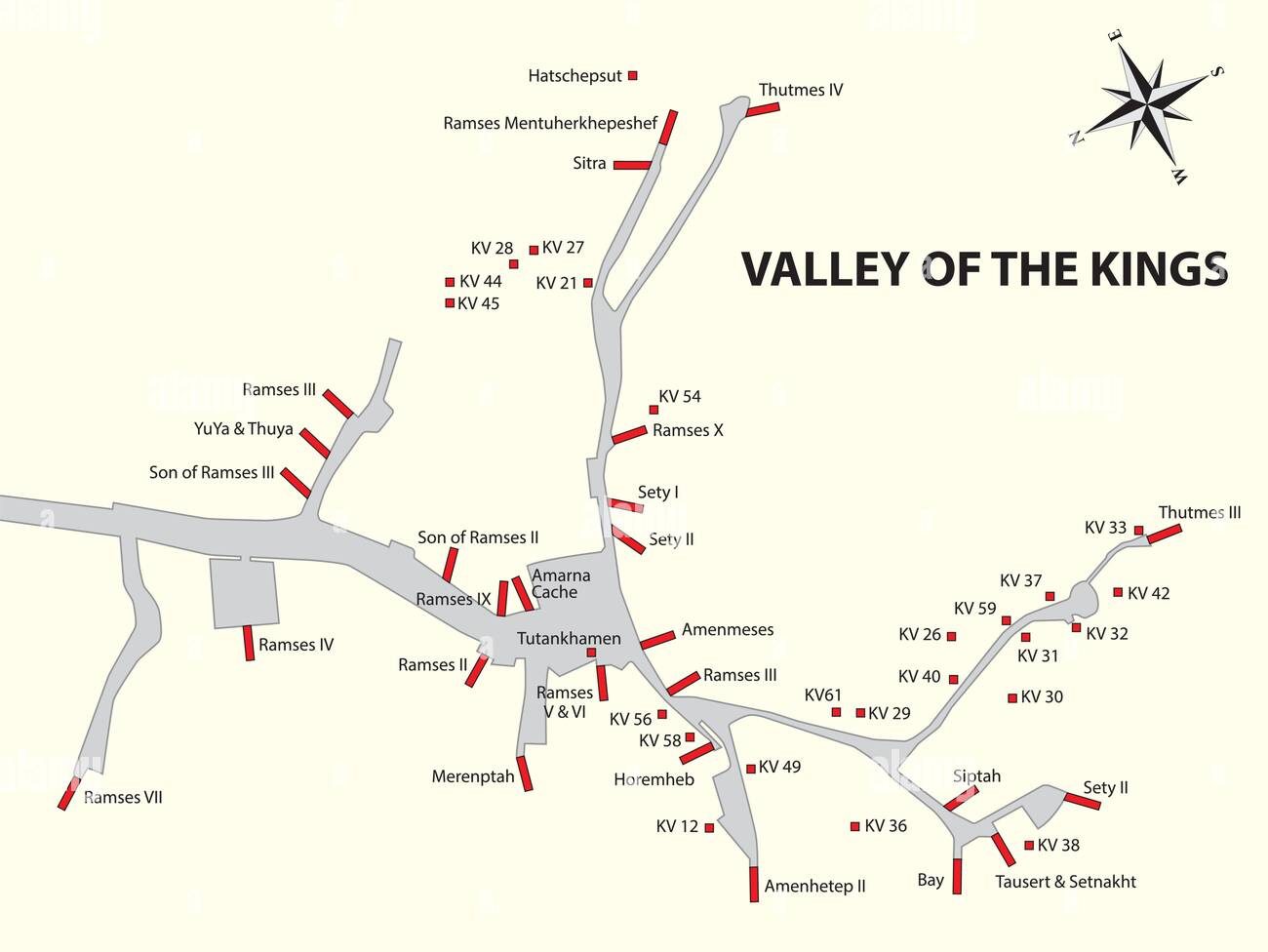
No matter how fit you are, you will find that, especially in neglected tombs without proper air circulation equipment due to lack in popularity, the air can get rather thin and humid if the tomb’s crowded. Don’t force yourself to move at the pace of others. Explore at your own speed. The last thing you want is to become one of the Valley’s newest residents.
Now that the exposition is out of the way, let’s talk tombs.
The ones i visited were:
KV17 – Seti I (Separate Ticket)
KV9 – Ramses V & VI (Separate Ticket)
KV11 – Ramses III (General Admission)
KV2 – Tomb of Ramses IV (General Admission)
KV14 – Tausert & Setnakht (General Admission)
KV 8 – Merenptah (General Admission)
Noticed I skipped Tutankhamun? Yeah, about that…
KV62 – Tutankhamun
As famous as it is, I believe it’s the discovery of Tutankhamun’s tomb that made it legendary—not the tomb itself. It’s small and modest compared to its neighbors. He died young and unexpectedly, so his burial was rushed and far from grand. The artwork is limited to a single chamber and, while historic, lacks the intricacy found in tombs like Seti I or Ramses VI. So for the 500 EGP price tag? Not worth it in my opinion.
The famous treasures found in the tomb—including the gold mask, chariots, and shrines—are no longer there. They’re now housed in the Egyptian Museum or the Grand Egyptian Museum in Cairo, so other than an elaborately decorated room, the actual mummified body of Tutankhamun inside a climate-controlled glass case in the antechamber, that’s pretty much it.
It’s also very crowded due to its fame, which can turn the whole experience into a claustrophobic mess. I’d rather spend that money on something with more historical and visual impact.
Like the Tomb of Seti I.
KV17 – Seti I
Remember how i said 500 EGP is ridiculous? Well to enter the Tomb of Seti I, it is a whopping 1800 EGP. Now hold your horses and un-clutch your pearls, there’s a reason for the hefty price tag.
The Tomb of Seti I is considered the crown jewel of the Valley—arguably onde of the most elaborate and beautifully decorated tomb ever discovered in Egypt. But it’s also incredibly fragile, and limiting visitor numbers helps preserve its artwork. Restoration has been ongoing for decades, involving cutting-edge conservation techniques. Entry is limited to reduce environmental damage (from CO₂, humidity, and human contact), tickets can only be purchased in person, and only a small number of visitors are allowed each day—another reason to arrive early.
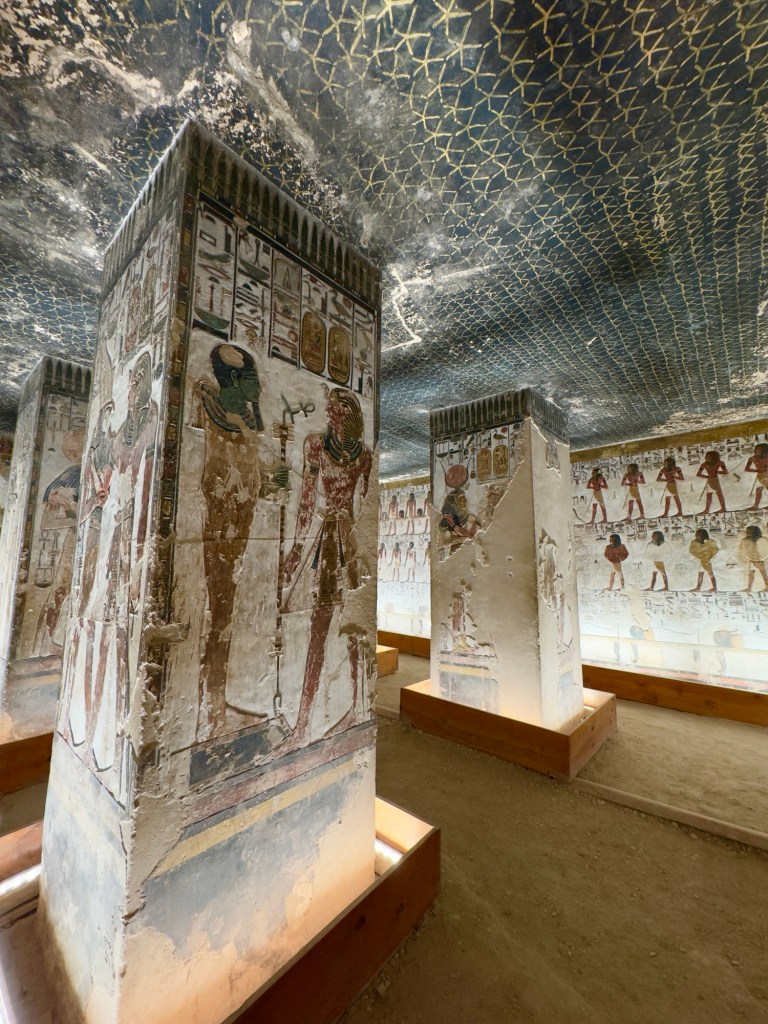
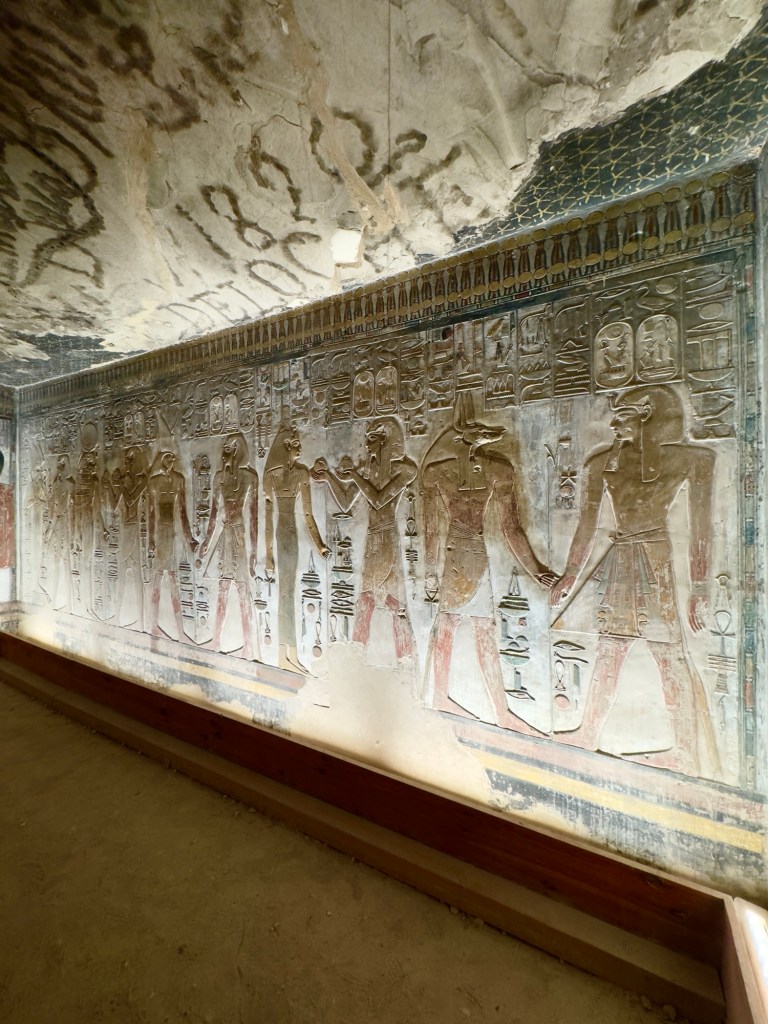

You get your money’s worth. The tomb is well-lit and ventilated. Glass barriers line the initial path down to protect the walls without blocking the view. The tomb extends over 137 meters into the bedrock and features more than 100 meters of painted corridors, carved walls, and chambers adorned with stunning reliefs. It’s the longest, deepest, and most intricately decorated tomb in the valley.
The artwork shows Seti I interacting with gods in richly detailed, symmetrical compositions—still vibrant after 3,000 years. The burial chamber originally held a massive alabaster sarcophagus (now in London’s Sir John Soane’s Museum) and is crowned with celestial ceiling art.
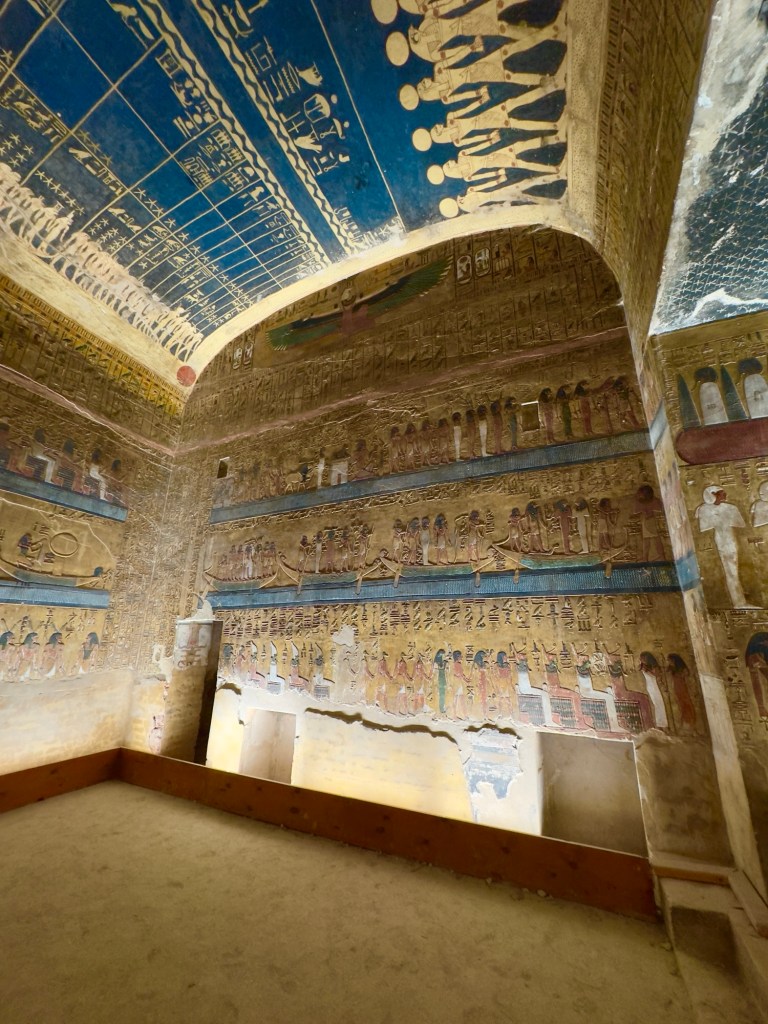


This tomb includes nearly every known funerary text of the period: the Book of the Dead, Amduat, Book of Gates, Book of the Heavenly Cow, and Litany of Ra. It reflects a deep spiritual dedication and desire to ensure Seti I’s safe passage into the afterlife—or just how determined he was to earn that golden ticket to heaven.
It’s less crowded due to the steep extra ticket price, which makes the experience even better. I had moments where it was just me and the silence of 3,000 years.
Tomb KV9 – Ramses V & VI
Originally built for Ramses V, then expanded by Ramses VI. While not as grand as Seti I’s, this tomb still spans 117 meters and is more straightforward in layout—one long corridor leading to a grand burial chamber.

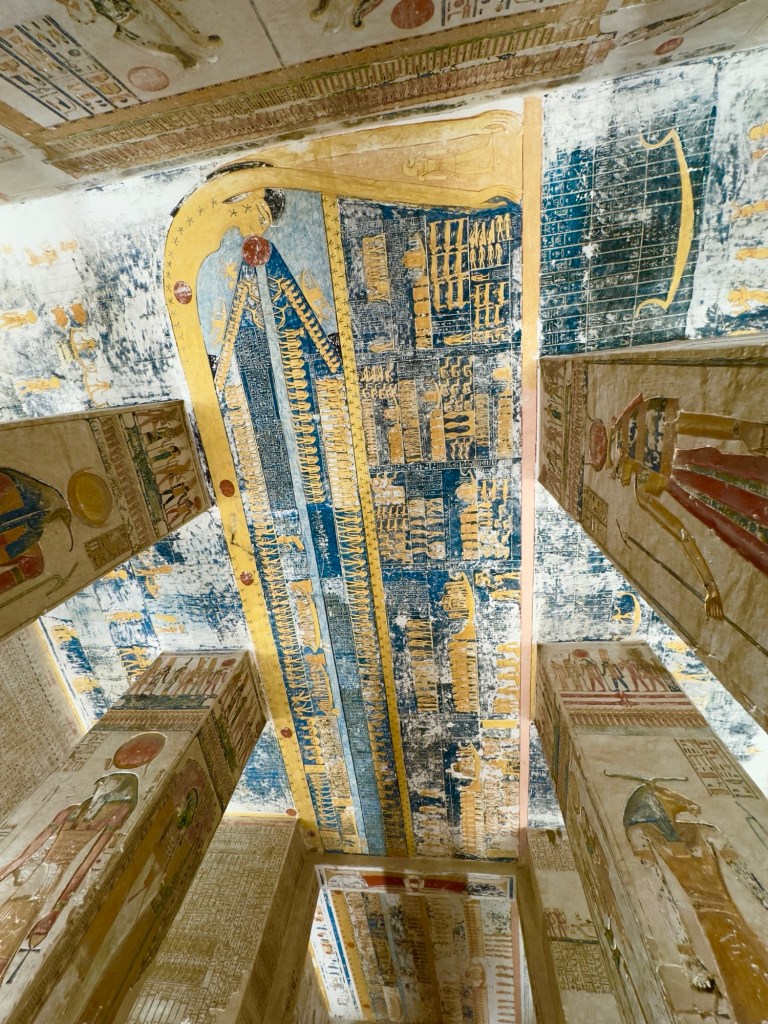
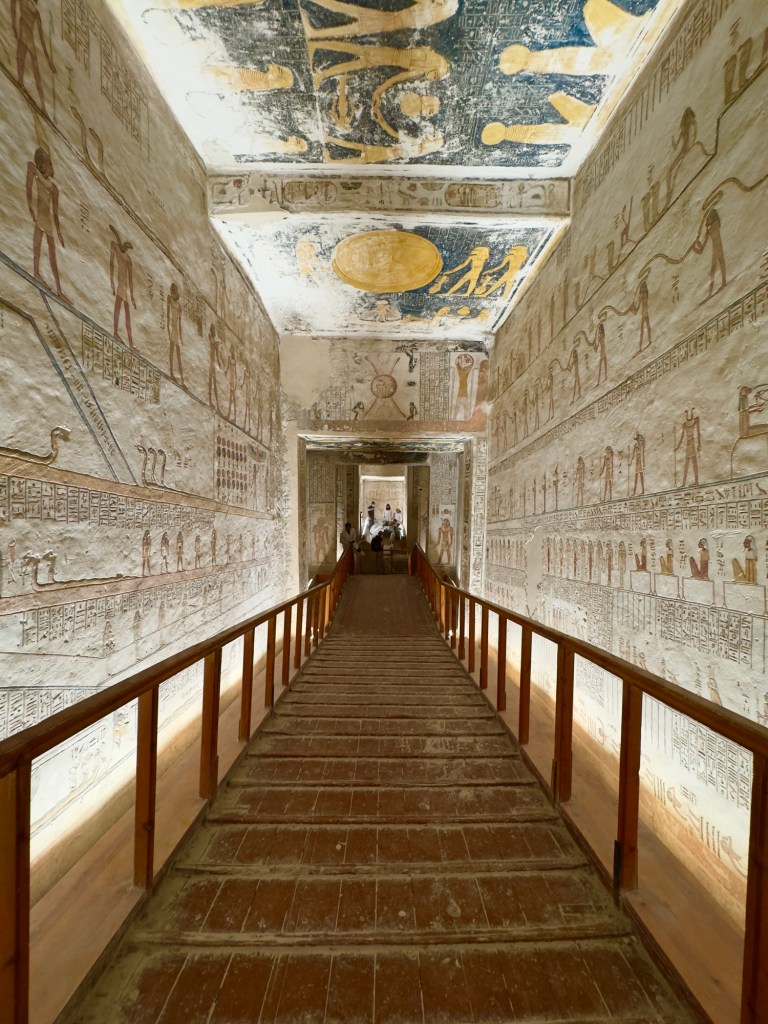
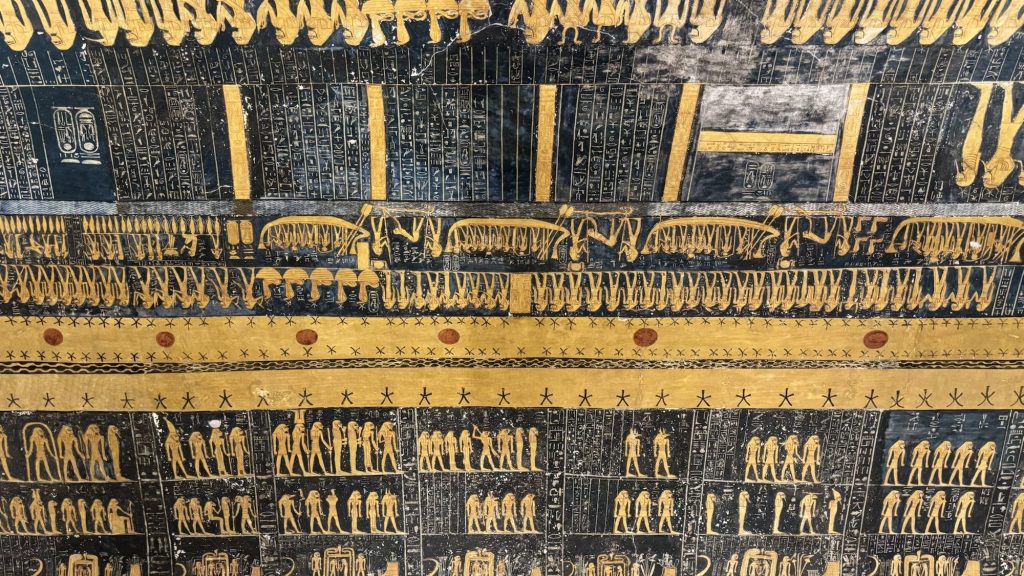
The walls and ceilings are lavishly painted, not carved like Seti I’s, with large-scale illustrations with vivid astronomical ceilings and cosmic depictions. The artwork is bold and symbolic, designed to make an impression through color and celestial imagery, much of the color still remains impressively pigmented till this day, and restorers are hard at work to ensure it remains this way. At the time of my visit, i was fortunate enough to catch a glimpse of a team of restorers hard at work to preserve the tombs conditions, ensuring the longevity and integrity of the tomb for generations to come.
The central feature is the sky goddess Nut, arching over the chamber, painted in rich blues and golds. She is shown swallowing the sun at night and birthing it in the morning, symbolizing the sun’s eternal cycle and rebirth—core to ancient Egyptian cosmology. This visual story wraps across the ceiling, making it one of the most detailed and iconic depictions of the heavens in any royal tomb.

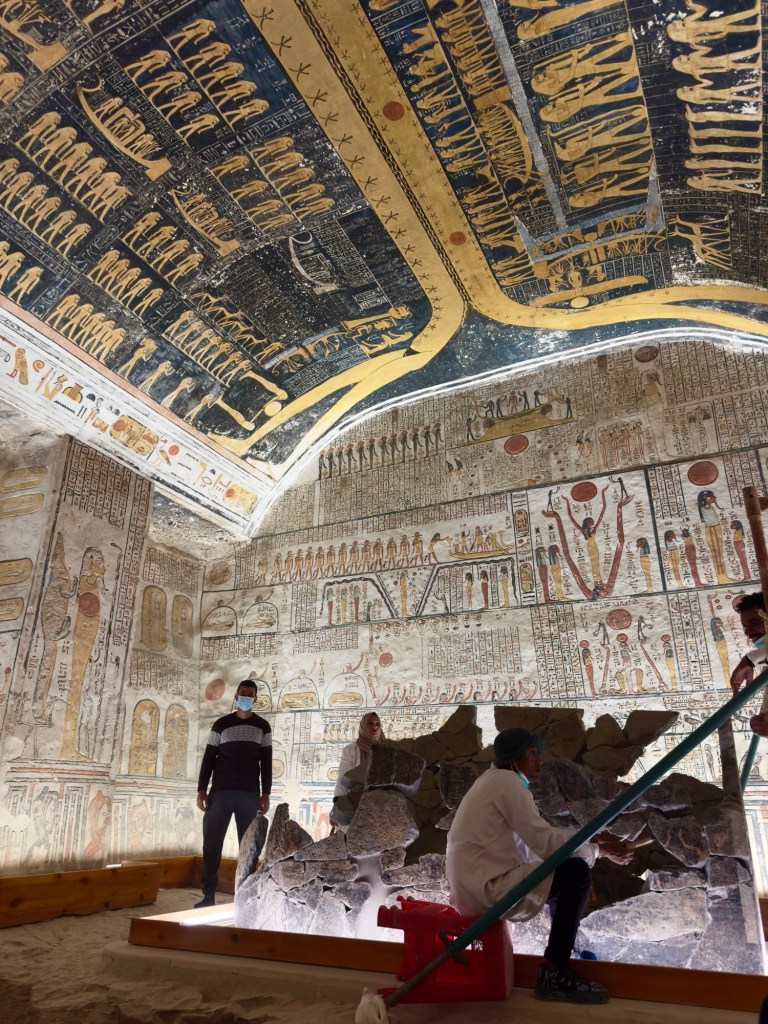
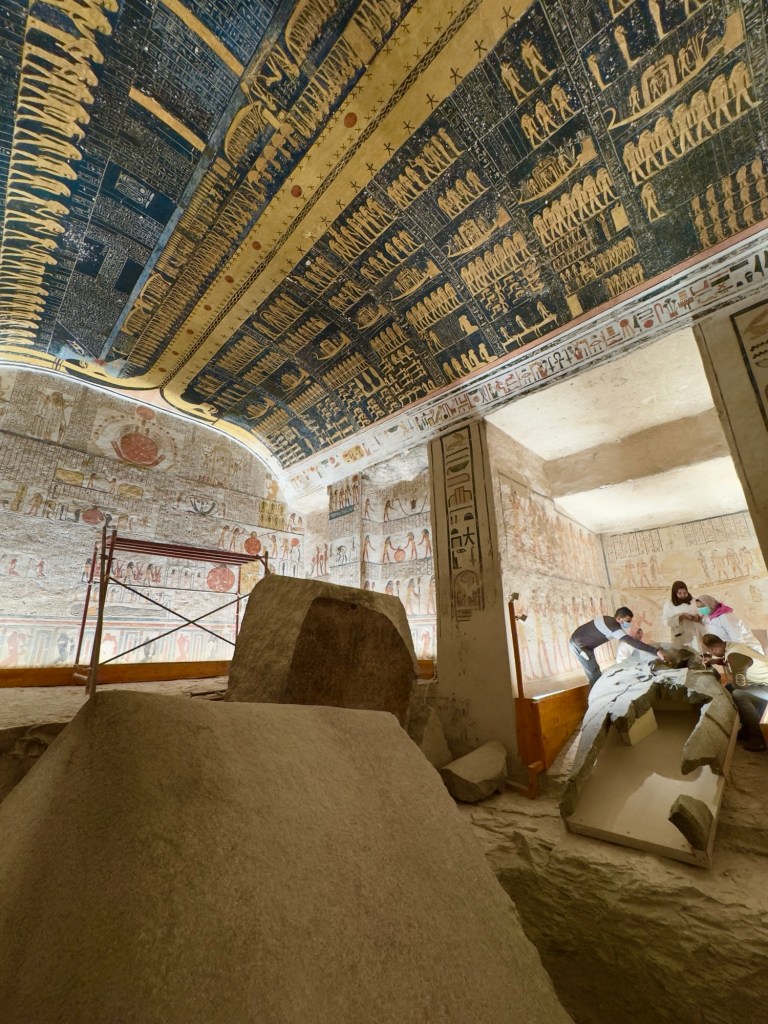
The burial chamber itself is impressive in its own right too, flour to ceiling inscriptions and painted text cover the walls with large, dramatic illustrations from the sacred texts of The Book of Gates & Book of Caverns, which detail the sun god Ra’s journey through the underworld, and serving as powerful spiritual maps, meant to guide the pharaoh’s soul to rebirth.
At just 180 EGP, this tomb is far more affordable and very accessible—it’s just one long (bumpy) slope down. If you’re short on time and want a showstopper tomb, this is your guy.
General Admission With a Perk
Next up are the General Admission tombs. For 600 EGP, you can visit up to three tombs with a single ticket. The ones I visited were KV14 (Tausert & Setnakht), KV11 (Ramses III), KV2 (Ramses IV), and KV8 (Merenptah).
Hold on—didn’t I say you could only visit three with one ticket?
Well, I got lucky.
At the entrance of every tomb, there’s usually a caretaker/security guy/tomb bouncer. They’ll ask to see your ticket so they can punch a hole in it, indicating how many tombs you’ve visited.
One of the first tombs I checked out was KV14, the tomb of Tausert & Setnakht. It’s located a little off the main route and requires a short 5-minute uphill hike to reach.
When I arrived, the gates were wide open… but no one was around. So, in typical horror film fashion, I walked right into the tomb. Halfway down the stairs, I got jump-scared by something white fluttering in the shadows—turns out it was Mr. Caretaker himself. I guess i found him.
Luckily, I was his first visitor of the day, and he let me off without punching my ticket—free tomb visit unlocked. At the mild expense of a potential heart attack, of course.
Quick PSA about these tomb ‘guardians’:
They might wave you over and offer to show you cool features or share stories about the tombs, since licensed tour guides aren’t allowed inside, and can get quite pushy about it. You’re free to listen or not, but just know they’ll likely expect a tip afterward if you do.
Tomb KV14 – Tausert & Setnakht
This one’s unique because it was originally constructed for a queen—Tausert—who ruled as a pharaoh, and later usurped and expanded by Setnakht. Because of this odd pairing, the tomb has an irregular and extended layout. You’ll notice a shift in decorative style partway through.
It’s interesting from both an artistic and political perspective. The idea of a woman ruling as pharaoh wasn’t exactly popular, and Setnakht seems to have literally bulldozed over her legacy by claiming her tomb and slapping his name all over it. Classic dude move.
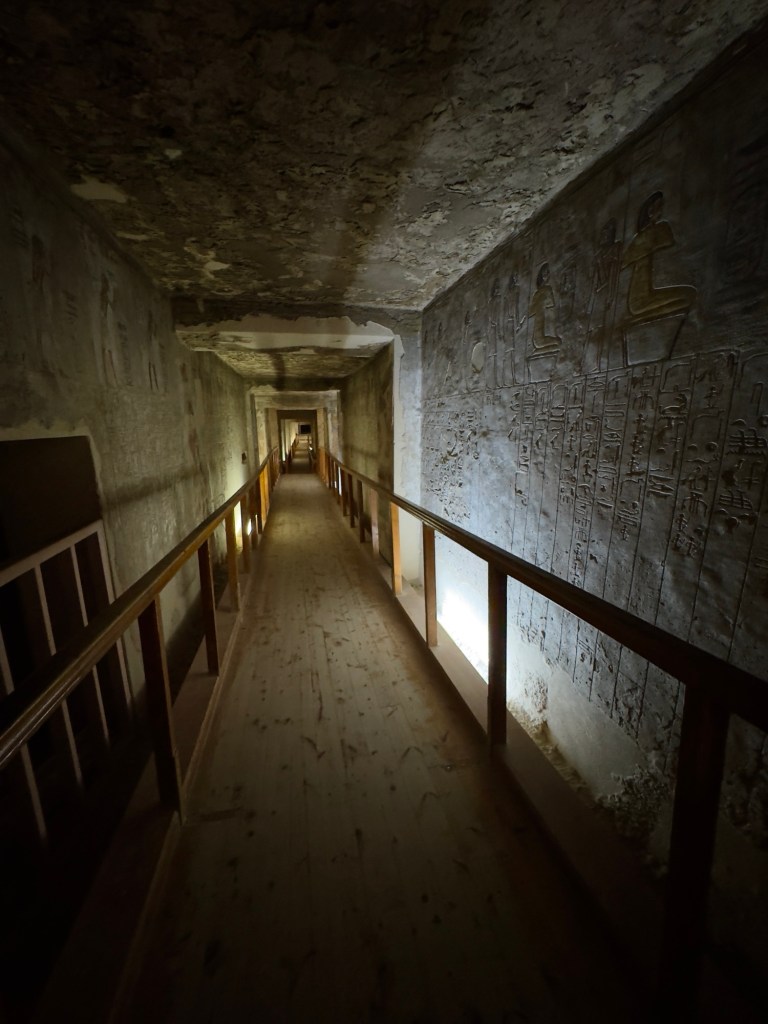
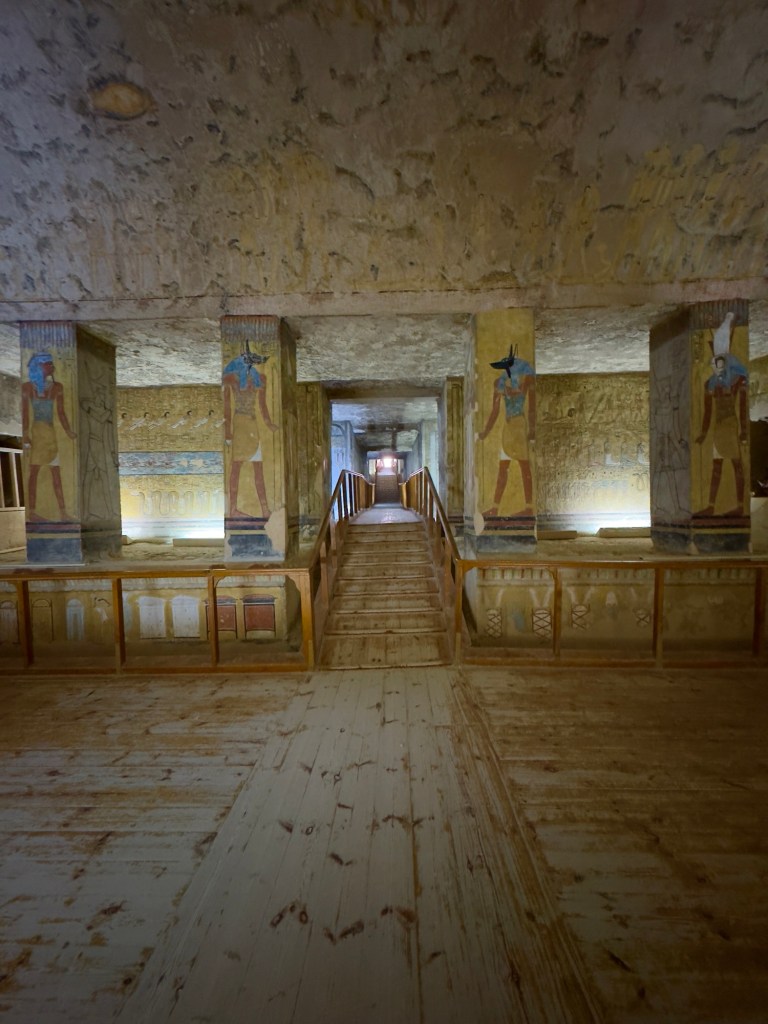
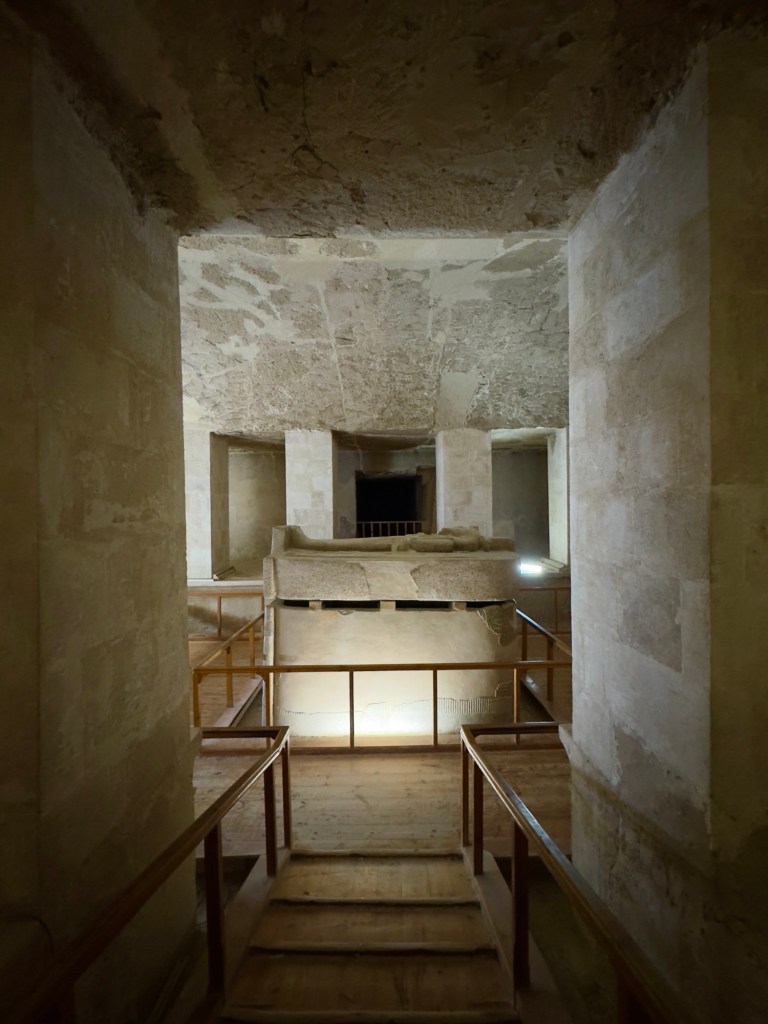
Here in this tomb you can see the interesting contrasts between dynasties, while the walls are adorned with vivid reliefs and painted scenes from key funerary texts like the Book of the Dead, Book of the Gates, and Amduat, Tausert’s sections reflect the 19th Dynasty artistic style—elegant, colorful, and detailed, and Setnakht’s additions are more restrained but still include rich symbolic scenes of the afterlife journey.
The 19th Dynasty was known to be riddled with political instability and succession disputes, and Setnakht came to power after a period of chaos, marking the beginning of the 20th Dynasty, it is believed that he seized the throne through force or political maneuvering, possibly after the collapse of Tausert’s regime, and there’s no record of him being related to Tausert or her husband, Seti II.
His usurpation of her tomb (KV14) is seen as a symbolic erasure of her legacy, possibly to legitimize his own rule by taking over royal burial grounds. So though not as elaborately decorated as KV17 or KV9, it’s spacious, historically significant, and you get a sense of how tombs evolved—or were retrofitted—based on who ended up in them.
Tomb KV11 – Ramses III
Following Setnakht, Tomb KV11 belonged to his son, Ramses III. If there is one must see in your general admission ticket, it’s this one.
Ramesses III was one of the most powerful pharaohs of the 20th Dynasty and was often considered the last great ruler of the New Kingdom. He managed to delay Egypt’s decline through military might and strong imagery even though the foundations of the empire were already eroding beneath him.
Ramesses III’s reign was marked by invasion, famine, economic collapse, and labor unrest. It is alleged that toward the end of his reign, assassination was the cause of his death. Known as the Harem Conspiracy, Queen Tiye (not to be confused with the Great Royal Wife of the Egyptian pharaoh Amenhotep III), one of his secondary wives, tried to install her son Pentawer as pharaoh, and the plot involved high officials, priests, and even members of the royal harem.
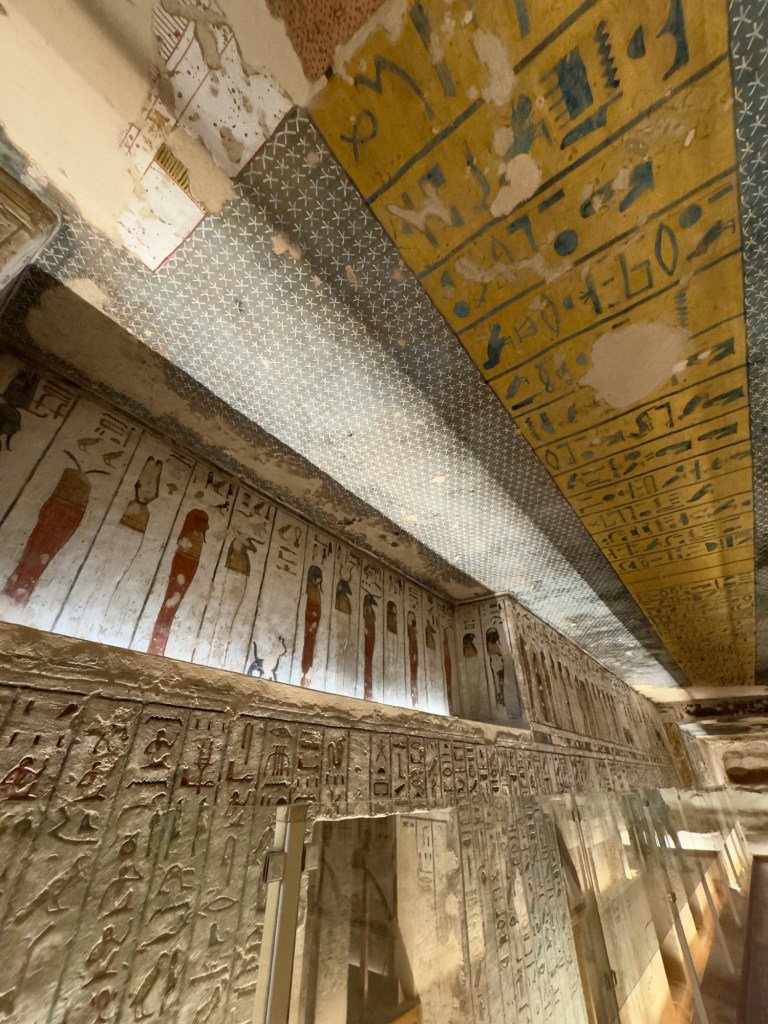
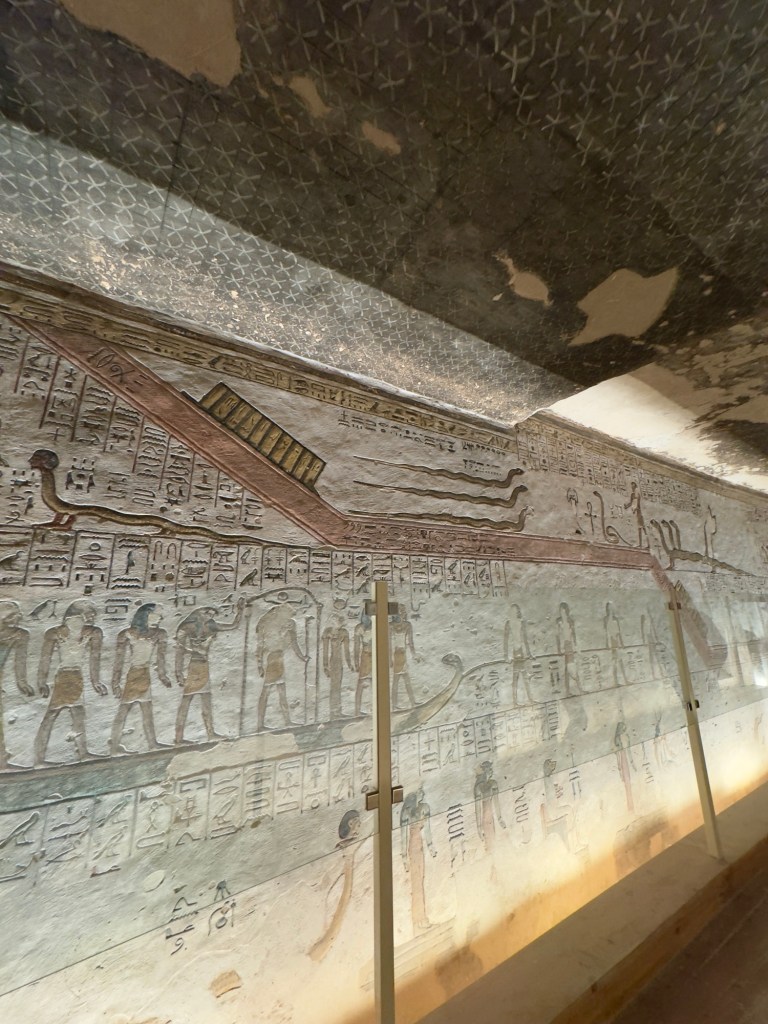
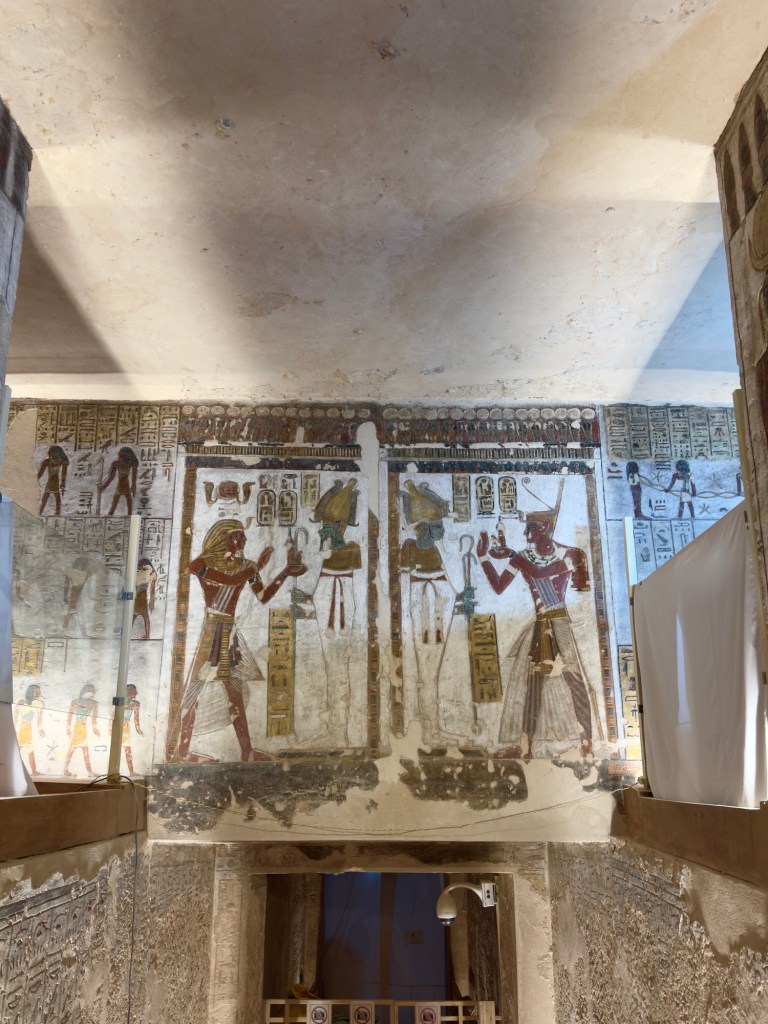
While the plan ultimately failed, Ramesses III was likely injured or murdered during this plot as CT scans of his mummy show a deep cut to the throat. Talk about some cut throat royal drama.
Even so, his tomb is one of the more resplendent, and elaborately decorated tombs in the Valley of the Kings. This reflects his desire to match or outdo earlier pharaohs, especially in the tradition of monumental burial. I would even say it has similarities to the tomb of Seti I. The tomb features nearly every major funerary text necessary to ensure safe passage for the king into the Egyptian afterlife, and also includes images of Ramesses III when he defended Egypt against the Sea Peoples (people from the Mediterranean) and maintained the empire during turbulent times – some of the most famous land and naval campaign from his reign are depicted in the Medinet Habu temple, a temple he heavily invested in constructing.
The last chamber, two pillared halls leading to the burial chamber (which is closed off to the public), were partially blockaded at the time of my visit as they were undergoing conservation by a team of German egyptologists, but i would love to see the tomb again should i ever go back again.
Tomb KV2 – Ramses IV
The tomb of Rameses IV is the closest to the entrance (of those open at the moment), and naturally this makes it one of the most popular.
Ramesses IV came to the throne after the assassination of his father, Ramesses III, he tried to present himself as a strong ruler in the tradition of his predecessors, especially Ramesses II and III, but his efforts were mostly symbolic. Egypt during his reign was still suffering the aftershocks of the Sea Peoples invasions and economic collapse and the power of the priesthood of Amun was rising dramatically, gradually eclipsing that of the pharaoh.
His reign only lasted a mere 6-7 years, cause of death unknown.
The tomb is a great introduction to the Valley of the Kings, built as a long corridor that culminates in the impressive burial chamber, relatively short and straightforward in layout, especially compared to the winding tombs of his predecessors.
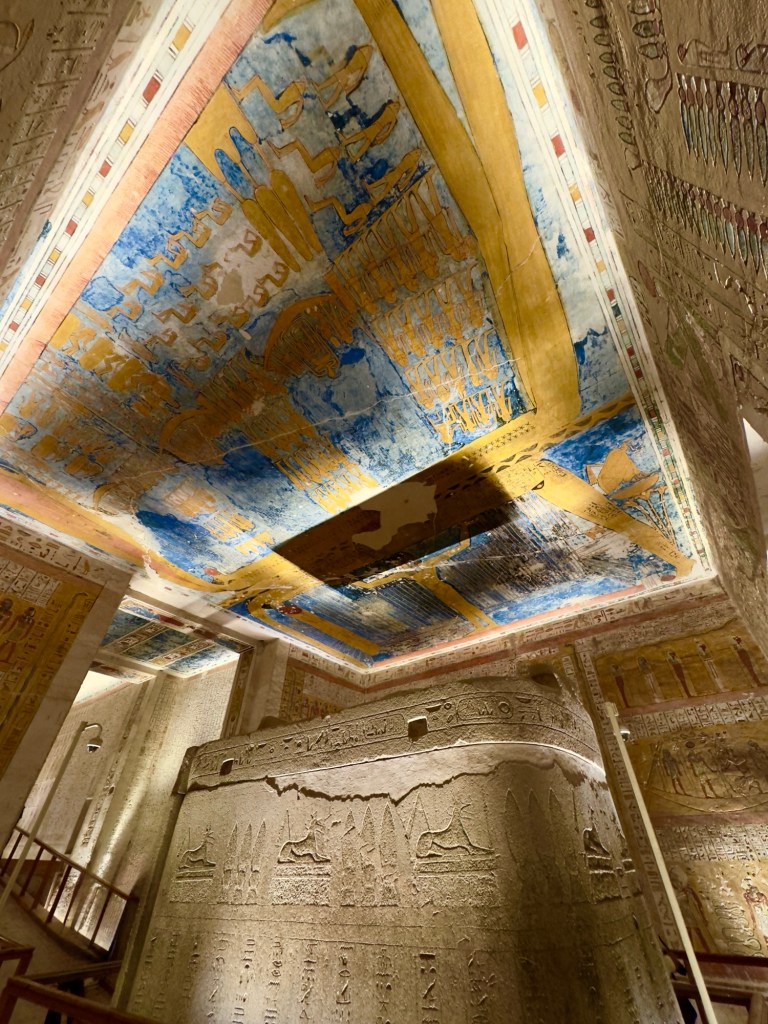

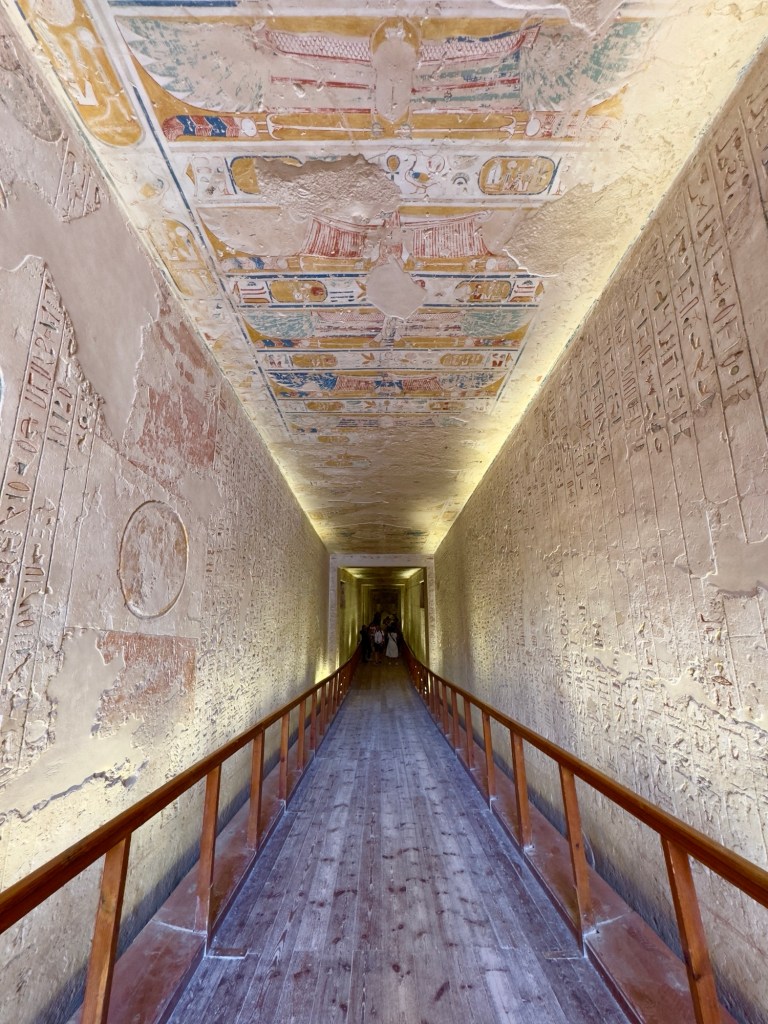
While the art and inscriptions at the start of the tomb have faded, it’s better preserved as you walk down towards the burial chamber. Here you’ll find his red granite sarcophagus, although damaged and without the lid, and surprisingly (and thankfully) not in France or UK.
At this point, i was a little stuck, my research only went as far as reading the history and looking for the tombs i wanted to visit, but with one more tomb visit still available to use from my general admission ticket, and 7 available options to choose from, a decision had to be made, one i left to a random tour guide waiting outside one of the tombs.
Tomb KV8 – Merenptah
Tomb KV8 of Merenptah isn’t one of the best in the Valley of the Kings, but it is one of the quietest in the first section of the valley, and is still worth visiting. Sadly, a lot of the art has deteriorated, but there are interesting sections of hieroglyphs and paintings still to see.
Merenptah was the 13th son of Ramesses II and became the fourth pharaoh of the 19th Dynasty. He ruled for roughly a decade, ascending to the throne late in life, around his 60s or 70s, due to his father’s unusually long reign. By then he had plenty of experience by the time he became pharaoh as he had previously been overseer of the army, Crown Prince and then Prince Regent for the last 12 years of Rameses II’s life.
After the victories of his father, Merenptah faced a series of challenges and revolts on the frontiers of Egypt, which he successfully repelled. He was the last stable ruler in the 19th dynasty as he was followed by three pharaohs (his son Seti II, grandson Siptah and daughter in law Tausert) who saw short reigns and disruption.
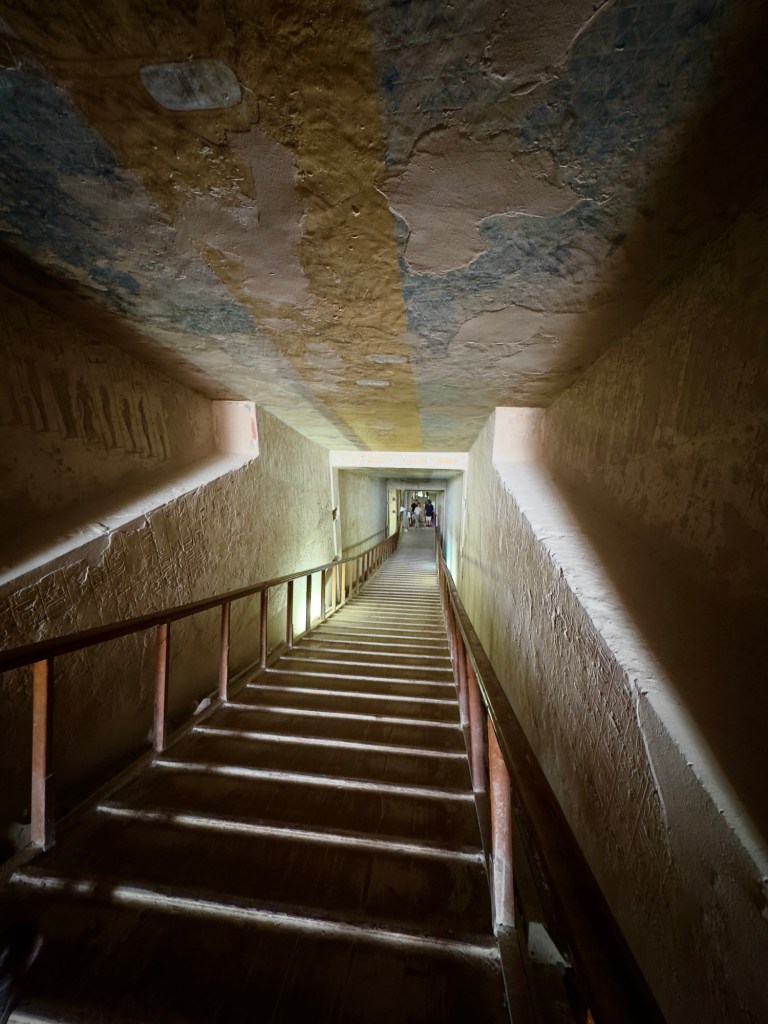

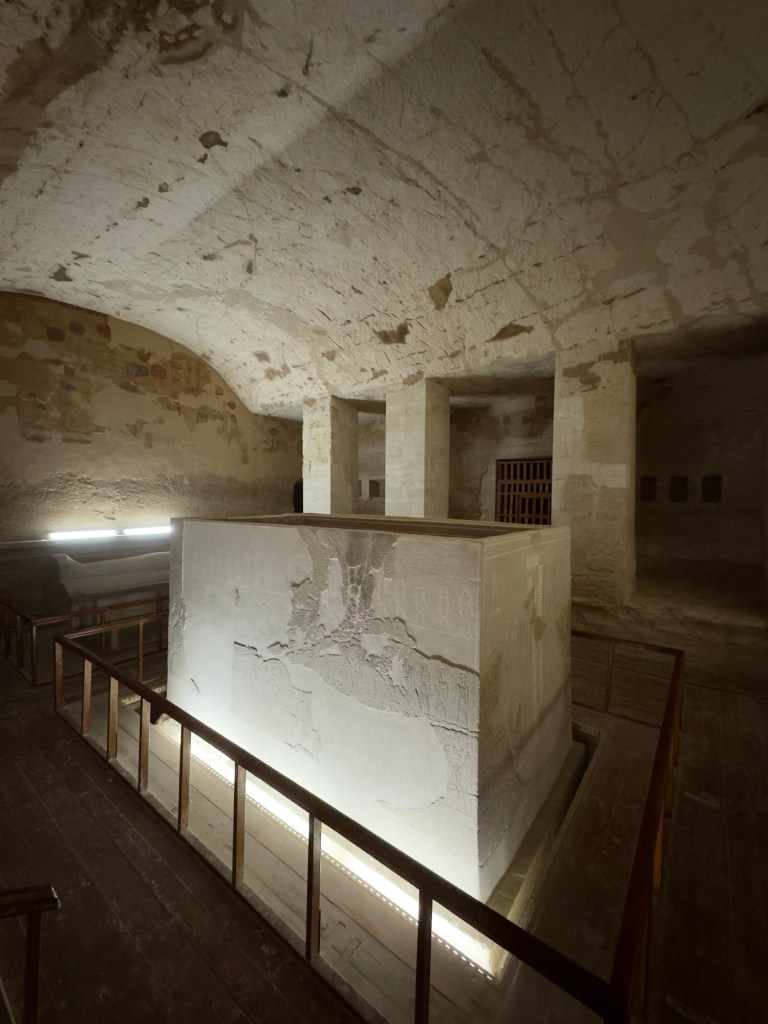
The tomb is huge and has a long corridor which leads down to two chambers. The first chamber has the lid of a sarcophagus, which has a mirror below it to show a carving of the goddess Nut.
Then there’s another corridor that finishes at the burial chamber, which still has the huge base of the sarcophagus in it and an impressive lid to the side. The burial chamber is huge and has a cathedral like feel to it, however a lot of the artwork on the walls has deteriorated, but remains accessible and contains elements typical of New Kingdom royal tombs
While the reliefs are softer and the colors more subdued, the tomb is still deep and dramatic. If you’re into moody, atmospheric ruins, this one has a bit of a “forgotten grandeur” vibe that’s oddly beautiful.
Let There Be Light
By the time I emerged back into the sunlight, I felt like I’d just completed a gauntlet. These tombs may not involve sand traps and rolling boulders, but they’ll absolutely test your endurance. Between the stairs, the stale air, and the emotional weight of being surrounded by millennia-old artwork meant to guide souls through the afterlife… it’s a lot.
Would I do it again? Absolutely. Would I wear better shoes next time? Also yes.
If Karnak is where the gods walked the Earth, then the Valley of the Kings is where the kings tried to join them in the stars. But i was nowhere near done with the Land of the Dead yet.
Next stop: Hatshepsut’s mortuary temple, Médinet Habou, and The Colossi of Memnon.








 Shenanigans Abroad